
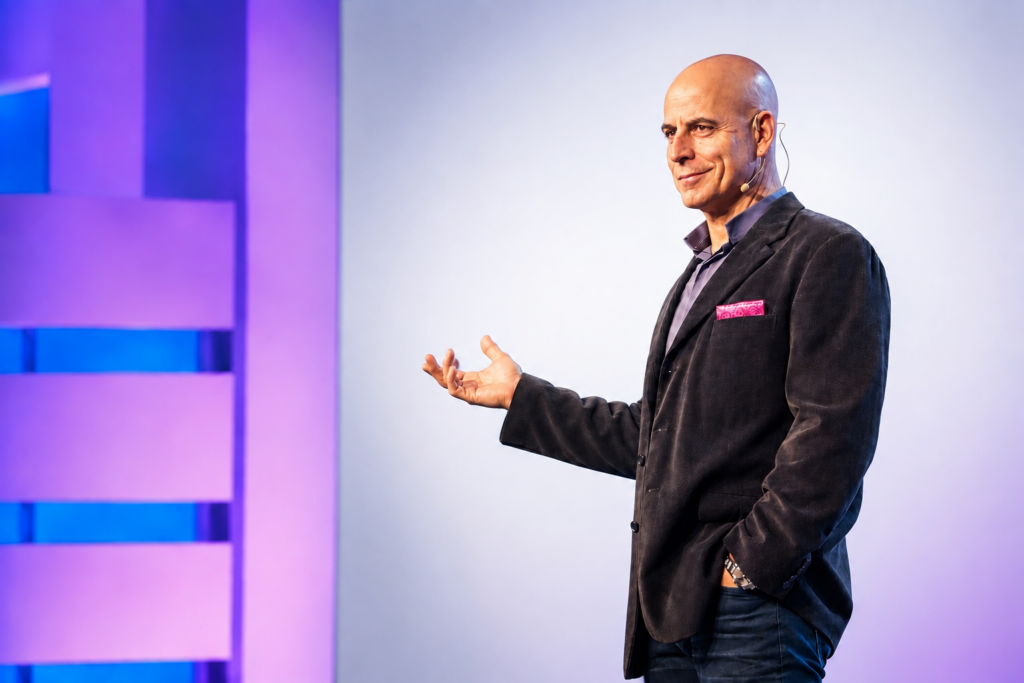
The speaker numbly scrolled through his slide deck, reading it word for word. He should have worked for the Dallas Fire Department, because I’ve never seen anyone clear a room faster.
Afterward I was talking with Erick Gamio, my brother from another mother. We were in awe that any human being could be so completely unaware of what was happening around him.
Erick told me about a program he’d attended in Buenos Aires, where a presenter couldn’t get the projector to sync with his laptop. So…he resorted to having someone stand on the stage…holding the laptop up…pointed at the audience.
In a situation like that, why wouldn’t a presenter simply skip the slides and give his presentation?
Because if he’s like most speakers — even professional speakers — he’s helpless without them. He’s reading his slides out loud because he doesn’t know how to structure and deliver a talk minus them.
It’s an uncomfortable truth, and since no one else will say it out loud to you, I’ll take one for the team and tell you…
PowerPoint was created for people who have neither power nor a point.
If you want to be a person of influence, someone who dents the Universe, you need to be able to make a point in a powerful way. And that starts with having a point…more specifically, a point of view (POV).
A POV means you’ve taken the time to reflect on a situation, evaluate the possible outcomes, and develop a mindful opinion on the right course of action. An opinion you actually give a fuck about, and that other people will care about. Even if they vehemently disagree with you. Especially if they vehemently disagree with you.
And before you file this under “problems for people who speak on stages,” understand that it isn’t one. It’s a problem in your conference room, on your team calls, and in your board deck. It costs real entrepreneurs real money. Let me show you one.
I got called in to work with an intriguing company that had produced exponential growth in a handful of countries and then run into a wall. Sales stalled. They called me to get unstuck.
Here’s what I discovered…
The founder is a brilliant visionary who built something almost no one else could have built. He’s a dreamer who actually ships. The world needs a lot more people like him. He’s the kind of mad genius I wrote a whole book about.
But while he is eminently qualified to found a company, managing one is not the best use of his talents. Deep down, he knows this. So he trusts that his executive team knows how to run the place — in no small part because they make such good PowerPoint presentations.
It took exactly one meeting with that team to find the cause. They had reached the level of their incompetence. Not because they’re bad people, or lazy, or don’t want to win. They are good people with the best intentions. But they had reached the point where they no longer knew which questions to ask.
They — and probably you — have been brainwashed into believing that your job as a speaker (founder, author, consultant, coach, CEO, CFO, CMO, podcaster, whatever) is to report the situation. You studied the landscape, and now you’re reporting back what you learned.
That was true five years ago. It is not true in the age of AI.
Because no one cares what you know. AI already knows everything you know, and everything everyone else knows. Oh, you read the 25 seminal books on management and can distill the best practices running through all of them? (Yawn.) AI does that better than you, in less than a minute, for free.
Let me say it again, louder, for the people in the back…
Nobody is going to pay you for what you know. They’re going to pay you for what you think. (Or you’ll be paying other people for what they think. Choose mindfully.)
In the case of that client, what the executive team did was prepare elaborate decks for every single team meeting. Pie charts showing the percentages of this. Bar charts tracking the history of that. Clever icons categorizing this. Big, bold numbers recapping that.
Those presentations might as well have been a documentary on the goddamned History Channel, because all they showed was the past. Any dimwit can summarize the past. (That’s what you know.) What’s needed is a critical thinker who can peek around the corner and tell you what’s coming. (That’s what you think.)
So, I’m sitting in a meeting where one of the key people is droning on showing slides about their ISO 9000 quality management certification, when I couldn’t help myself and interrupted to bark, “Nobody gives a shit about your ISO certification. They want to know why you can’t keep the products in stock.”
The stunned silence that followed was what allowed the breakthrough to occur. Because as Dan Sullivan likes to point out, all breakthroughs begin with telling the truth.
The truth was, the CEO needed to fire himself, move up to chairman, get back to being a visionary doing visionary stuff, and bring in some new executives who could get the trains running on time.
Now perhaps you don’t possess the high levels of charm, tact, politeness, diplomacy, and political correctness that I do. 😬 But at some point, if you want to make a difference, you’re going to need a POV — and the courage to articulate it.
Because of AI and what it can do for us, the fundamentals of your ability to make an impact and co-create progress in the Universe have changed:
- Have a point of view and something to say.
- Say it authentically, as only you can.
- Be a thought leader, not a thought repeater.
- Make it about the audience, not about you.
- Solve real problems and add real value.
Your voice, your critical thinking, your passion, your integrity, and your capacity to care are your superpowers. Collaborate with AI. Use it to sharpen your thinking. Study the past for the lessons in it. But always question the premise.
The legendary Bill Gove once told me, “You’re not responsible for your audience. You’re responsible to your audience.”
Here’s what that really means. You are not responsible for what your audience — readers, clients, tribe, viewers — does or doesn’t do with what you share. But you are responsible to deliver your truth in the best way they can understand it and act on it, if they choose to.
If you really want to make a monumental positive impact, we need you to have a point of view, and the courage to share it. So let me ask you…
What’s your POV — and when is the last time you said it out loud in a room that might disagree with you?
Peace,
– RG
Previous Post: The Old You Can’t Come Along
Reader interactions
One Reply to “PowerPoint Was Created for People Who Have Neither Power Nor a Point”
I got booed out of a a theatre when I tried to call Anthony Bourdain on his bs.. the crowd didn’t want to hear anything bad about their hero.. funny thing was Bourdain was cool with it, he wanted to hear my points, he hated that hero worship.. you can read about if you like at my site.. Google Bourdain, Napa Sonoma Insider.. cheers Napa David