
Entrepreneurship has long been associated with freedom, innovation, and financial success, but the reality is often far more complex. Behind every growing business are founders facing challenges around leadership, funding, scaling, technology, and personal resilience. These are all areas that have driven demand for resources, such as entrepreneur coaching, development programs, and strategic mentorship and performance-focused training.
To find out what 1,901,057 opinions of founder entrepreneurs in the US were about entrepreneurship, we utilized AI-driven audience profiling to synthesize insights from online discussions over 12 months, ending on May 18th, 2026, to a high statistical confidence level. The results reveal the opportunities, pressures, and priorities shaping founder-led companies across the United States in 2026.
Index
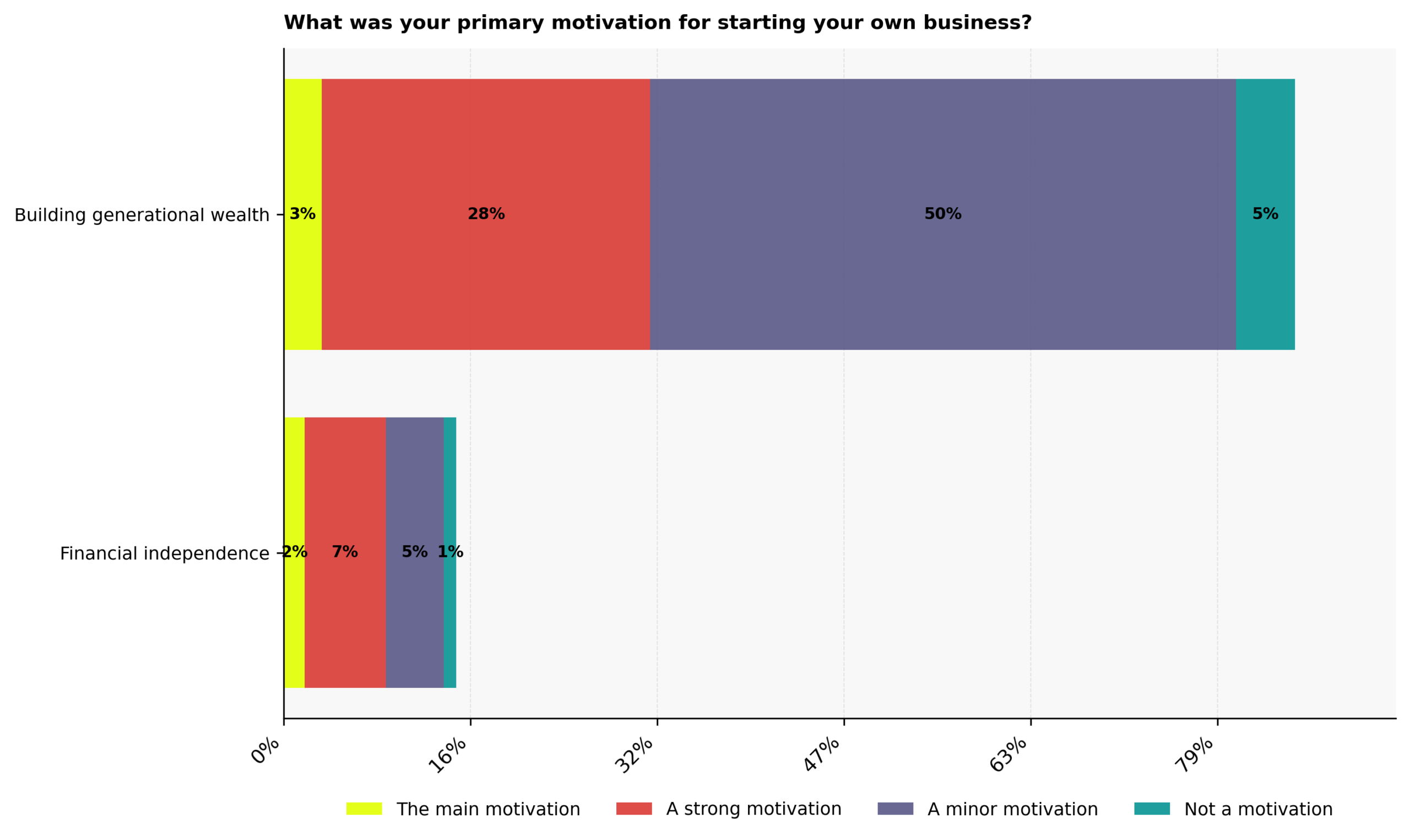
- Building generational wealth is a major motivator for starting a business for 31% of founder entrepreneurs, yet it’s just a minor motivation for 50%, and not a motivator at all for 5%, while financial independence motivates 14%, but not 1%
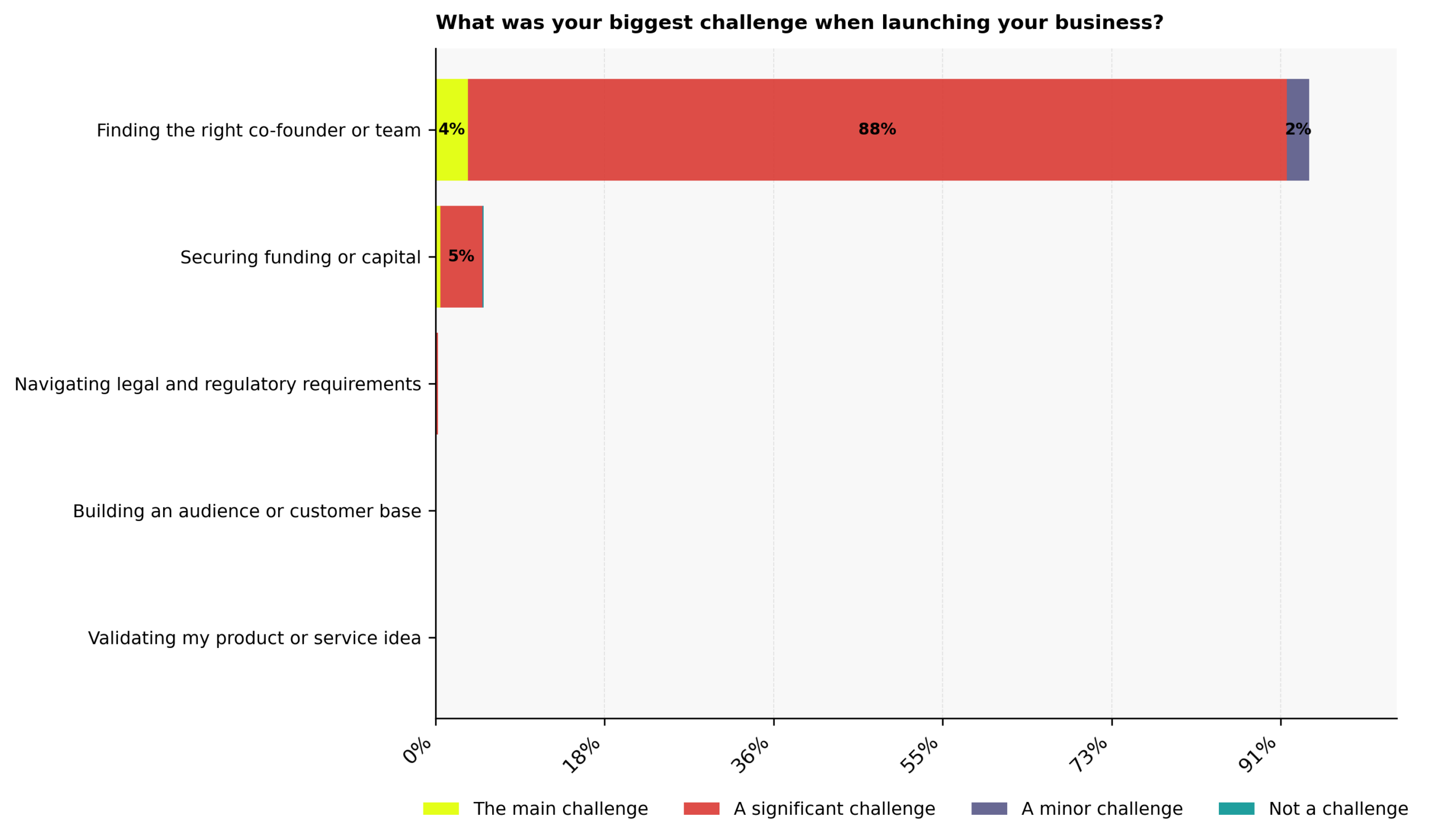
- For 88% of founder entrepreneurs, finding the right co-founder or team was a significant challenge for 88%, while 4% found this the main challenge, and 2% said it was only a minor hurdle; conversely, just 5% struggled with securing funding or capital
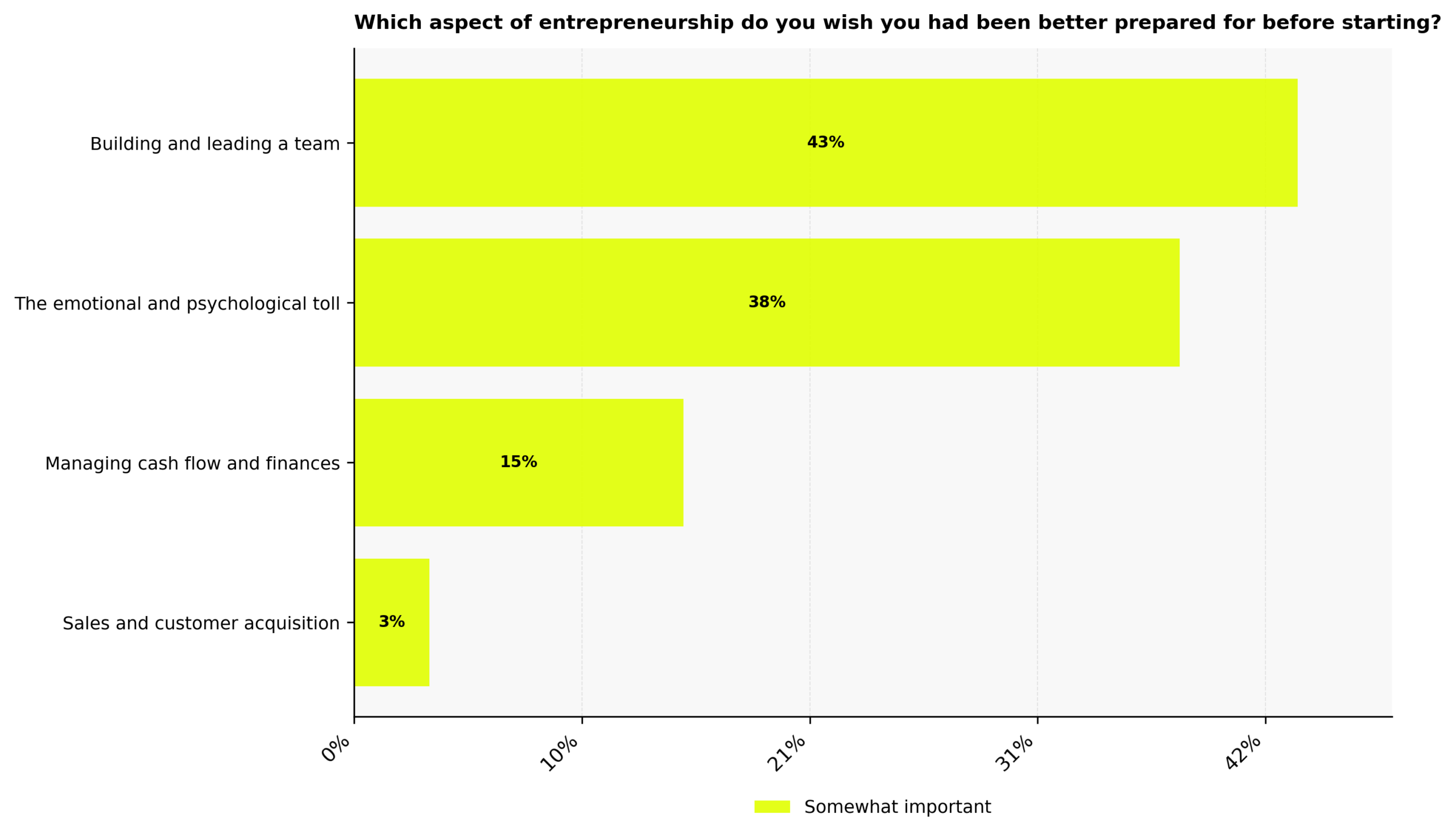
- 43% of founder entrepreneurs wish they’d been better prepared for building and leading a team prior to starting their business, 38% didn’t realize the impact of the emotional and psychological toll, 15% wish they were better prepared for managing cash flow and finances, and 3% sales and customer acquisition
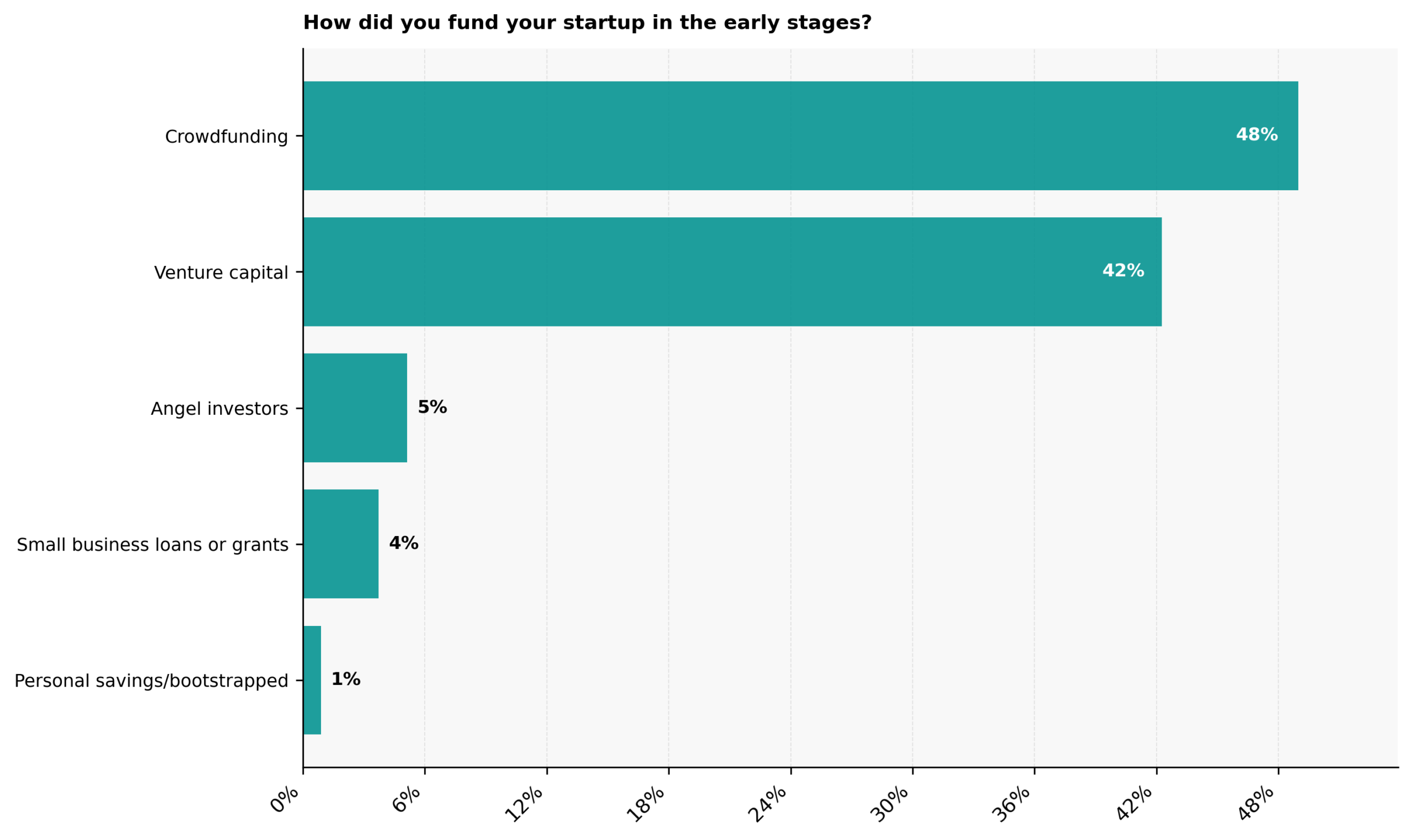
- 48% of founder entrepreneurs funded their businesses in the early stages using crowdfunding, 42% relied on venture capital, 5% on angel investors, 4% small business loans or grants, and 1% used personal savings or bootstrapping
- 48% of founder entrepreneurs have no guidance at all in their journey, 23% have some guidance, and 3% are absolutely guided, while 17% have varying degrees of input from an informal mentor, and 5% have a formal paid coach or mentor
- 40% of founder entrepreneurs’ businesses are in the 2-5 year growth stage, 25% in the idea or pre-launch phase, 17% are scaling or expanding, 4% have been established for more than 5 years, and 1% are in the 1-2 year early stage
- Subscription or recurring revenue is the business model used by 80% of founder entrepreneurs’ companies to generate revenue, 9% generate revenue from licensing and royalties, 5% by physical or digital product sales, 3% from service-based endeavors, and 3% from a marketplace or platform
- 62% of founder entrepreneurs have 2-5 full-time employees or contractors, 15% have 16-50, another 15% 6-15 employees, and 8% are solopreneurs with no employees or contractors
- 25% of founder entrepreneurs’ annual business revenue is between 500k and $1 million, 19% are earning between $1 and $5 million annually, 8% more than $5 million a year, 10% between $100 and $500k; however, just 2% are earning under $100k annually
- 64% of founder entrepreneurs’ businesses are not yet profitable, 22% took 2-5 years to become profitable, and 14% took 6-12 months to show a profit
- Social media is used by 64% of founder entrepreneurs to generate leads, while 26% primarily use email marketing, 4% SEO and organic search, another 4% use networking events and conferences, and 2% generate leads using paid ads
- Strategic partnerships are the main driver of founder entrepreneurs’ growth strategies, while 24% agree that this is a significant factor, 25% have had the best results from paid advertising, but 7% haven’t found this to be a growth driver, and only 1% credit content marketing and thought leadership as their main driver
- While 20% of founder entrepreneurs find marketing and brand visibility a somewhat challenging area of business to manage, 37% don’t find it too hard, and 26% feel the same about hiring and team culture, yet 11% find this to be somewhat challenging, just 1% struggle with financial management and cash flow, and 5% think this isn’t too hard of an area to manage
- 48% of founder entrepreneurs’ biggest obstacle to scaling their business is access to capital, and this is an issue for 47%; however, 2% don’t have this hurdle, finding and retaining top talent is the biggest hurdle to scaling for 2%, and fewer than 1% cite their own mindset or limiting beliefs and a lack of systems and processes as theirs
- 48% of founder entrepreneurs typically make data and analytics-driven decisions, 46% make decisions based on team consensus, 4% use a combination of data and intuition, 1% get advice from mentors or advisors, and another 1% rely on gut instinct and experience
- 49% of founder entrepreneurs typically work 30-40 hours a week, 23% work 60+ hours, 16% work 51-60 hours a week, 11% 41-50 hours, and 1% work less than 30 hours a week
- 43% of founder entrepreneurs fear losing passion or burning out, compared to 1% who are not scared by this. 19% fear running out of money. 14% failing publicly, 13% making the wrong strategic decisions, and 6% are most scared of being outcompeted
- 74% of founder entrepreneurs struggle with mental health and haven’t found a solution, 17% use therapy, coaching, or peer support to avoid burnout, 7% rely on regular exercise and physical wellness routines, and 2% maintain strict boundaries around work hours
- 71% of founder entrepreneurs have female coaching or mentorship to help them with personal development, 7% use online courses and programs, 1% podcasts, books, and self-study, and another 1% mastermind groups or peer communities, yet 21% don’t have a structured approach
- Thinking bigger and setting bolder goals had the biggest impact on 34% of founder entrepreneurs’ success, 22% benefitted by letting go of perfectionism, 23% from embracing failure as learning, and 17% form investing in themselves and their personal development
- 52% of founder entrepreneurs’ ultimate goal is to create a brand or lasting legacy in the next 3-5 years, and 22% say this is a strong priority; however, this isn’t the main focus for 15%, and it’s not important to 9%, while just 1% view building a team and stepping back from daily operations as their ultimate goal
- 85% of founder entrepreneurs probably wouldn’t recommend entrepreneurship as a career path, as the risks mostly outweigh the rewards, and 3% definitely wouldn’t, but 4% disagree, saying it’s the only way to live, 4% would recommend this path but with the right preparation, and 4% are neutral about it, as it depends heavily on the person
- AI is most used by 25% of founder entrepreneurs for content creation and marketing. 10% are using it in operations, workflows, and productivity, 2% for financial analysis and forecasting, 1% for sales prospecting and CRM, and 1% for customer service and automation; however, 56% are not currently using AI in their business despite its recognized potential
- 38% of founder entrepreneurs are actively using AI tools across multiple areas of their business, and 9% are using it for specific tasks like content, admin, or customer service; yet 41% are not using AI, nor are they planning on it, 7% are still experimenting, and 4% are aware of it but have yet to implement it in any way
- 79% of founder entrepreneurs believe AI gives their business a moderate advantage right now. 11% feel they gain a significant advantage, and 5% are still figuring out where it adds value, while 3% haven’t seen any meaningful results yet, and 2% are not sure yet if AI is giving them an advantage
- 42% of founder entrepreneurs’ biggest concern about adopting AI in their business is not knowing where to start or which tools to use, while 20% are concerned about difficulty integrating with existing systems, 17% about data privacy and security risks, and 13% about the cost of implementation; fewer than 1% are concerned about AI replacing human jobs and team morale
- 33% of founder entrepreneurs feel the US government currently offers entrepreneurs and small businesses very poor support, 29% feel the support is poor, and 3% have a neutral opinion, but 27% feel that the government supports them very well, and 8% agree they do so somewhat, but that the support is hard to access
- 79% of founder entrepreneurs agree that better access to government contracts for small businesses would have the greatest positive impact on their businesses, 17% think that easier access to small business grants and low-interest loans would have the most impact, 2% want simplified tax structures and incentives for startups, and 1% agree that regulatory reform to reduce compliance burdens would be the most effective
- Receiving grants or incentives benefited 6% of founder entrepreneurs and made a meaningful difference to their business, but 5% found the process too complex compared to the benefit received, and 15% relied on private funding and self-sufficiency instead, with a further 62% disagreeing with this but not benefitting from grants or incentives either
- Mindset and peak performance strategies are the most valuable type of content or resource for 42% of founder entrepreneurs, networking and community access is most valuable for 20%, expert coaching and accountability are best for 17%, founder stories and case studies for 6%, and 2% agree that practical playbooks and step-by-step resources are the most valuable
- Key takeaways on the challenges, opportunities, and realities of entrepreneurship
- About the data
What are founder entrepreneurs’ primary motivations for starting a business?
Building generational wealth is a major motivator for starting a business for 31% of founder entrepreneurs, yet it’s just a minor motivation for 50%, and not a motivator at all for 5%, while financial independence motivates 14%, but not 1%
Motivations for building a business are clear:
Building long-term wealth remains one of the strongest drivers behind entrepreneurship in the United States, particularly because inherited wealth is not available to most people.
CFA Institute research shows that roughly 20% of US citizens have received an inheritance, but only between 10% and 17% have been able to reap the benefits of a substantial ongoing financial legacy. This shows that building wealth directly through owning a business is a major motivation for many entrepreneurs, and our audience agrees.
For 50% of founder entrepreneurs, building generational wealth is a minor motivation for starting a business, with a further 28% agreeing it was a strong motivation. Another 3% cite it as their main motivation. Conversely, 5% say it was not a motivation at all.
It’s evident that wealth creation influences a large share of entrepreneurs, though for many it is part of a broader mix of ambitions rather than the single defining reason.
Financial independence follows a different pattern and is far less of a driving force. Just 2% say it was their main motivation for starting a business, while 7% describe it as a strong motivation. According to 5%, it played a minor role, and the remaining 1% say it was not a factor.
What was the biggest challenge for founder entrepreneurs when launching their business?
For 88% of founder entrepreneurs, finding the right co-founder or team was a significant challenge for 88%, while 4% found this the main challenge, and 2% said it was only a minor hurdle; conversely, just 5% struggled with securing funding or capital
One challenge stands out above the rest:
People often portray launching a business as a financial challenge, but getting the right people around you can be just as difficult. Many entrepreneurs start with a strong idea but quickly realize that turning it into a real business venture depends heavily on finding people they can trust and who will work well with them.
Our audience clearly felt this pressure.
Finding the right co-founder or team is the biggest challenge entrepreneurs face when launching their business. An overwhelming 88% describe it as a significant challenge, while a further 4% say it was the main challenge they encountered. According to 2%, it is a minor challenge, suggesting that very few entrepreneurs progressed through this stage without some difficulty.
Interestingly, securing funding or capital appears to have been less of a barrier than expected, with just 5% identifying it as the main challenge. Navigating legal and regulatory requirements, building an audience or customer base, and validating a product or service idea attracted little to no emphasis in comparison.
What do founder entrepreneurs wish they’d been better prepared for?
43% of founder entrepreneurs wish they’d been better prepared for building and leading a team prior to starting their business, 38% didn’t realize the impact of the emotional and psychological toll, 15% wish they were better prepared for managing cash flow and finances, and 3% sales and customer acquisition
Preparation extends beyond the management side of entrepreneurship:
Starting a business may be challenging, but many entrepreneurs only realize later that building the business externally is often easier than leading the people inside it. Skills that seem less important in the beginning quickly become the ones that matter most.
Our audience makes this point clear. Building and leading a team is the aspect that founder entrepreneurs most wish they had been better prepared for before starting, with 43% feeling this way. Hiring, managing diverse personalities, giving feedback, and taking responsibility for others are very different from simply having a good business idea.
Not far behind, 38% wish they had better understood the emotional and psychological toll, as numerous studies show that this role requires long-term resilience. As for the rest of our audience, 15% cite managing cash flow and finances as an issue, while the remaining 3% point to sales and customer acquisition as areas they wish they had been better prepared for.
How did founder entrepreneurs fund their startups in the early stages?
48% of founder entrepreneurs funded their businesses in the early stages using crowdfunding, 42% relied on venture capital, 5% on angel investors, 4% small business loans or grants, and 1% used personal savings or bootstrapping
Funding comes from two predominant sources:
Starting a new business is a costly endeavor. While many people assume that founder entrepreneurs have big personal savings accounts or have secured traditional financing, newer ways to fund startups are becoming more common. In 2025, the global crowdfunding market stood at just over US$1.8 billion. Analysts expect this figure to grow further, reaching over US$2 billion in 2026 and nearing US$6 billion by 2034.
This shift is reflected in our audience, with 48% financing their startups through crowdfunding. Close behind were the 42% who took the more traditional route of venture capital.
The remaining funding methods were far less common. Just 5% of founder entrepreneurs relied on angel investors, while 4% turned to small business loans or grants. Only 1% selected personal savings or bootstrapping, putting them firmly in the minority.
Do founder entrepreneurs have a mentor or coach guiding their journey?
48% of founder entrepreneurs have no guidance at all in their journey, 23% have some guidance, and 3% are absolutely guided, while 17% have varying degrees of input from an informal mentor, and 5% have a formal paid coach or mentor
Formal guidance is not commonplace:
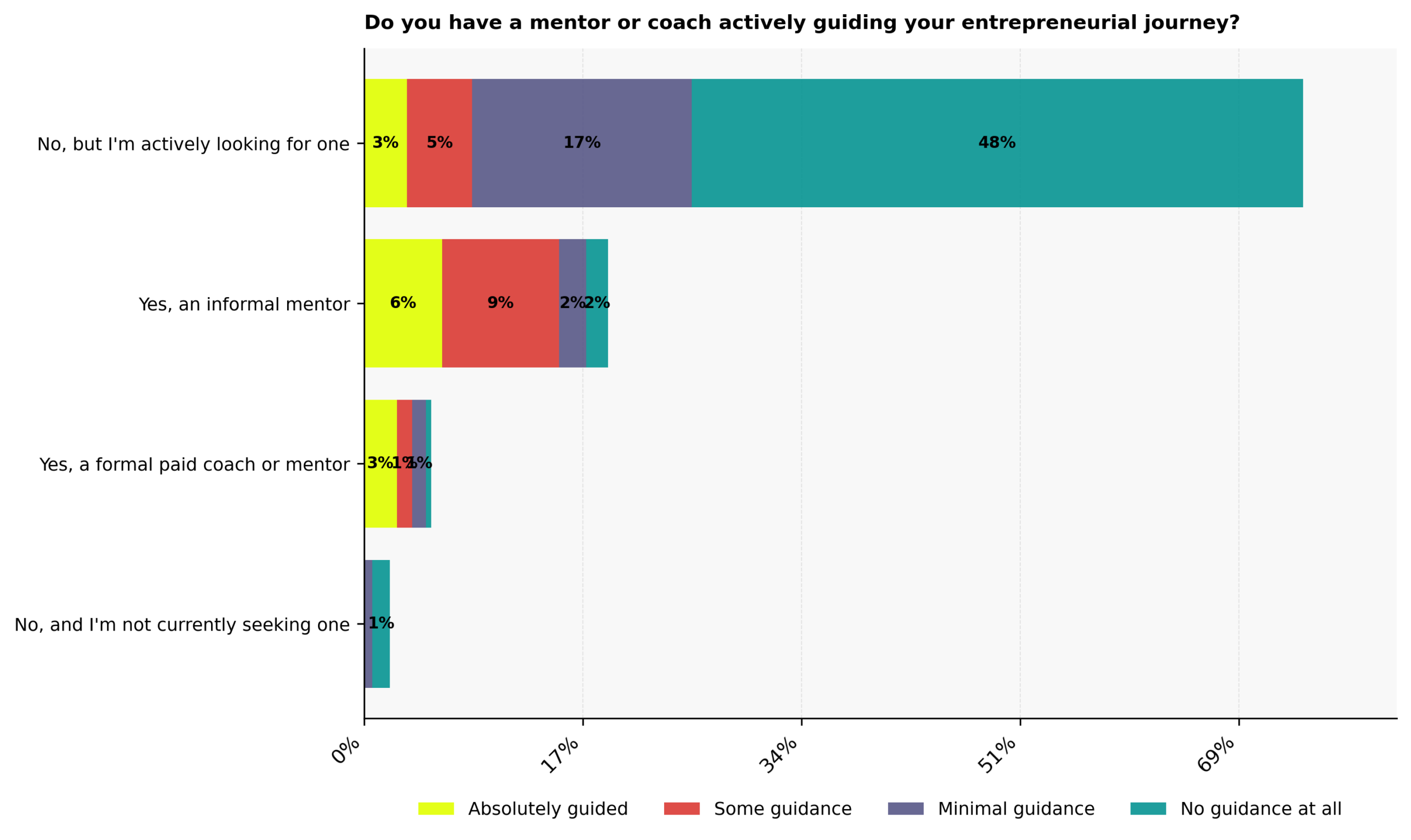
Building a business is often described as a process of learning as you go. While mentors and coaches are extremely valuable resources, our audience still rarely receives structured guidance.
The largest segment is made up of founder entrepreneurs who currently have no guidance but are actively looking for support, at 48%. Another 17% receive minimal guidance, while 5% receive some guidance, and just 3% feel absolutely guided. This indicates that support is widely sought but not consistently available.
Informal mentoring appears to be more established than formal coaching. Among founder entrepreneurs with an informal mentor, 9% receive some guidance, and 6% feel fully guided. Support is minimal, with only 2% indicating they receive guidance, while the remaining 2% report receiving none.
Formal coaching represents the lowest segment, with just 3% feeling fully guided, 1% receiving some guidance, and another 1% receiving minimal guidance. The remaining 1% are not currently looking for any mentor, coach, or external support at all.
What stage is founder entrepreneurs’ business currently in?
40% of founder entrepreneurs’ businesses are in the 2-5 year growth stage, 25% in the idea or pre-launch phase, 17% are scaling or expanding, 4% have been established for more than 5 years, and 1% are in the 1-2 year early stage
Business stages are generally more established:
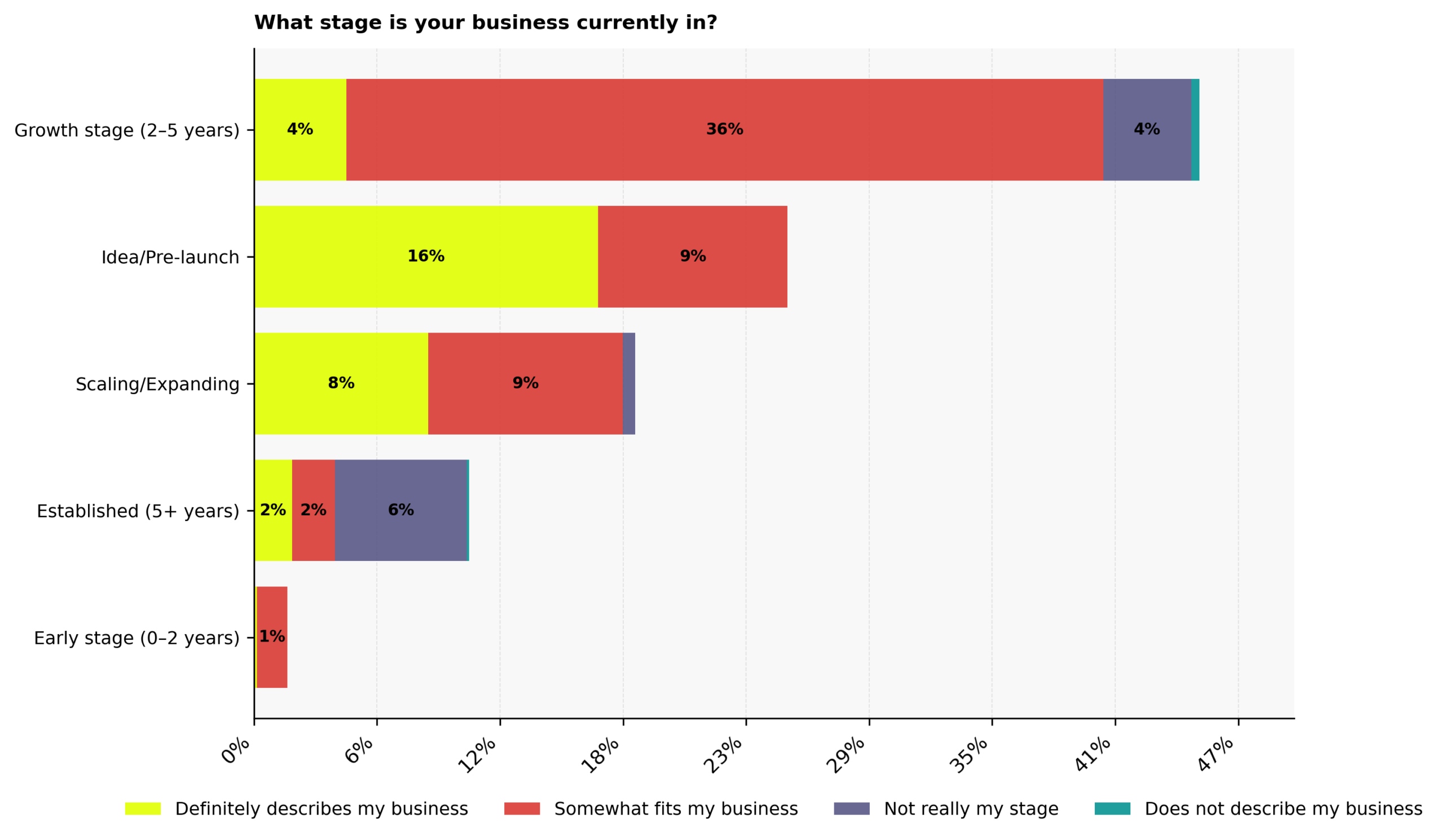
Building a business beyond the first few years is an achievement in itself. Research shows that one in five startups fail within their first year. The founder entrepreneurs in our audience appear to be doing well overall, with many already operating beyond the stage when businesses are most vulnerable.
The largest segment is in the growth years (2-5 years). For 36%, this phase somewhat describes their business, while for 4%, it definitely reflects where they are today. Conversely, according to 4%, growth years (2-5 years) do not really describe their current position.
Ideas/pre-launch is the next largest category. This stage strongly describes 16% of founder entrepreneurs, while a further 9% say it somewhat fits. Scaling/expanding follows a similar pattern, with 8% saying this stage strongly reflects their business and another 9% agreeing it somewhat applies.
As for the rest of our audience, 6% identify as established (5+ years), while only 1% align with the early stage (0–2 years). This points to a majority who are well established and have made it past the average “danger zone”.
Which business model generates revenue for founder entrepreneurs’ companies?
Subscription or recurring revenue is the business model used by 80% of founder entrepreneurs’ companies to generate revenue, 9% generate revenue from licensing and royalties, 5% by physical or digital product sales, 3% from service-based endeavors, and 3% from a marketplace or platform
Revenue generation focuses on a few key services:
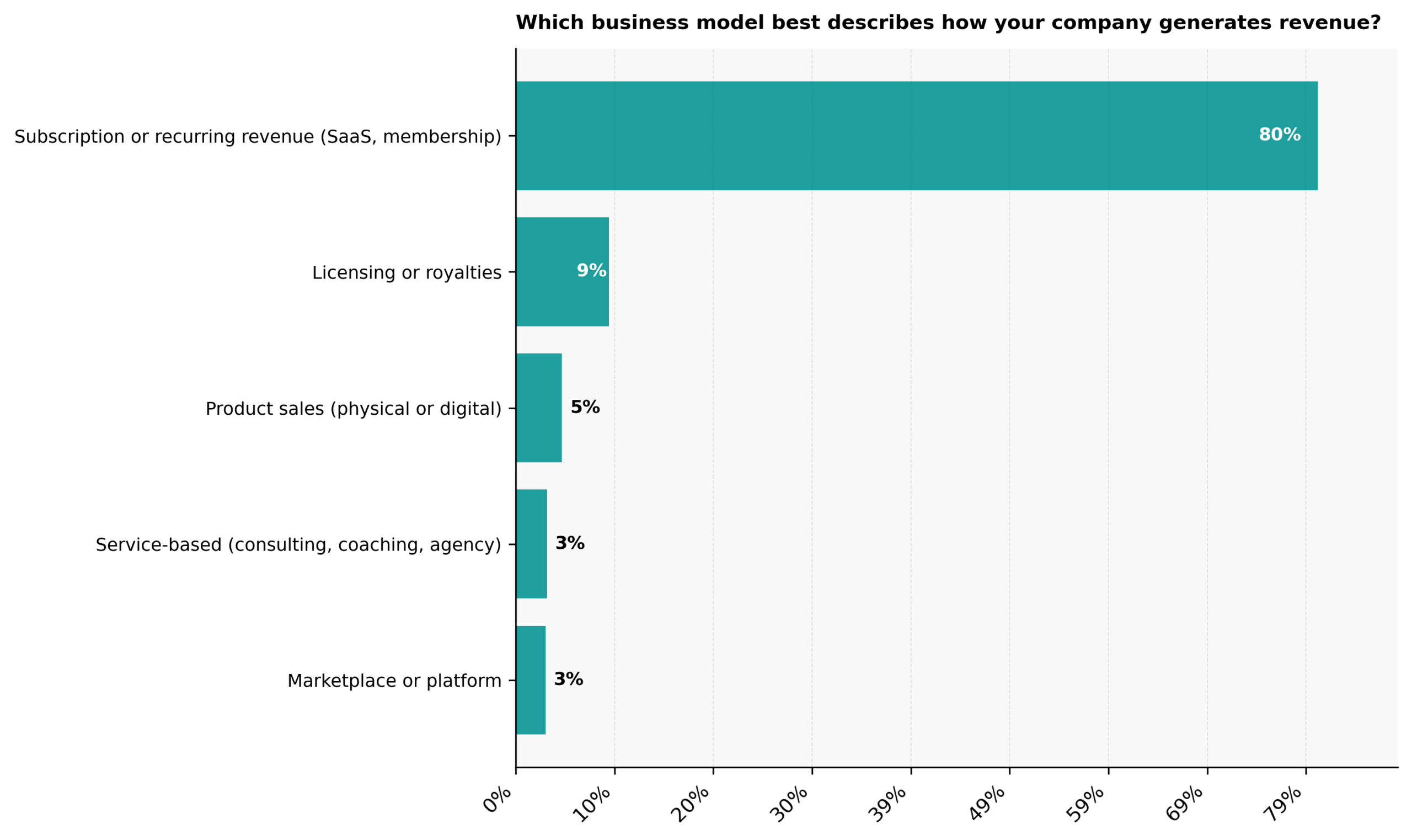
The subscription or recurring revenue (SaaS or membership) stream reflects how the vast majority (80%) of our audience’s business models are generating revenue. Following far behind are the 9%, for whom licensing or royalties are the basis of their income. Physical or digital product sales accounted for 5%, service-based revenue (such as consulting, coaching, and agency) accounted for 3%, and marketplace or platform revenue accounted for 3%.
This dominance of subscription and recurring revenue business models is reflected in the wider growth of the SaaS sector worldwide. The global SaaS market was estimated at around US$300 billion in 2025 and is expected to reach more than US$1 trillion by 2034.
How many full-time employees or contractors do founder entrepreneurs’ businesses have?
62% of founder entrepreneurs have 2-5 full-time employees or contractors, 15% have 16-50, another 15% 6-15 employees, and 8% are solopreneurs with no employees or contractors
Employees are more common than solopreneurs:
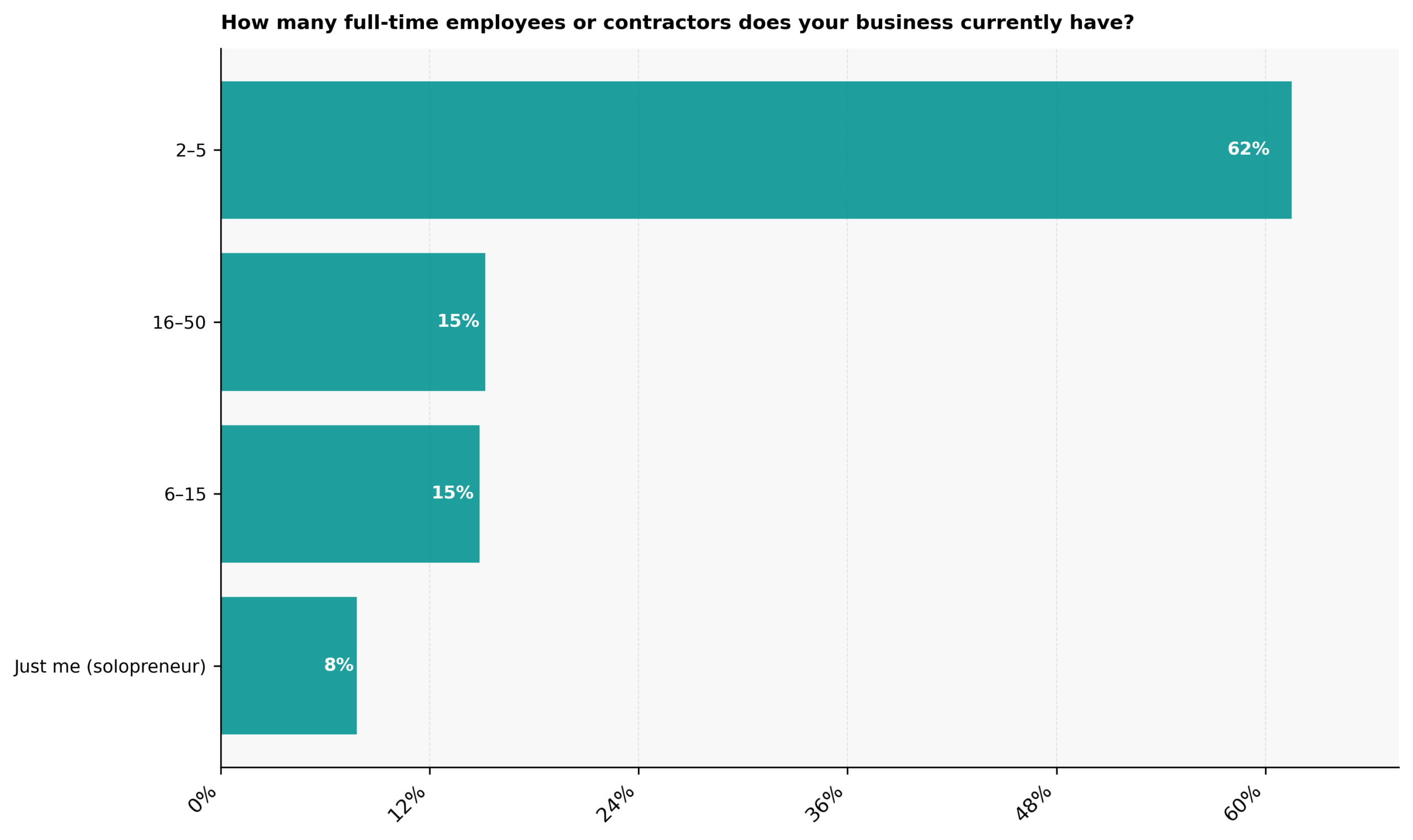
Although 15% of founder entrepreneurs run businesses with 6 to 15 full-time employees or contractors, and another 15% operate with between 16 and 50, the vast majority are working with much smaller teams, at 62%. Just 8% are solopreneurs.
What this suggests is that most founder-led businesses are staying lean during their growth stages. Rather than building large workforces early on, many founders appear to prefer smaller teams that are easier to manage, cheaper to run, and more flexible.
At the same time, the combined 30% running teams larger than 5 people shows that a sizable group is already moving beyond the startup level and scaling their operations.
What is founder entrepreneur’s annual business revenue?
25% of founder entrepreneurs’ annual business revenue is between 500k and $1 million, 19% are earning between $1 and $5 million annually, 8% more than $5 million a year, 10% between $100 and $500k; however, just 2% are earning under $100k annually
Founder entrepreneurs’ earnings are on the higher end:
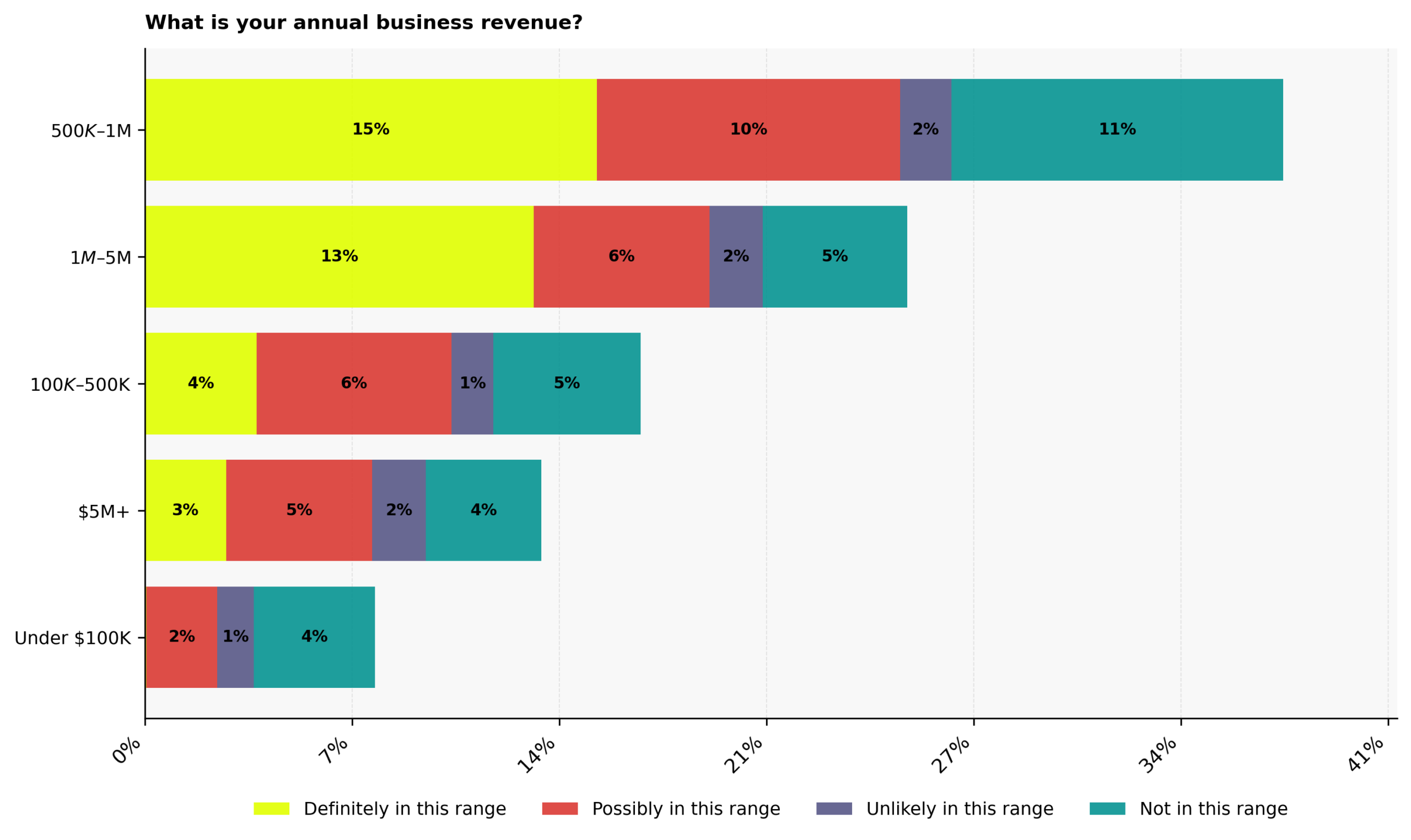
Founder entrepreneurs are most strongly concentrated in the $500,000 to $1 million annual revenue bracket. In this category, 15% of our audience clearly falls within this range, 10% possibly fall into this bracket, 2% view it as unlikely, and 11% do not fit this revenue range at all.
Businesses generating between $1 million and $5 million annually are also common. Within this bracket, 13% of our audience clearly fall into this range, 6% possibly fit into this category, 2% view it as unlikely, and 5% do not fit this revenue level.
For businesses earning between $100,000 and $500,000 annually, 4% clearly fit within this category, 6% possibly fall into this range, 1% view it as unlikely, and 5% do not fit this bracket.
Among the highest earners, 3% clearly fall into the annual revenue category above $5 million, while 5% possibly fit into this bracket, 2% view it as unlikely, and 4% do not fit this range.
At the lower end, 2% possibly fall below $100,000 in annual revenue, 1% view this as unlikely, and 4% do not fit this category. No businesses clearly fall into the under $100,000 revenue bracket.
This spread indicates that founder entrepreneurs are predominantly running established small to mid-sized businesses. While a smaller segment has grown beyond $5 million, very few appear to be operating at the earliest revenue stage, revealing that most have already achieved strong commercial traction.
How long did it take founder entrepreneurs’ businesses to profit?
64% of founder entrepreneurs’ businesses are not yet profitable, 22% took 2-5 years to become profitable, and 14% took 6-12 months to show a profit
Over half of businesses are not yet profitable:
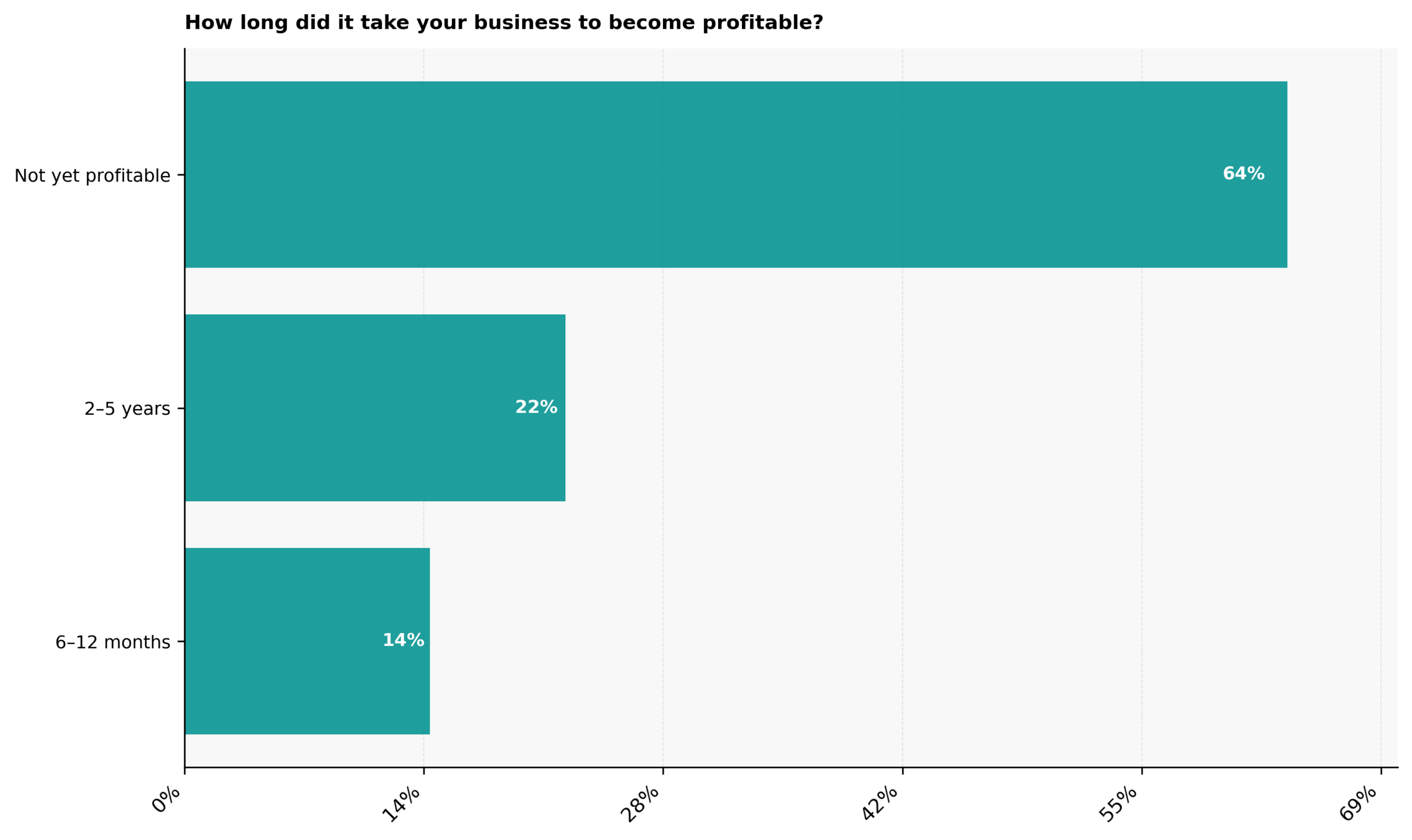
Most founder entrepreneurs’ businesses are not yet profitable, with 64% of our audience indicating that they have not yet reached this stage. This tells us that many are still in the growth stage, where money is being reinvested in the business through expansion, hiring, marketing, or product development rather than being turned into profit.
Among businesses that are already profitable, 22% reached this stage within 2 to 5 years. Another 14% became profitable within 6 to 12 months, showing that a smaller group managed to build stable revenue much faster than most. This aligns with wider startup trends, which find that new startups generally take between 18 and 24 months before they start seeing a profit
How do founder entrepreneurs generate leads or new customers?
Social media is used by 64% of founder entrepreneurs to generate leads, while 26% primarily use email marketing, 4% SEO and organic search, another 4% use networking events and conferences, and 2% generate leads using paid ads
Lead generation methods vary:
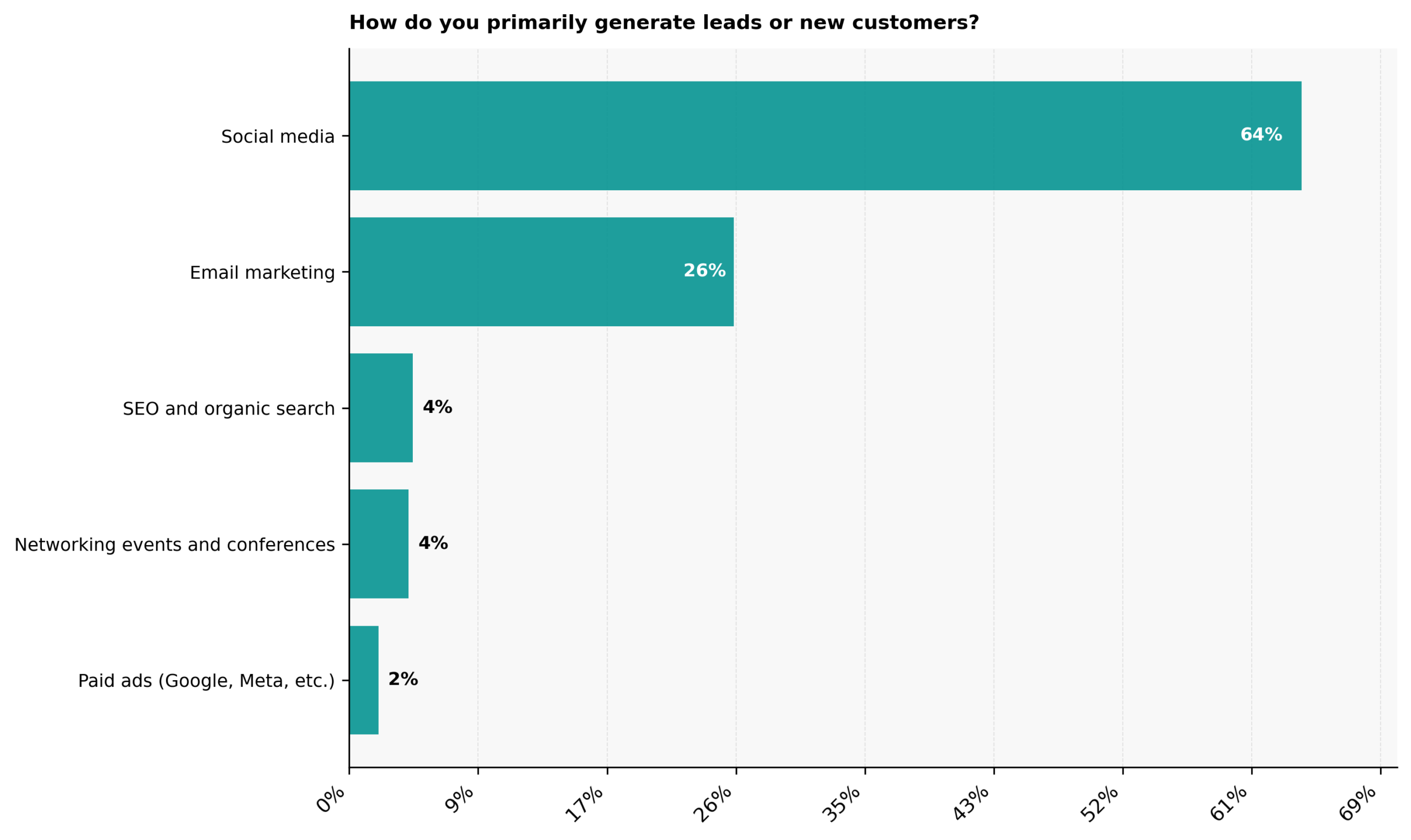
64% of our audience primarily generate leads and get new customers using social media platforms. This has become a hugely popular option, with studies showing that nearly 70% of marketers accomplish these tasks in just six hours a week.
Another 26% of founder entrepreneurs rely on more traditional email marketing, and 4% use SEO and organic search.
A further 4% rely on networking events and conferences, and just 2% use paid ads on Google and Meta, among others. This points to the fact that founder entrepreneurs strongly favor low-cost, direct, and flexible marketing channels over more expensive traditional methods and are using the former to get real results.
Which growth strategy delivers the most results for founder-entrepreneurs’ businesses?
Strategic partnerships are the main driver of founder entrepreneurs’ growth strategies, while 24% agree that this is a significant factor, 25% have had the best results from paid advertising, but 7% haven’t found this to be a growth driver, and only 1% credit content marketing and thought leadership as their main driver
Growth is encouraged by different factors:
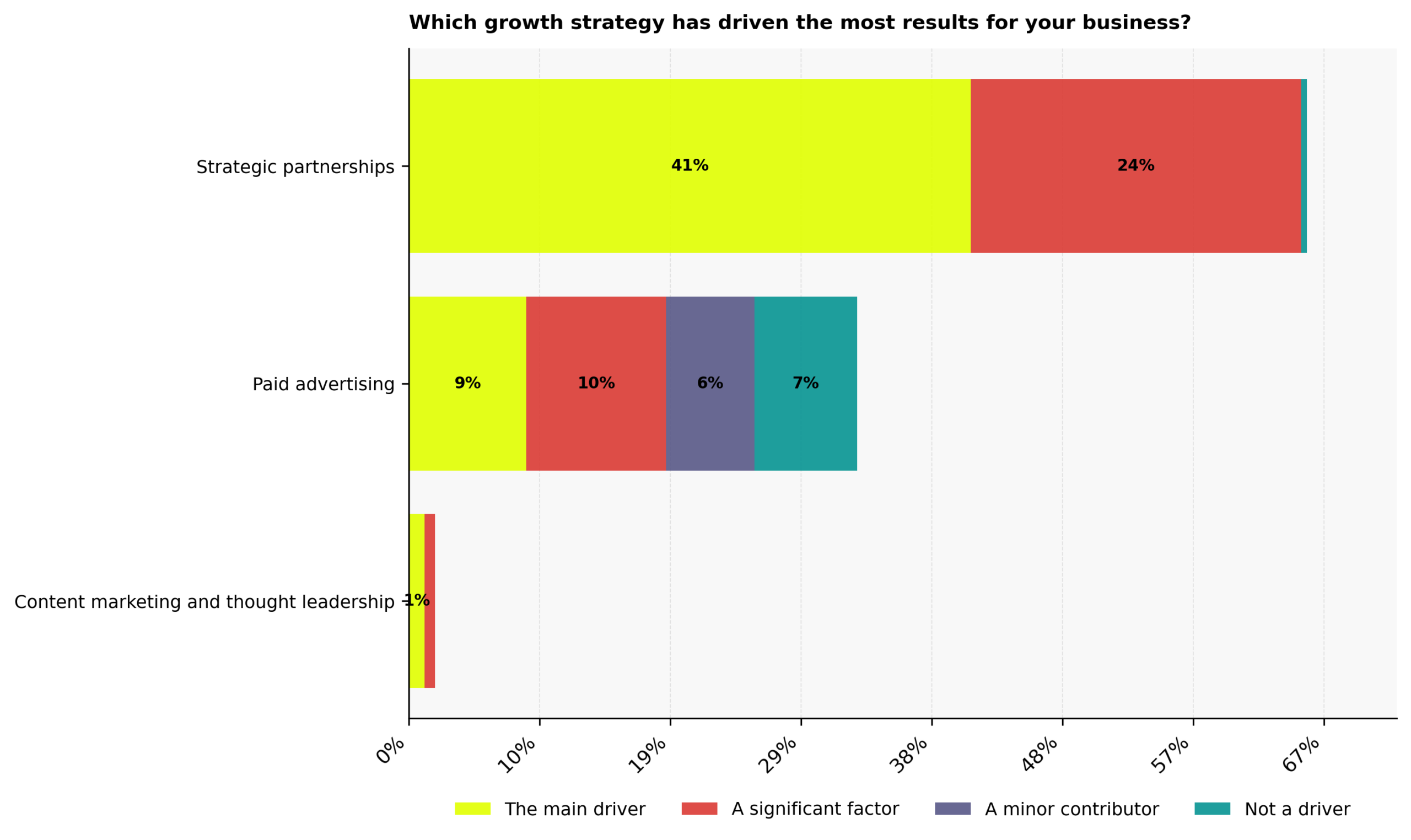
Founder entrepreneurs seem to favor strategic partnerships as part of their growth strategies.
41% of our audience use this approach as their main driver of business growth, and 24% describe it as a significant factor. This means that many founders are growing their startups using business relationships, collaborations, joint ventures, and referrals rather than focusing solely on direct marketing.
When it comes to paid advertising, the picture is more mixed. Although 9% see it as the main driver of their business’s growth and 10% view it as a significant factor, 6% describe it as a minor contributor only, and 7% do not view it as a growth driver at all. This points to paid ads working well for some but producing less consistent results.
In comparison, content marketing and thought leadership play a minimal role, with only 1% of our audience identifying them as main drivers of growth.
What business area do founder entrepreneurs find most difficult to manage?
While 20% of founder entrepreneurs find marketing and brand visibility a somewhat challenging area of business to manage, 37% don’t find it too hard, and 26% feel the same about hiring and team culture, yet 11% find this to be somewhat challenging, just 1% struggle with financial management and cash flow, and 5% think this isn’t too hard of an area to manage
Core business areas are not too much of a struggle to manage:
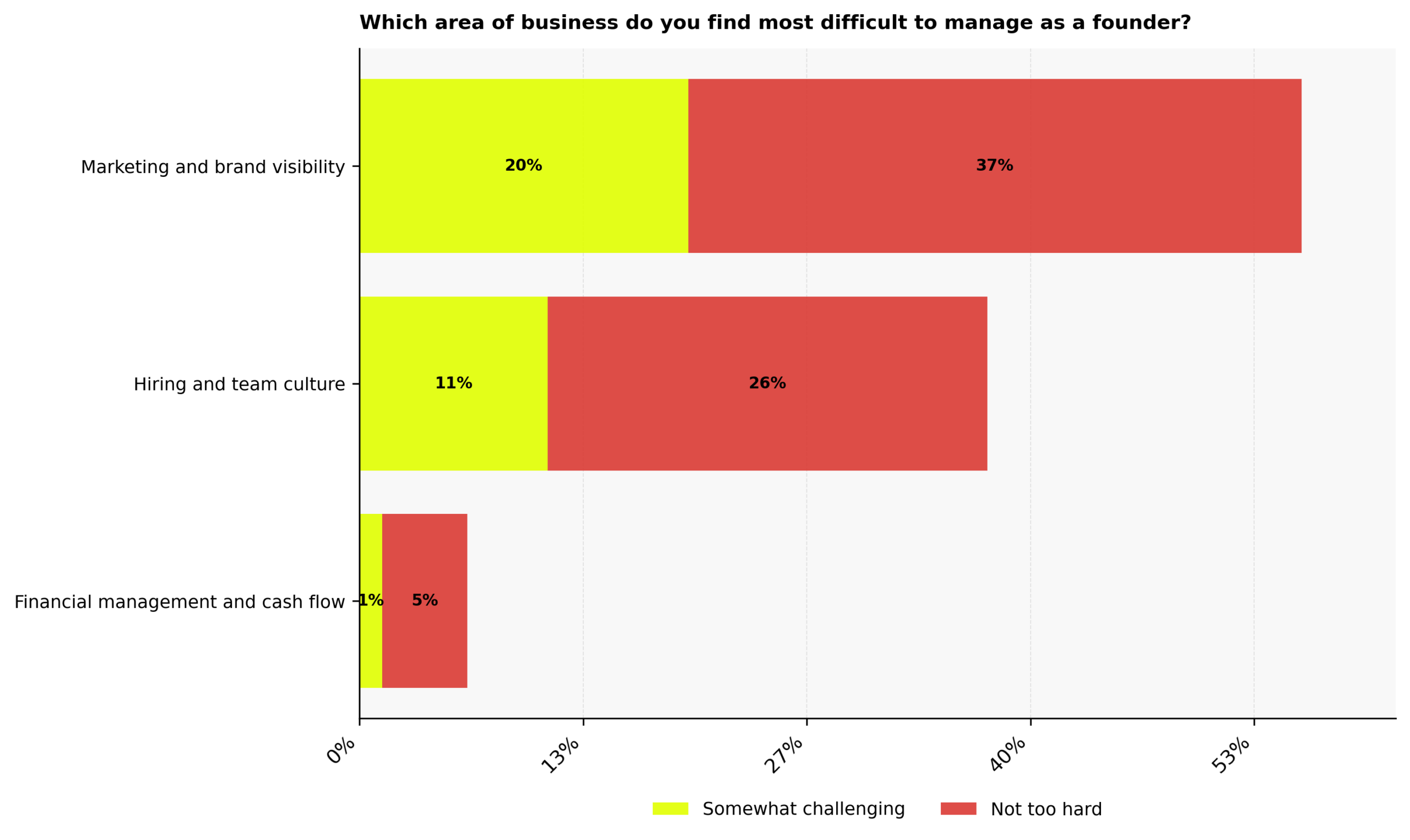
Marketing and brand visibility are the areas of business that the majority of founder entrepreneurs find most difficult to manage to varying degrees. 20% of our audience find it somewhat challenging, but a more positive 37% say it’s not too hard.
Up next is hiring and team culture, with 11% finding this aspect somewhat challenging, and 26% saying it’s not too much of a hard task. Coming in last are financial management and cash flow, with 1% finding it somewhat challenging and 5% saying it is not too hard to manage.
It’s evident that founder entrepreneurs struggle most with getting their businesses noticed and attracting attention in crowded markets. Marketing and brand visibility create the biggest pressure points, which makes sense given how competitive online spaces have become for smaller businesses trying to grow without relying on massive budgets.
What are founder entrepreneurs’ biggest obstacles to scaling their business?
48% of founder entrepreneurs’ biggest obstacle to scaling their business is access to capital, and this is an issue for 47%; however, 2% don’t have this hurdle, finding and retaining top talent is the biggest hurdle to scaling for 2%, and fewer than 1% cite their own mindset or limiting beliefs and a lack of systems and processes as theirs
Barriers to scaling are both personal and people-management related:
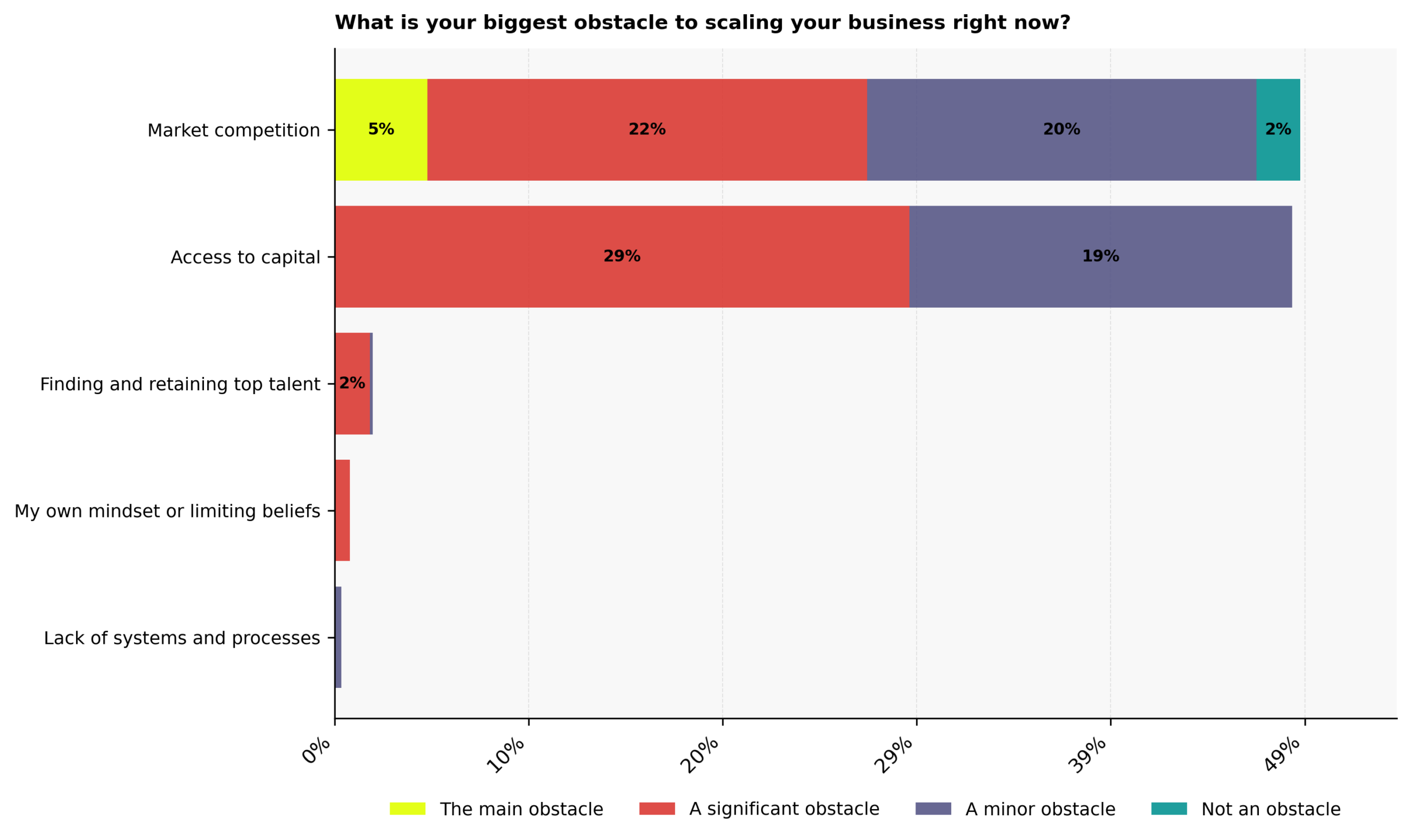
Market competition stands out as the biggest obstacle that founder entrepreneurs currently face in scaling their businesses. 5% view it as the main obstacle, 22% as a significant obstacle, 20% as a minor obstacle, and only 2% as not an obstacle.
Recent research emphasizes that market competition in the United States of America is particularly fierce these days because of the intersection of borderless digital commerce, the growing use of AI tools and automation, hyper-accessible global supply food chains, and the shift towards consolidated market power where big legacy brands aggressively preserve their advantage.
Access to capital is another significant obstacle for 29%, with only 19% seeing it as minor, and 2% of our audience says finding and retaining top talent is a significant obstacle.
Fewer than 1% of founder entrepreneurs also battle with their own mindset or limiting beliefs, as well as a lack of systems and processes.
How do founder entrepreneurs make major business decisions?
48% of founder entrepreneurs typically make data and analytics-driven decisions, 46% make decisions based on team consensus, 4% use a combination of data and intuition, 1% get advice from mentors or advisors, and another 1% rely on gut instinct and experience
Decisions are both data and people-driven:
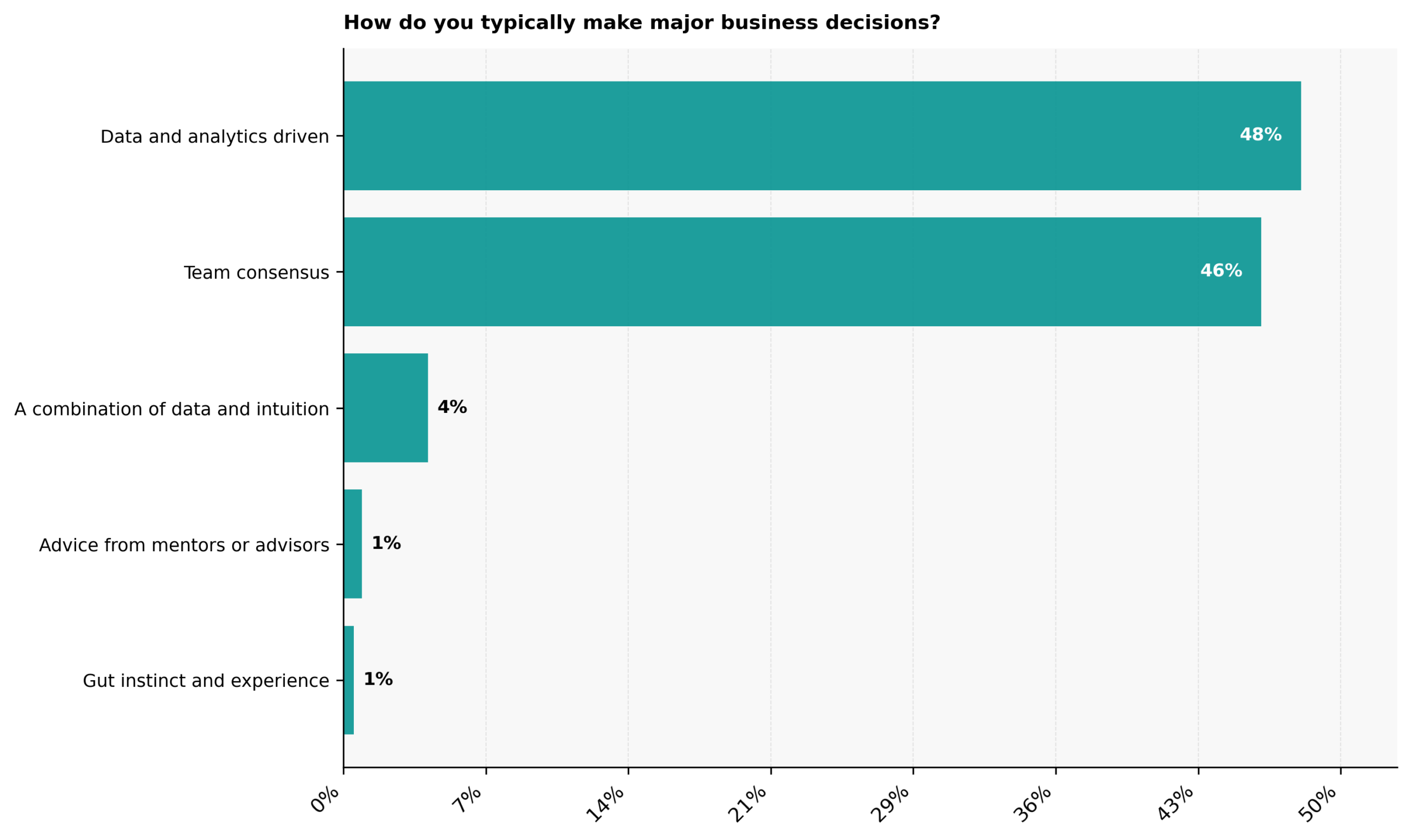
When it comes to major business decisions, founder entrepreneurs appear to favor structured decision-making approaches that balance measurable insights with collaboration and internal discussion. Very few rely solely on instinct or outside guidance alone.
48% of our audience typically make major business decisions based on data and analytics, while 46% rely on team consensus to do so. 4% use a combination of data and intuition, and 1% depend on advice from mentors and advisors, along with another 1% that go on gut instinct and experience.
Clearly, most founder entrepreneurs are approaching decision-making deliberately and collaboratively rather than relying solely on instinct.
How many hours per week do founder entrepreneurs work?
49% of founder entrepreneurs typically work 30-40 hours a week, 23% work 60+ hours, 16% work 51-60 hours a week, 11% 41-50 hours, and 1% work less than 30 hours a week
More hours than fewer are the norm:
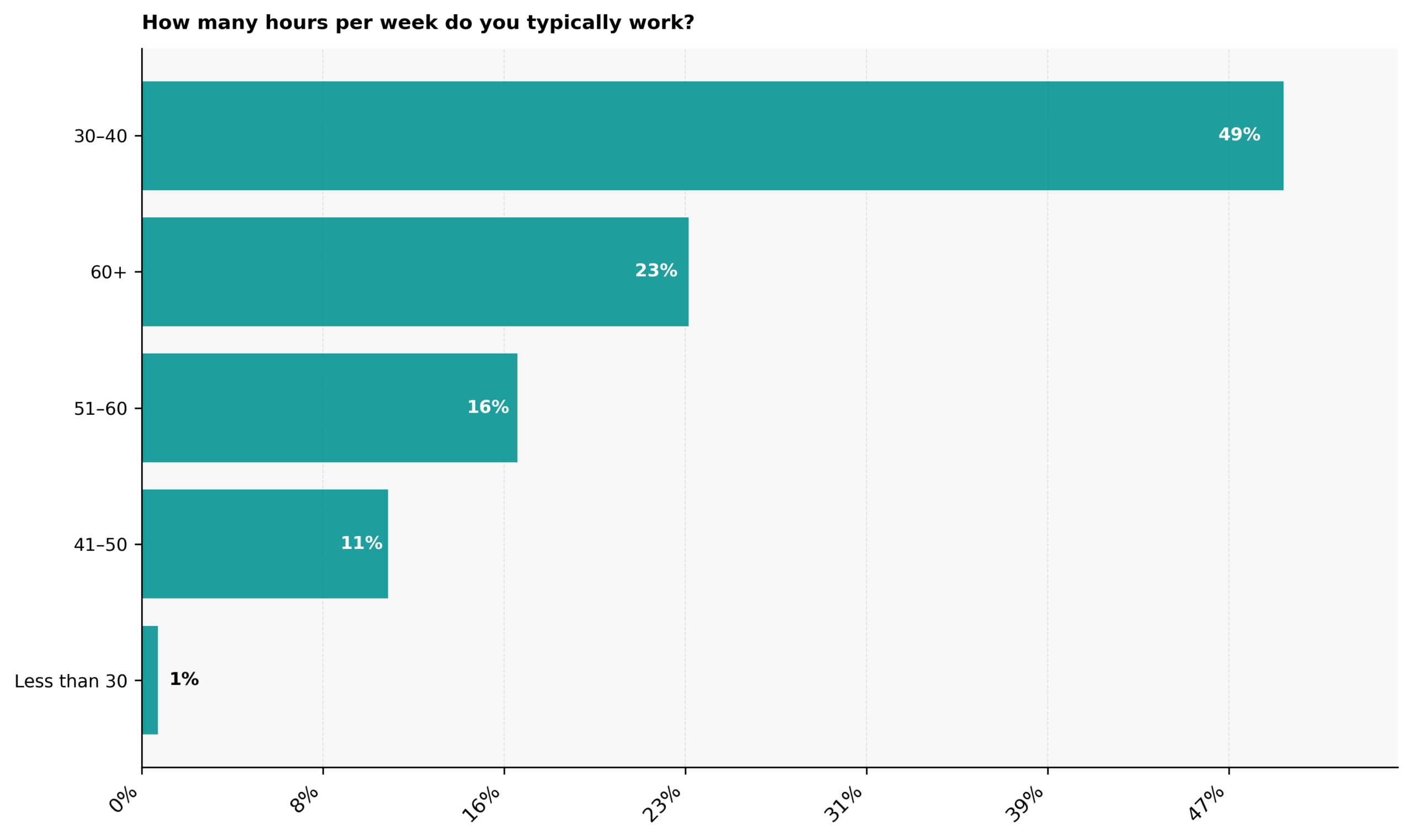
49% of founder entrepreneurs typically work between 30 and 40 hours a week, with 23% putting in as many as 60 hours every seven days. 16% spend between 51 and 60 hours at work, and 11% between 41 and 50, with very few, at just 1%, spending fewer than 30 hours working.
Long working hours are still very common among founder entrepreneurs, with most spending well beyond a standard working week building and managing their businesses.
What are founder entrepreneurs’ biggest fears?
43% of founder entrepreneurs fear losing passion or burning out, compared to 1% who are not scared by this. 19% fear running out of money. 14% failing publicly, 13% making the wrong strategic decisions, and 6% are most scared of being outcompeted
Fears are spread across different areas:
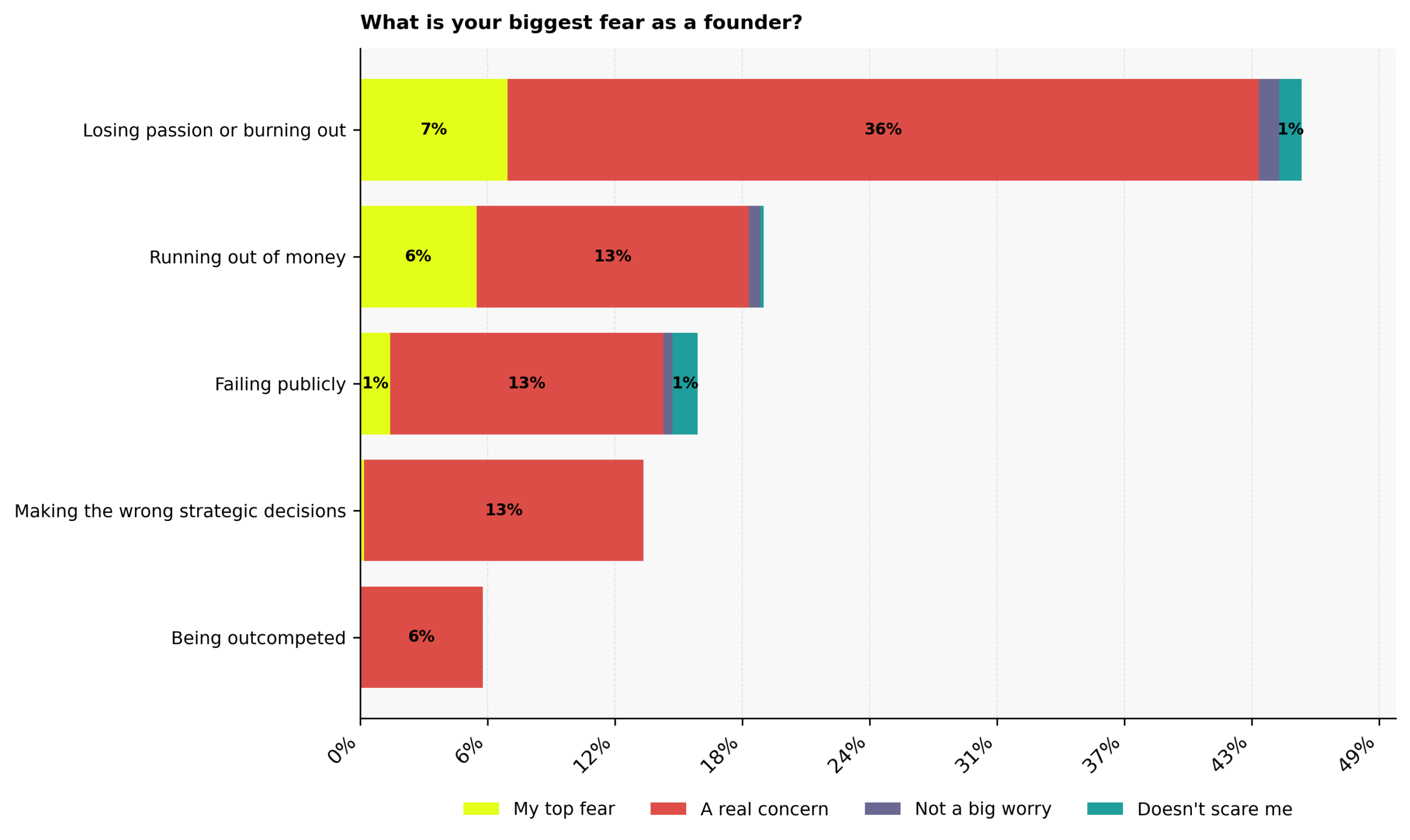
Founder entrepreneurs face numerous fears, but by far the biggest is losing passion or burning out. For 36%, this is a real concern. 7% say this issue is their top fear, and just 1% say this doesn’t scare them. Our audience is not alone. A Fortune study found that, for nearly 90% of founders, battling anxiety, burnout, depression, or all three is a real concern.
Running out of money is a real concern for 13% of our audience, with 6% saying it’s their top fear and fewer than 1% saying it’s not a big worry. Failing publicly is another big source of anxiety for founder entrepreneurs, with this being a real concern for 13%, a top fear for 1%, and another 1% saying it doesn’t scare them.
13% of founder entrepreneurs are worried about making the wrong strategic decisions, with fewer than 1% having this as a top fear, and 6%’s real concern is being outcompeted.
These numbers show that founder entrepreneurs are under heavy personal and financial pressure as they try to grow their businesses in highly competitive markets.
How do founder entrepreneurs protect their mental health and avoid burnout?
74% of founder entrepreneurs struggle with mental health and haven’t found a solution, 17% use therapy, coaching, or peer support to avoid burnout, 7% rely on regular exercise and physical wellness routines, and 2% maintain strict boundaries around work hours
The struggle to avoid burnout is clear:
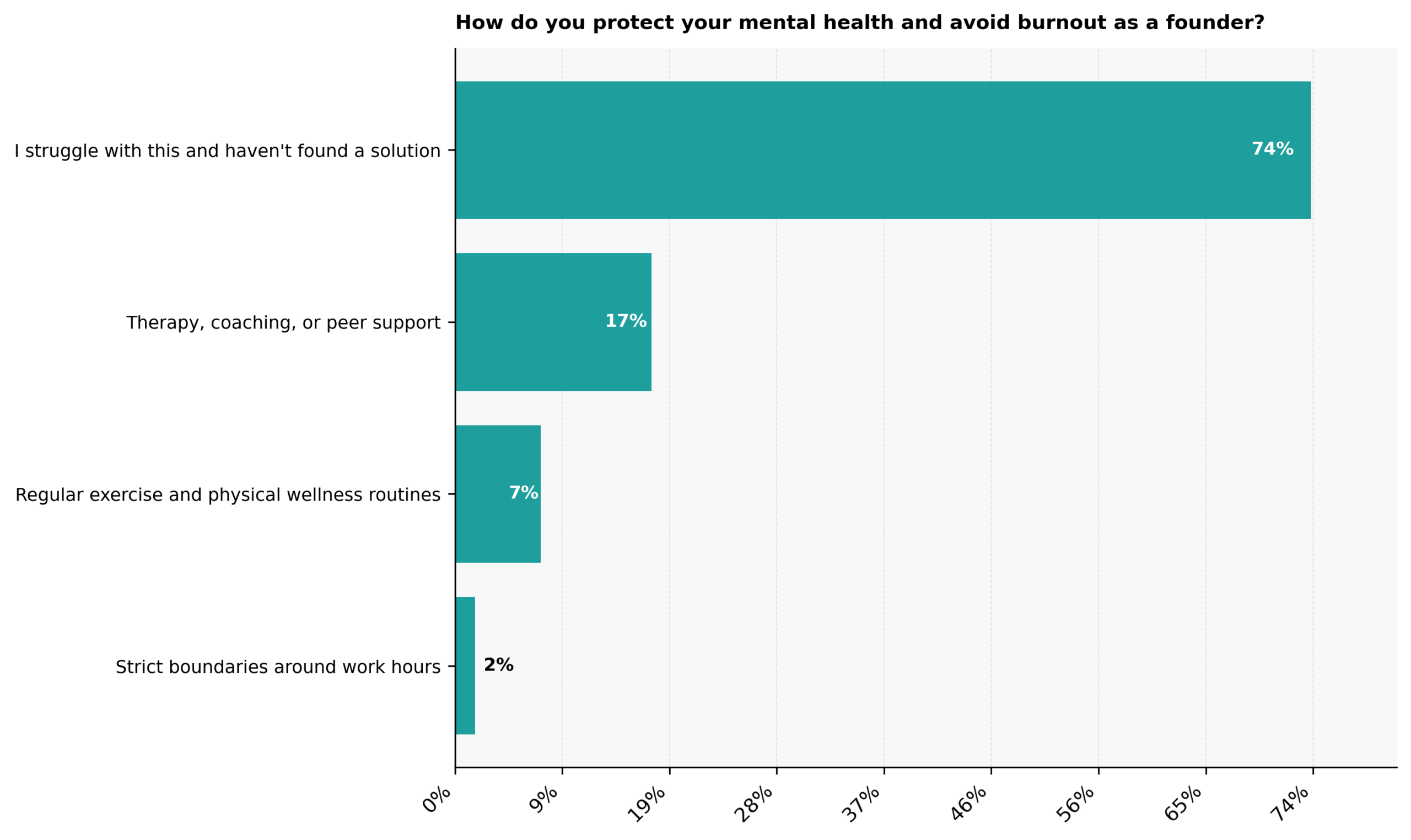
According to a Gallup workplace study, burnout is a serious issue that, amongst other issues, causes a 23% drop in productivity. For our audience, it’s a major concern, too. 74% of founder entrepreneurs are struggling with burnout and have yet to find a solution, while 17 rely on therapy, coaching, or peer support to manage it. Regular exercise and physical wellness routines are the answer for 7% and 2% set strict boundaries around their work hours.
The fact that the majority have yet to find a coping mechanism points to a bigger problem that could have lasting repercussions for those who push themselves too hard.
How do founder entrepreneurs approach personal development?
71% of founder entrepreneurs have female coaching or mentorship to help them with personal development, 7% use online courses and programs, 1% podcasts, books, and self-study, and another 1% mastermind groups or peer communities, yet 21% don’t have a structured approach
Not everyone is focusing on personal development:
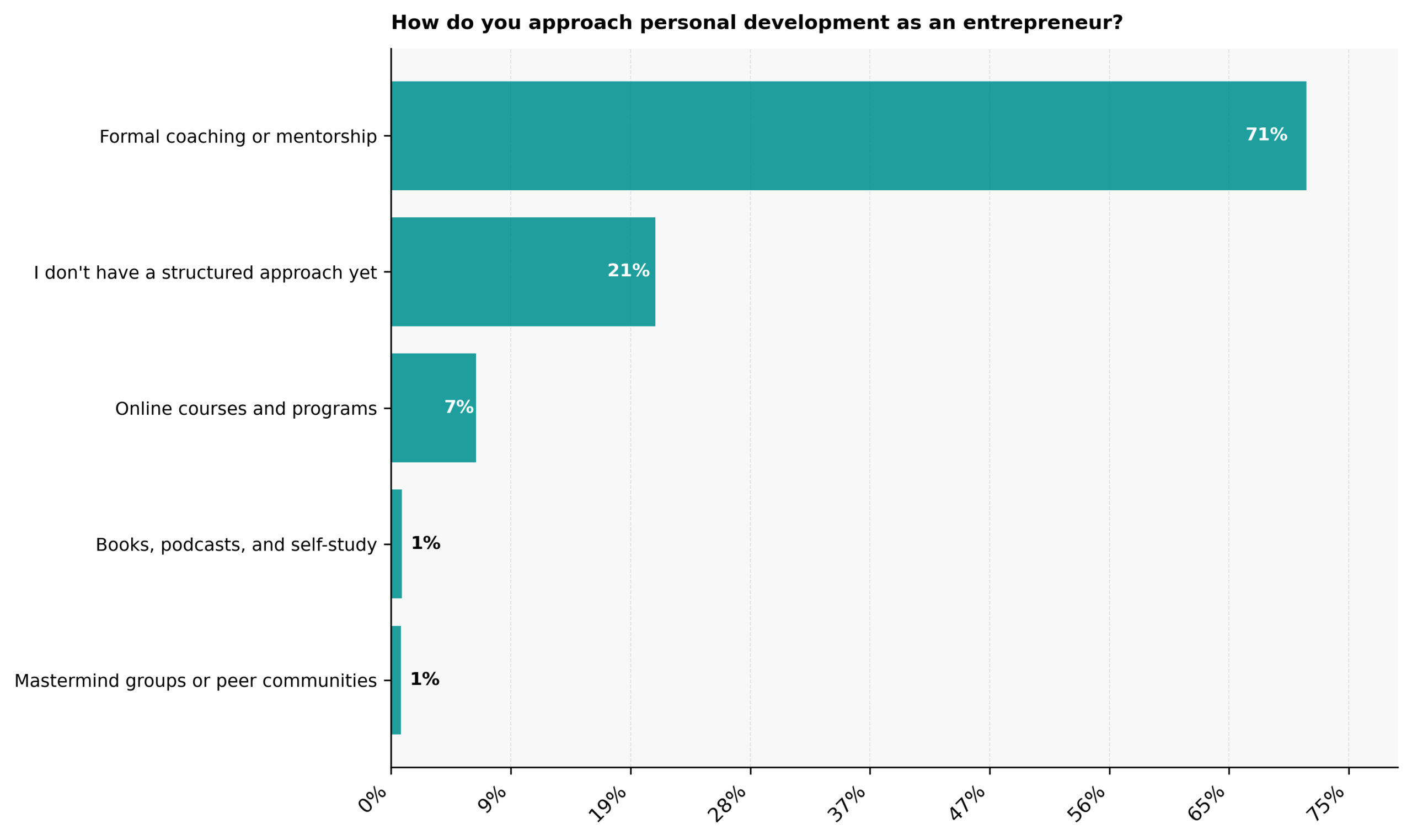
Personal development is as important as business development, as a business will struggle to grow if the owner stagnates. 71% of our audience approaches personal development as an entrepreneur via formal coaching or mentorship, and 21% don’t have a structured approach yet. 7% rely on online courses and programs, 1% on books, podcasts, and self-study, and 1% depend on mastermind groups or peer communities.
SBA research has shown that small businesses that receive early mentoring during their development stage generate higher revenue and more business, indicating that most founder entrepreneurs are making good decisions regarding strategic guidance in the foundation phase.
What mindset shift had the biggest impact on founder entrepreneurs’ success?
Thinking bigger and setting bolder goals had the biggest impact on 34% of founder entrepreneurs’ success, 22% benefitted by letting go of perfectionism, 23% from embracing failure as learning, and 17% form investing in themselves and their personal development
Mindshifts play a major role in creating success:
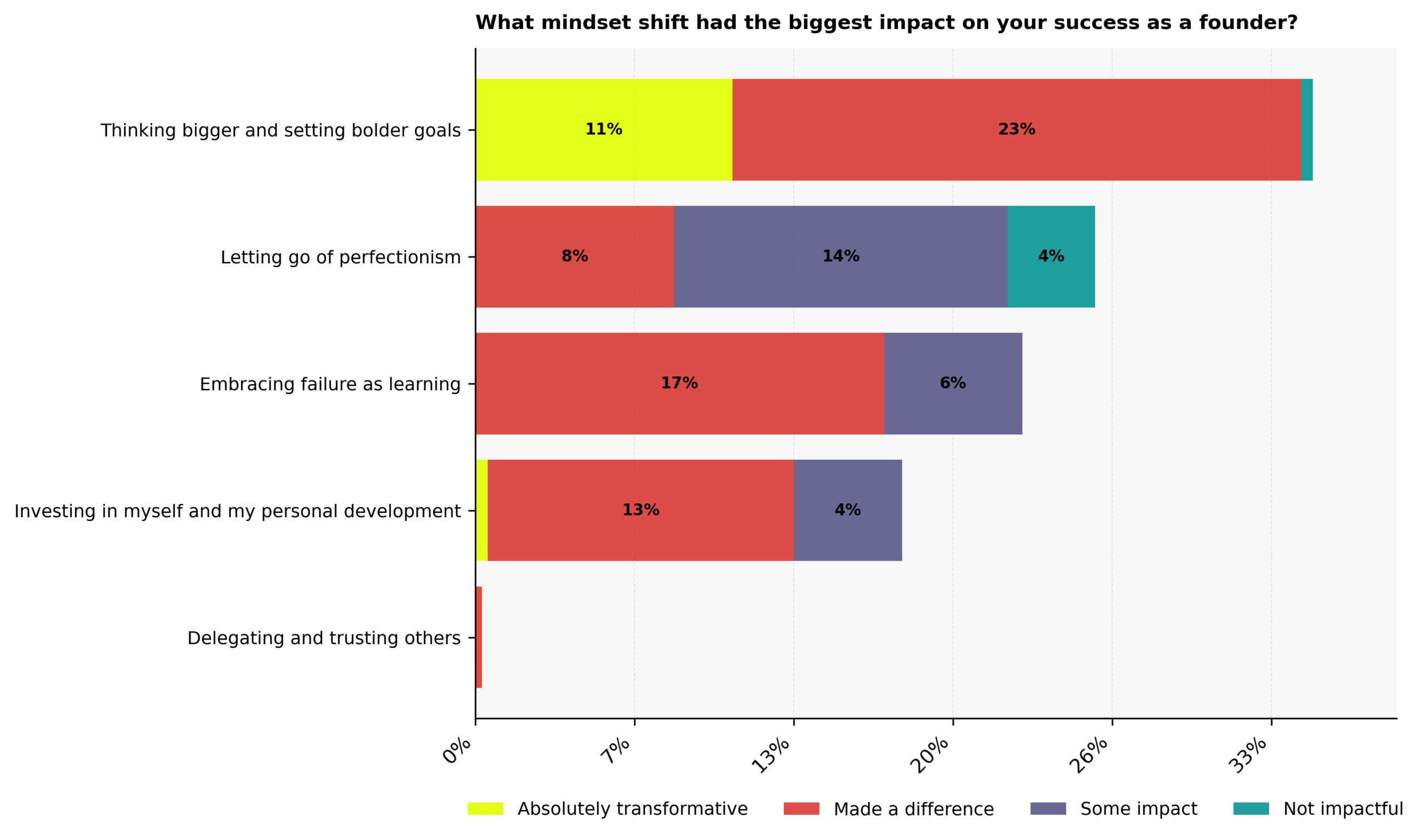
We saw above how founder entrepreneurs approach personal development, and here, we see how this can play an integral role in their success. Thinking bigger and setting bolder goals made a difference for 23% of our audience, while 11% stated that this mindset shift had an absolutely transformative effect on their success as a founder.
14% cited letting go of perfection as having some impact, 8% said it made a difference, and 4% found that it was not impactful.
Embracing failure as learning made a difference to 17%, while this made some impact for 6%. 13% invested in themselves and their own personal development, with 4% stating that this choice had some impact.
Delegating and trusting others made a difference for less than 1%, putting the focus firmly on personal mindset and self-development rather than team management as the primary drivers of success.
What does success look like for founder entrepreneurs in the next 3–5 years?
52% of founder entrepreneurs’ ultimate goal is to create a brand or lasting legacy in the next 3-5 years, and 22% say this is a strong priority; however, this isn’t the main focus for 15%, and it’s not important to 9%, while just 1% view building a team and stepping back from daily operations as their ultimate goal
Success looks similar for a lot of founder entrepreneurs:
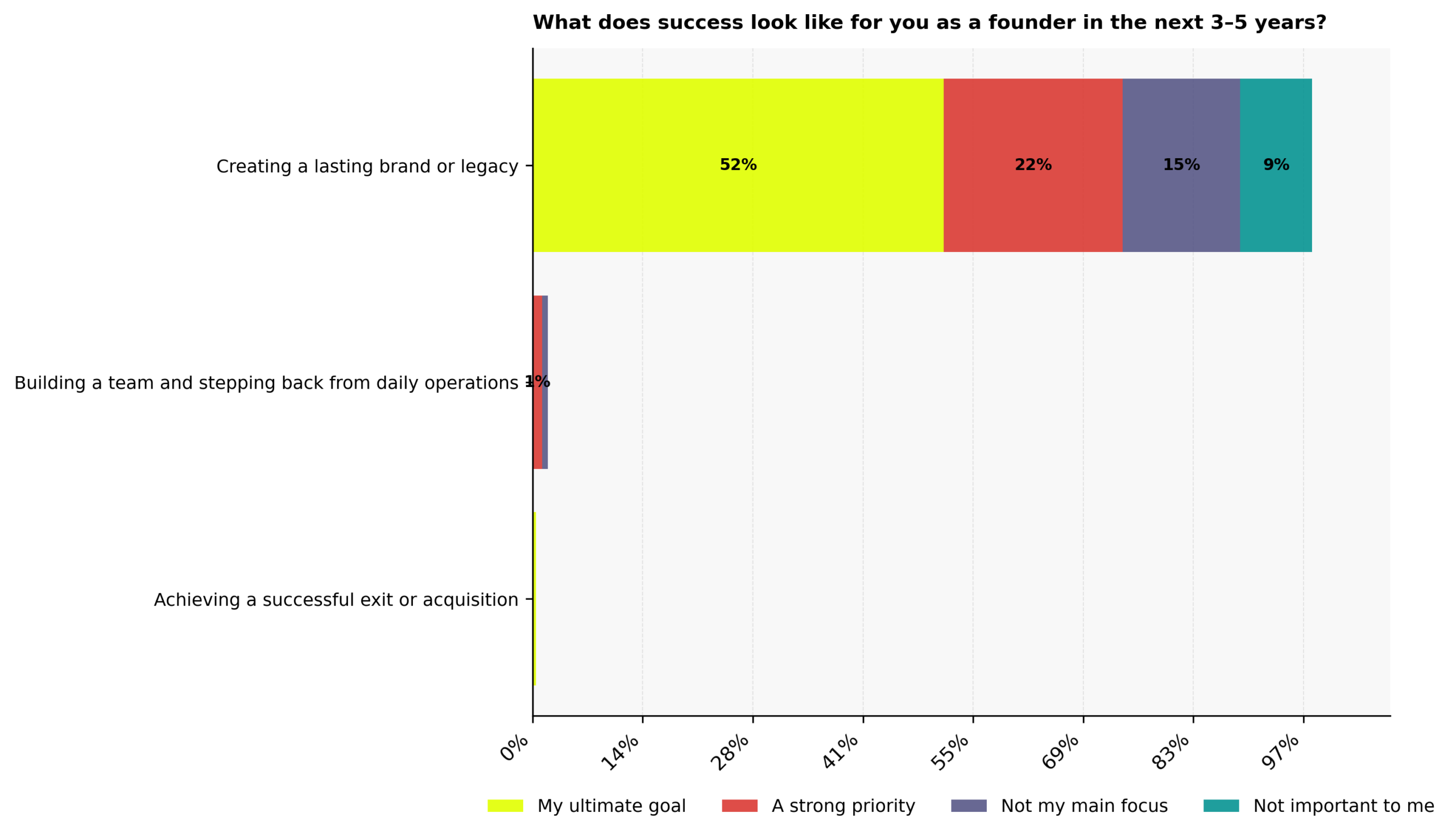
In terms of what success looks like as a founder in the next three to five years, 52% want to create a lasting brand or legacy, 22% call this a strong priority, 15% say it’s not their main focus, and 9% don’t feel it’s important.
1% have building a team and stepping back from daily operations as a strong priority, while less than 1% say this is not their main focus.
Less than 1% of our audience considers achieving a successful exit or acquisition as their ultimate goal, suggesting that most founder entrepreneurs are focused on building long-term businesses rather than selling their startups quickly and making a profit. It seems that greater value is being placed on ownership, impact over the long-term, and making something meaningful rather than chasing quick exits or stepping away entirely.
How likely are founder entrepreneurs to recommend entrepreneurship as a career path?
85% of founder entrepreneurs probably wouldn’t recommend entrepreneurship as a career path, as the risks mostly outweigh the rewards, and 3% definitely wouldn’t, but 4% disagree, saying it’s the only way to live, 4% would recommend this path but with the right preparation, and 4% are neutral about it, as it depends heavily on the person
Entrepreneurship certainly isn’t recommended by everyone:
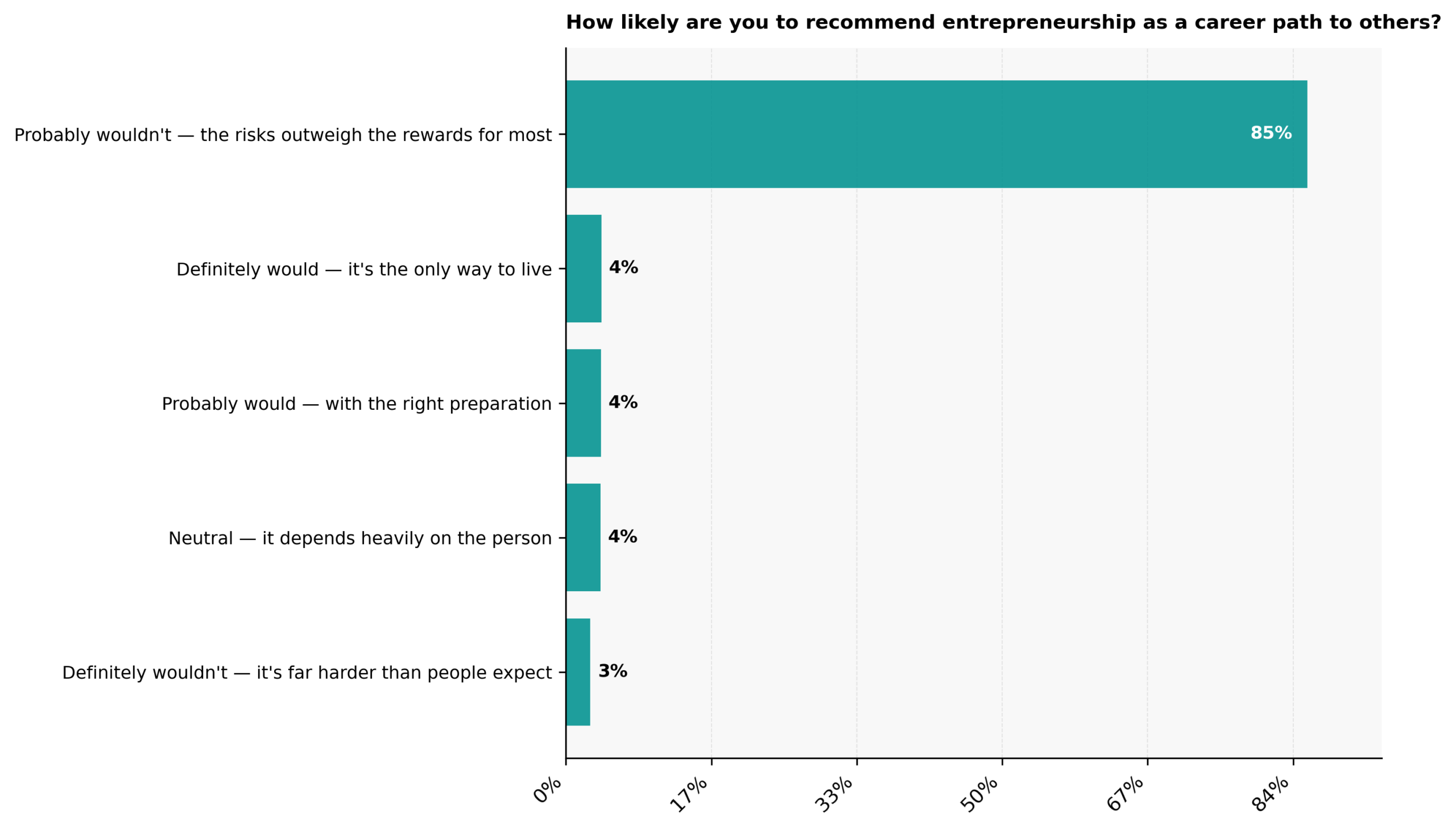
There’s no denying that entrepreneurship is not for everyone, or that it’s easy. This is evident once again in the whopping 85% of founder entrepreneurs who probably wouldn’t recommend this as a career path to others because the risks outweigh the rewards, but 4% push back on that, saying not only that they would recommend it but that it’s the only way to live.
Another 4% say that they probably would as long as the right preparations are in place, and yet another 4% remain neutral about it, explaining that it relies heavily on the person. 3% definitely wouldn’t because entrepreneurship is far harder than people expect, with studies revealing that as many as 19% return permanently to paid employment after their experiments with it.
Which areas of business are founder entrepreneurs using AI tools?
AI is most used by 25% of founder entrepreneurs for content creation and marketing. 10% are using it in operations, workflows, and productivity, 2% for financial analysis and forecasting, 1% for sales prospecting and CRM, and 1% for customer service and automation; however, 56% are not currently using AI in their business despite its recognized potential
AI tool use is varied or not yet implemented:
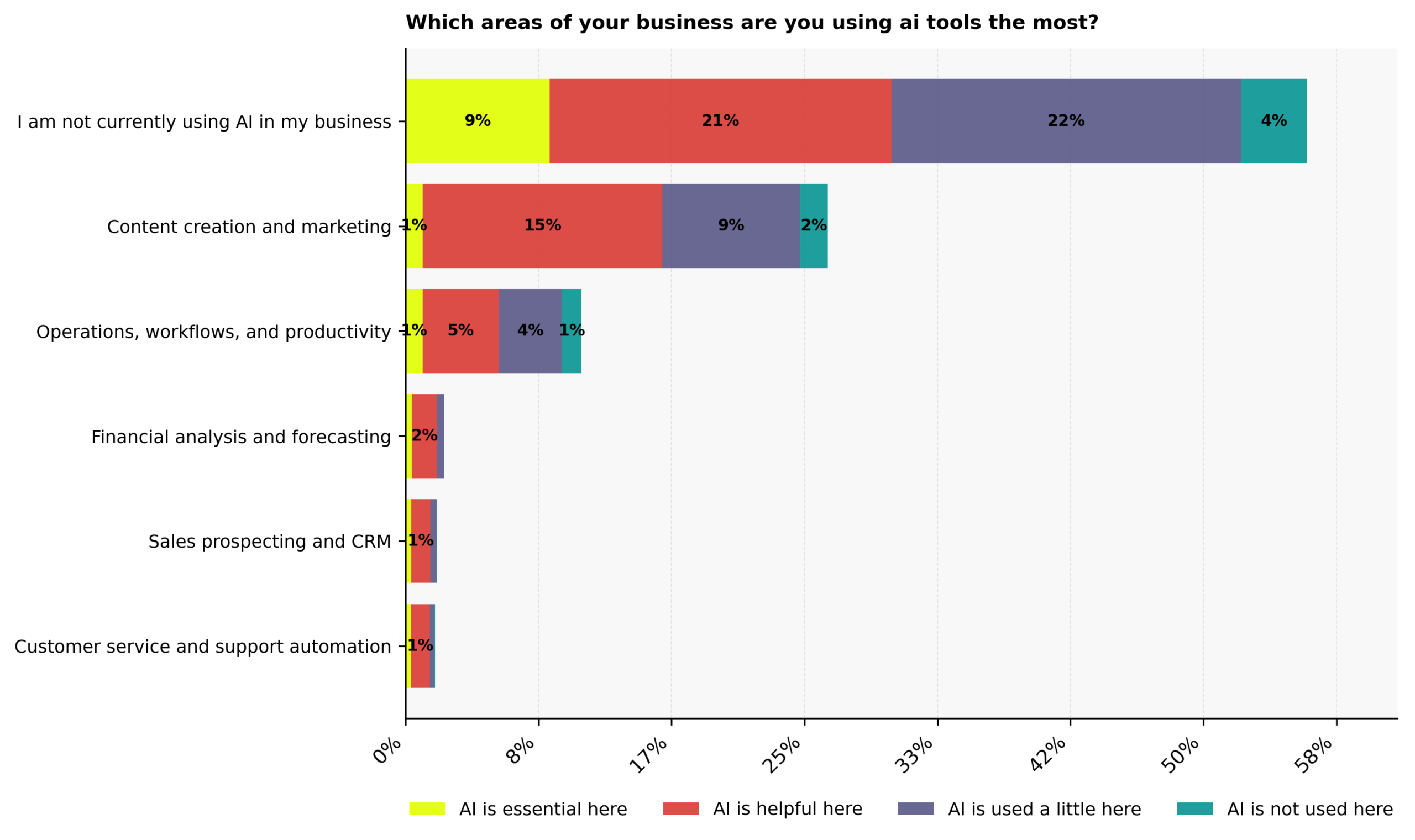
According to the US Chamber of Commerce, 58% of small businesses are using generative AI. This is a 40% increase from 2024, and it is more than twice as high as in 2023. Yet for our audience, not everyone is embracing the potential. While AI is seen as essential in their business, 9% of founder entrepreneurs are not currently using it, while it’s helpful for 21%, it’s still not in use, and for 22%, AI is only used a little but not for operational purposes, and 4% are not using it at all.
Conversely, 1% say AI use is essential for content creation and marketing, while 15% find it helpful in this area, and 4% use it a little for assistance, and just 2% don’t use it. Next are those who are using AI for operations, workflows, and productivity. 1% cite it as essential, 5% as helpful, 4% as a tool they use a little, and 1% as not something they use in this area.
On the lower side are the 2% who find AI helpful for financial analysis and forecasting, 1% who feel the same about AI for sales prospecting and customer relationship management (CRM), and the remaining 1% who find this technology helpful for customer service and support automation. As yet, AI is not being put to use across the board, and many entrepreneurs are missing out on the potential it offers across their businesses.
How are founder entrepreneurs using AI tools in their business?
38% of founder entrepreneurs are actively using AI tools across multiple areas of their business, and 9% are using it for specific tasks like content, admin, or customer service; yet 41% are not using AI, nor are they planning on it, 7% are still experimenting, and 4% are aware of it but have yet to implement it in any way
Not everyone is planning on adopting AI into their business:
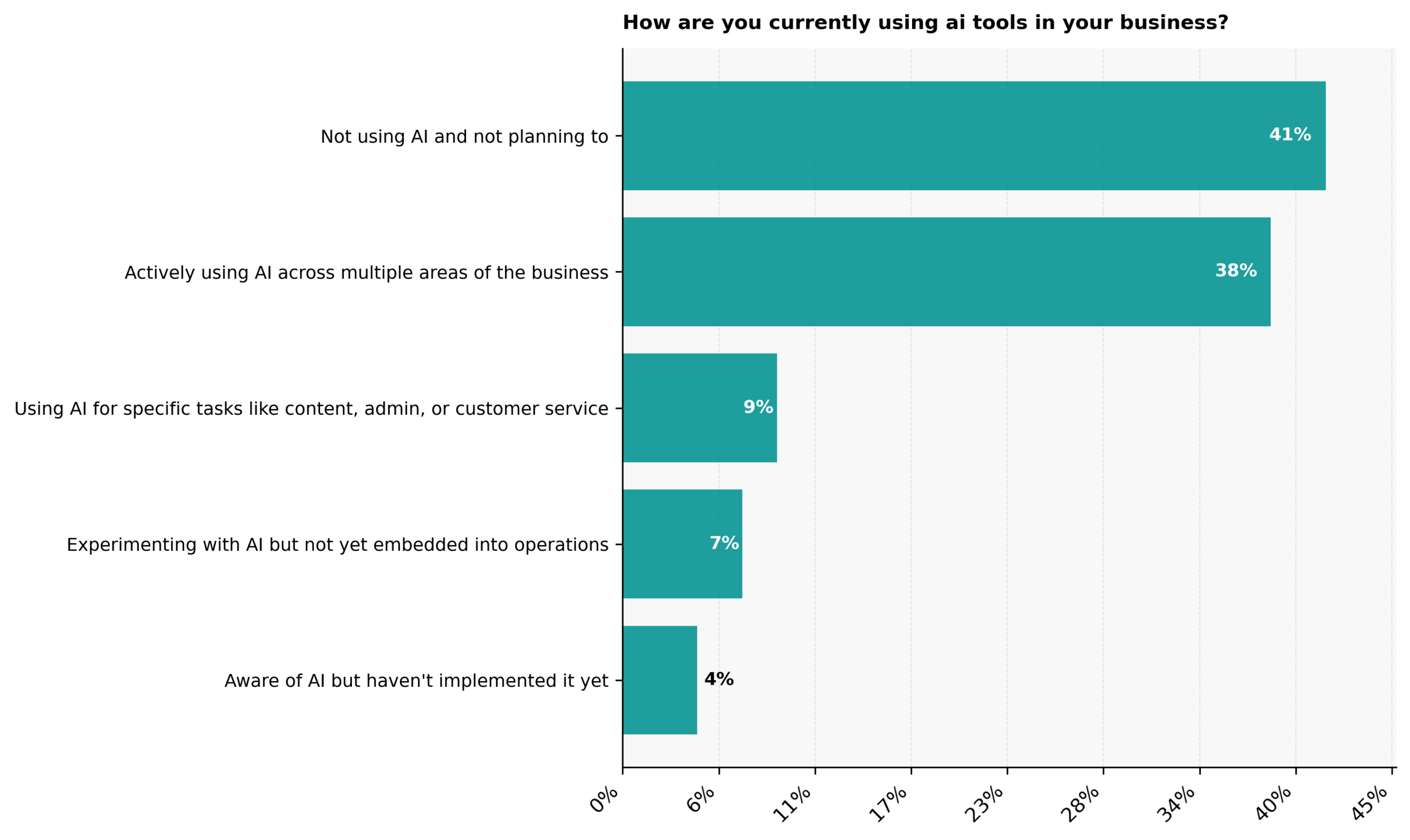
Although a Forbes AI in Business study stated that 46% of business owners use AI to craft internal communications, 41% of our audience not only does not use AI, but has no plans to either. This correlates with the figures we saw above.
38% of founder entrepreneurs are actively using AI across multiple areas of their business, and 9% use it for specific tasks like content, admin, or customer service. 7% are experimenting with AI but haven’t yet embedded it into operations, and 4% are aware of AI but haven’t implemented it.
The current situation is that founder entrepreneurs are still divided on AI. While many businesses are already using it to save time and improve productivity, a large group remains cautious and has not fully integrated AI into daily operations.
What competitive advantage do founder entrepreneurs believe AI gives their business?
79% of founder entrepreneurs believe AI gives their business a moderate advantage right now. 11% feel they gain a significant advantage, and 5% are still figuring out where it adds value, while 3% haven’t seen any meaningful results yet, and 2% are not sure yet if AI is giving them an advantage
AI is still a sticking point:
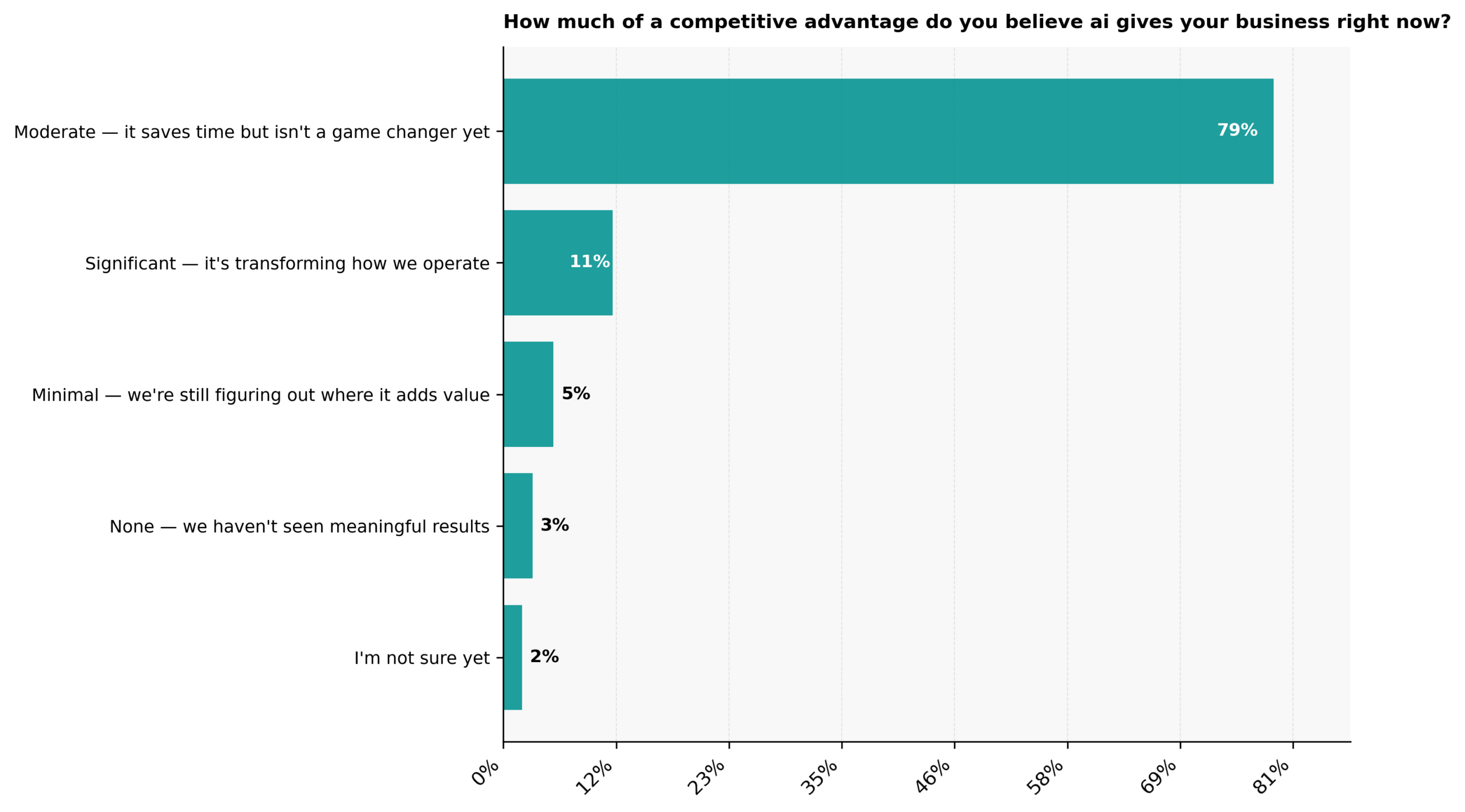
We’ve seen how not everyone is keen on adopting AI, nor is everyone utilizing tools within their business. So, it is understandable that while 79% of founder entrepreneurs believe that AI gives their business a moderate advantage, they also believe that while it saves time, it isn’t a game-changer yet. A far smaller percentage (11%) says that it’s transforming how they operate. However; 5% say that it’s a minimal advantage and that they’re still figuring out where it adds value, and 3% have not seen any meaningful results. 2% are not sure yet.
These figures closely match wider business trends. Research from LegalZoom found that 69% of business owners believe AI gives them at least a moderate competitive advantage, suggesting many founders are seeing practical day-to-day benefits from AI tools even if they are still early in the adoption process.
What are founder entrepreneurs’ biggest concerns about adopting AI?
42% of founder entrepreneurs’ biggest concern about adopting AI in their business is not knowing where to start or which tools to use, while 20% are concerned about difficulty integrating with existing systems, 17% about data privacy and security risks, and 13% about the cost of implementation; fewer than 1% are concerned about AI replacing human jobs and team morale
Concerns about adopting AI are myriad:
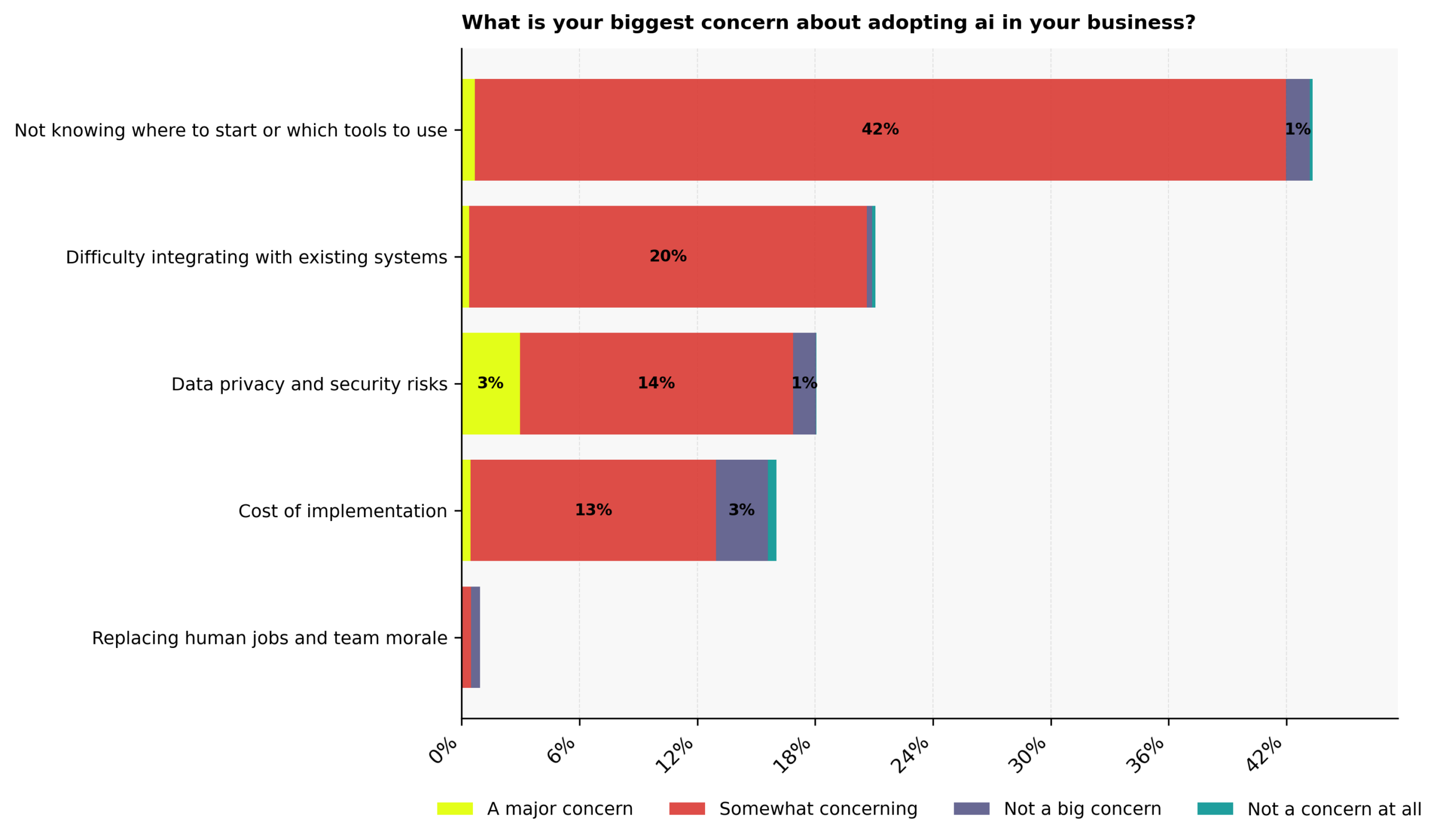
When looking at founder entrepreneurs’ biggest concerns about adopting AI into their businesses, it becomes clear why so few are currently utilizing this technology. Evidently, there is a large knowledge gap that hinders adoption, as not knowing where to start or which tools to use is a major concern for 42% of our audience. This large percentage is somewhat concerned about this, while just 1% revealing that it’s not a big concern.
Additionally, while fewer than 1% have difficulty integrating AI with existing systems, 20% find this aspect somewhat concerning. As integration can bring a business to a standstill, this is a critical gap.
Comparatively, data privacy and security risks are a major concern for 3%, somewhat concerning for 14%, and only 1% don’t view this as a big concern. This is likely due to data policy regulations and the fines that can be imposed for violating them. Lastly, replacing human jobs and team morale does not play a significant role, with less than 1% seeing this as either somewhat concerning or not a big concern.
How do founder entrepreneurs feel the US government currently supports them?
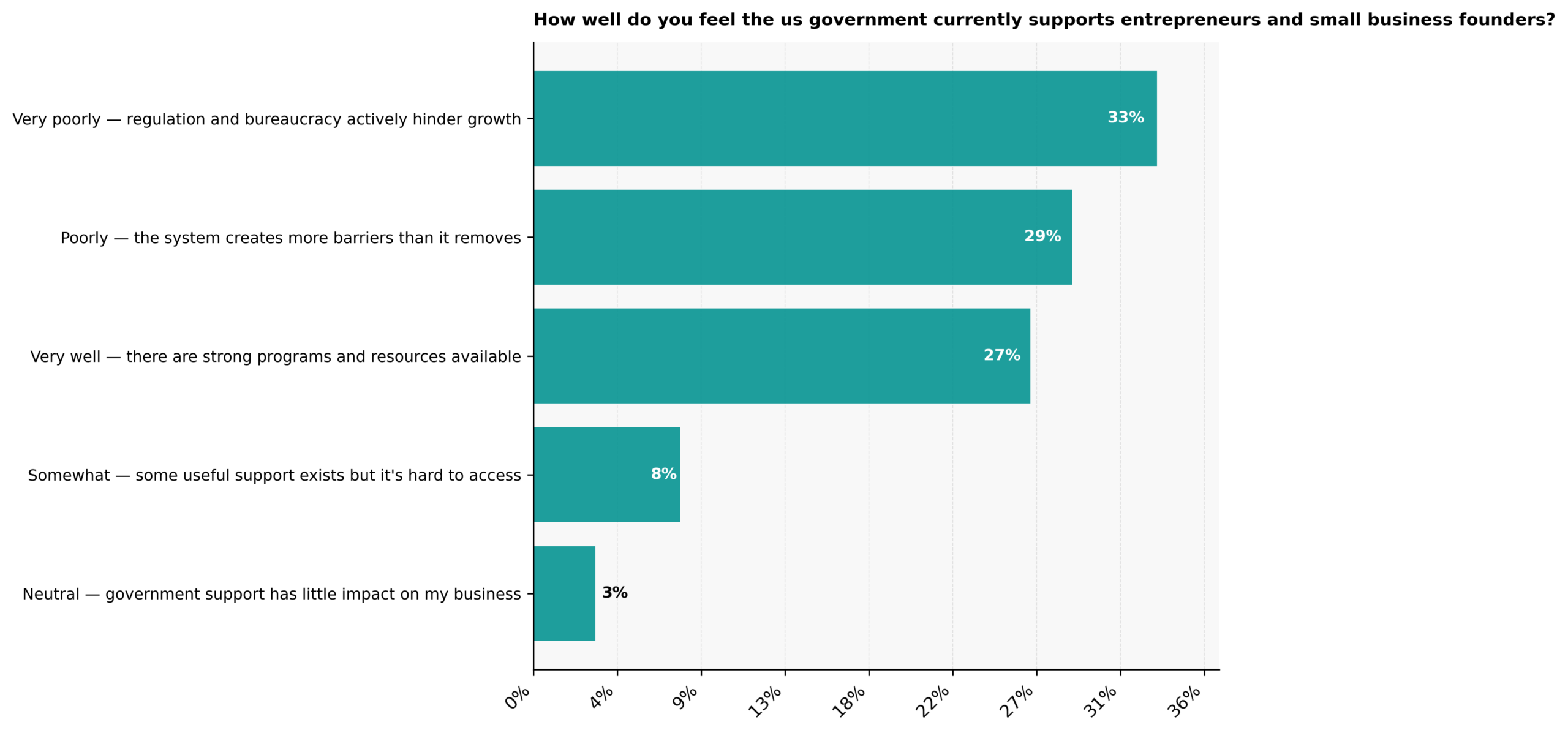
33% of founder entrepreneurs feel the US government currently offers entrepreneurs and small businesses very poor support, 29% feel the support is poor, and 3% have a neutral opinion, but 27% feel that the government supports them very well, and 8% agree they do so somewhat, but that the support is hard to access
Not everyone agrees about the availability of government support:
According to Startup Science, government agencies help startups by funding incubators, providing grants and loans, and supporting small-business growth programs in other ways. These resources help founders with money, training, mentorship, office space, and networking opportunities, and many programs are designed to help businesses not only grow faster but also survive the early stages of building a company.
Yet, only 27% of our audience feels they are very well supported by the government, and that there are strong programs and resources available. In contrast, 33% feel that government support is very poor, with regulation and bureaucracy actively hindering growth, and 29% feel that the support is poor, as the system creates more barriers than it removes.
8% are slightly more positive, saying the government somewhat supports them, but that while useful support is available, it remains difficult to access. Just 3% retain a neutral viewpoint as government support has very little impact on their businesses.
What government support would positively impact founder entrepreneurs’ businesses?
79% of founder entrepreneurs agree that better access to government contracts for small businesses would have the greatest positive impact on their businesses, 17% think that easier access to small business grants and low-interest loans would have the most impact, 2% want simplified tax structures and incentives for startups, and 1% agree that regulatory reform to reduce compliance burdens would be the most effective
Various areas of government support would make an impact:
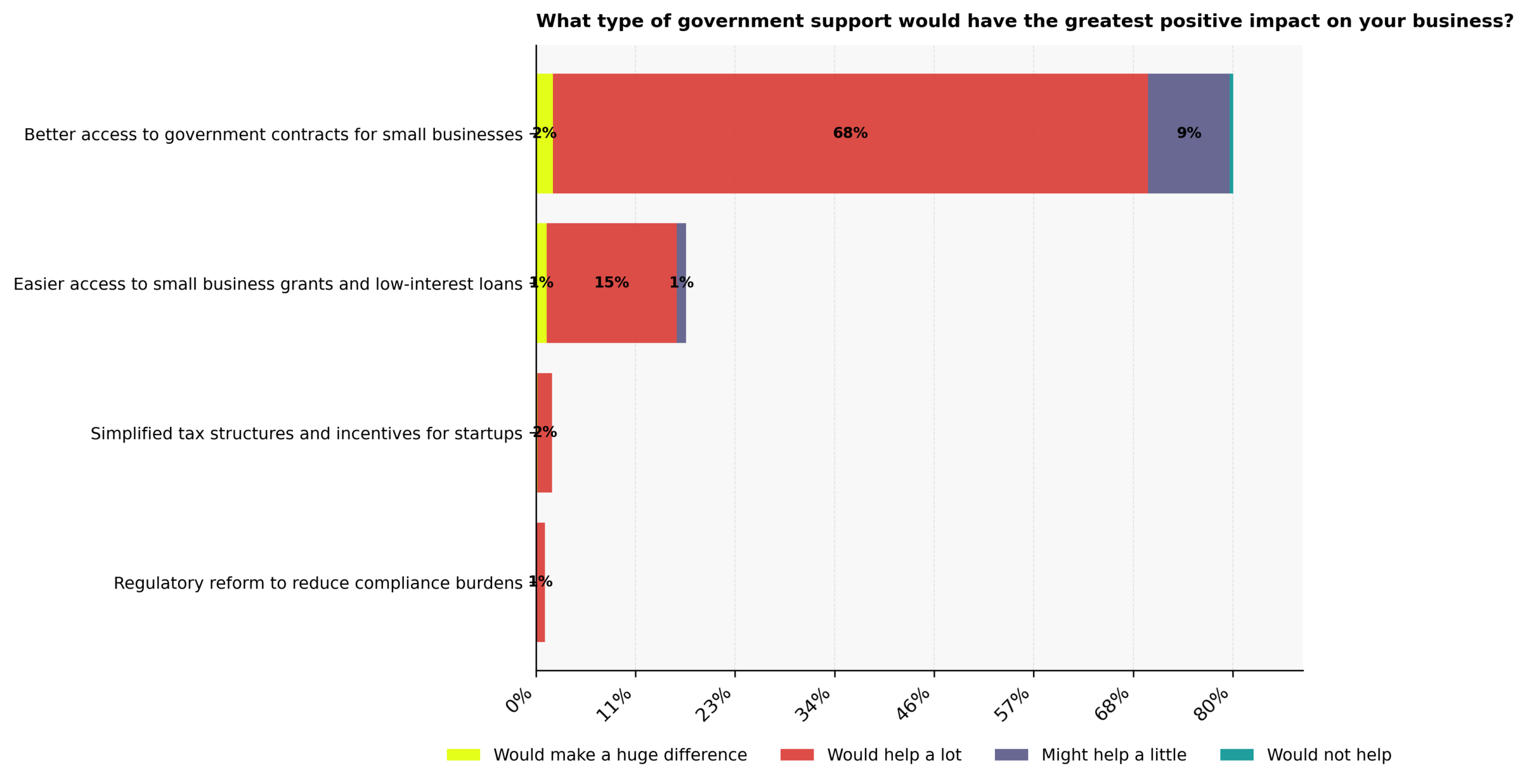
While not everyone agrees on how readily available and useful US government support is for entrepreneurs and small business founders, there are clear patterns in the type of support that would be most appreciated. According to 68% of our audience, better access to government contracts for small businesses would have the greatest positive impact on their businesses. A further 9% agree that this might help a little, and 2% say it would make a huge difference.
Easier access to small business grants and low-interest loans appeals to 1% who feel it would make a huge difference, 15% who say it would help a lot, and 1% state this might help a little.
Another 2% feel simplified tax structures and incentives for startups would help a lot, and 1% want regulatory reform to reduce the burdens of compliance.
It’s clear that founder entrepreneurs see government support as an important tool for growth, especially in terms of contracts and funding. This is in keeping with US federal policy, where usually more than 23% of spend on governmental contracting is typically reserved for the completion and expansion of small businesses.
Are there any advantages for founder entrepreneurs receiving grants or incentives?
Receiving grants or incentives benefited 6% of founder entrepreneurs and made a meaningful difference to their business, but 5% found the process too complex compared to the benefit received, and 15% relied on private funding and self-sufficiency instead, with a further 62% disagreeing with this but not benefitting from grants or incentives either
Grants or incentives are not always beneficial:
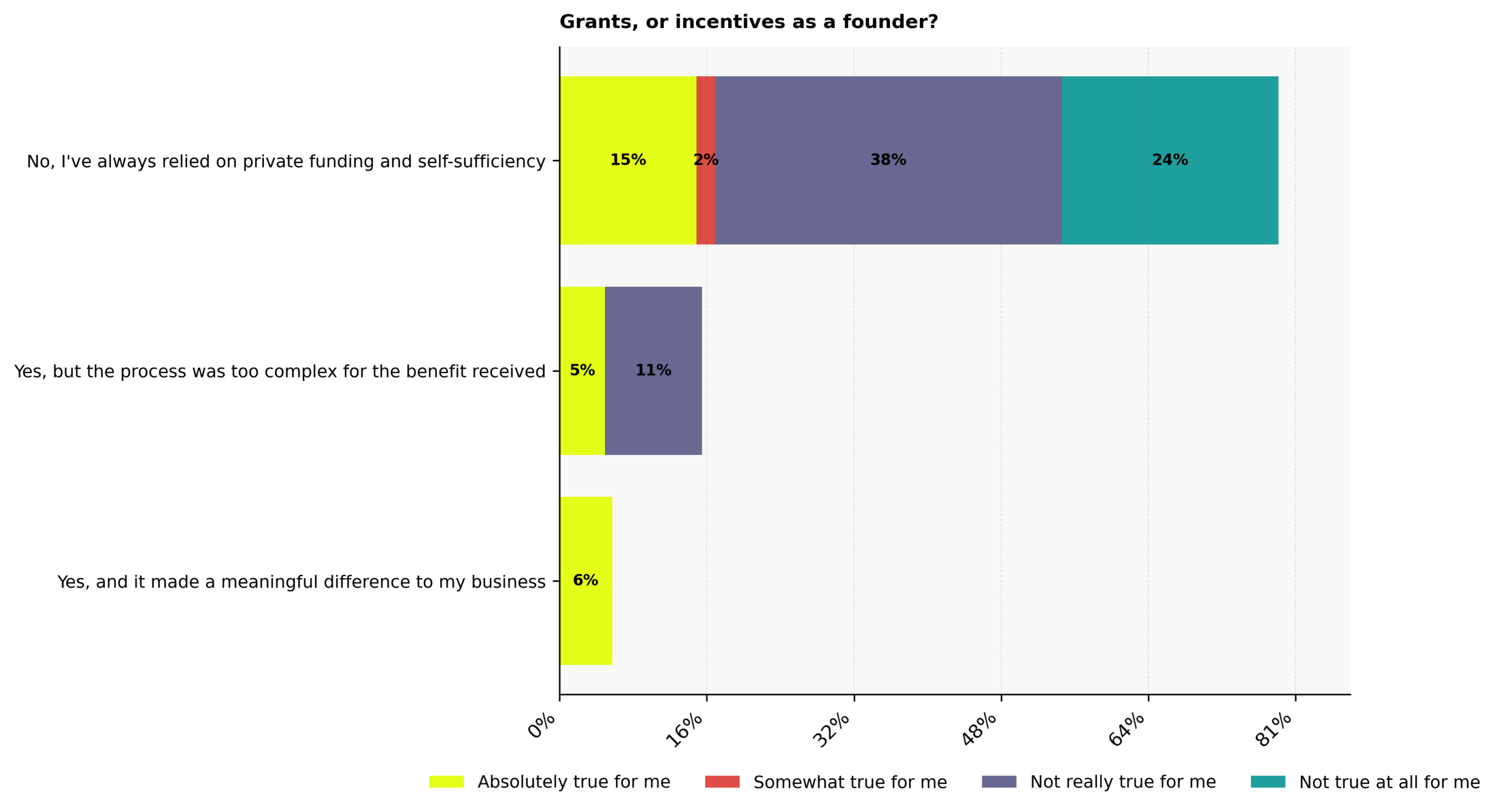
While we’ve seen that the availability of grants or funding isn’t always high or accessible and what type of support founder entrepreneurs would value most, now we’re seeing whether those who have received grants or incentives actually found them beneficial. The results are mixed, with far fewer benefiting than those who have taken care of their funding and support themselves.
Just 6% say that the grants or incentives they received made a meaningful difference to their business, compared to the 5% who said that while it was true that they received support, the process was too complex for the benefit received. A further 11% said this wasn’t really true for them, suggesting they benefited despite overly complicated processes.
On the other hand are the 79% majority who are split into 2% who’ve generally always relied on private funding and self-sufficiency, the 15% who have always done so, followed by the largest number (38%) who say this is not really true for them, and the remaining 24% who agree it’s not true at all. This indicates that this group is split between entrepreneurs who have deliberately built their businesses without relying on grants or incentives and those for whom external funding support has simply never played a significant role.
What type of content or resources are most valuable to founder entrepreneurs?
Mindset and peak performance strategies are the most valuable type of content or resource for 42% of founder entrepreneurs, networking and community access is most valuable for 20%, expert coaching and accountability are best for 17%, founder stories and case studies for 6%, and 2% agree that practical playbooks and step-by-step resources are the most valuable
Valuable resources differ:
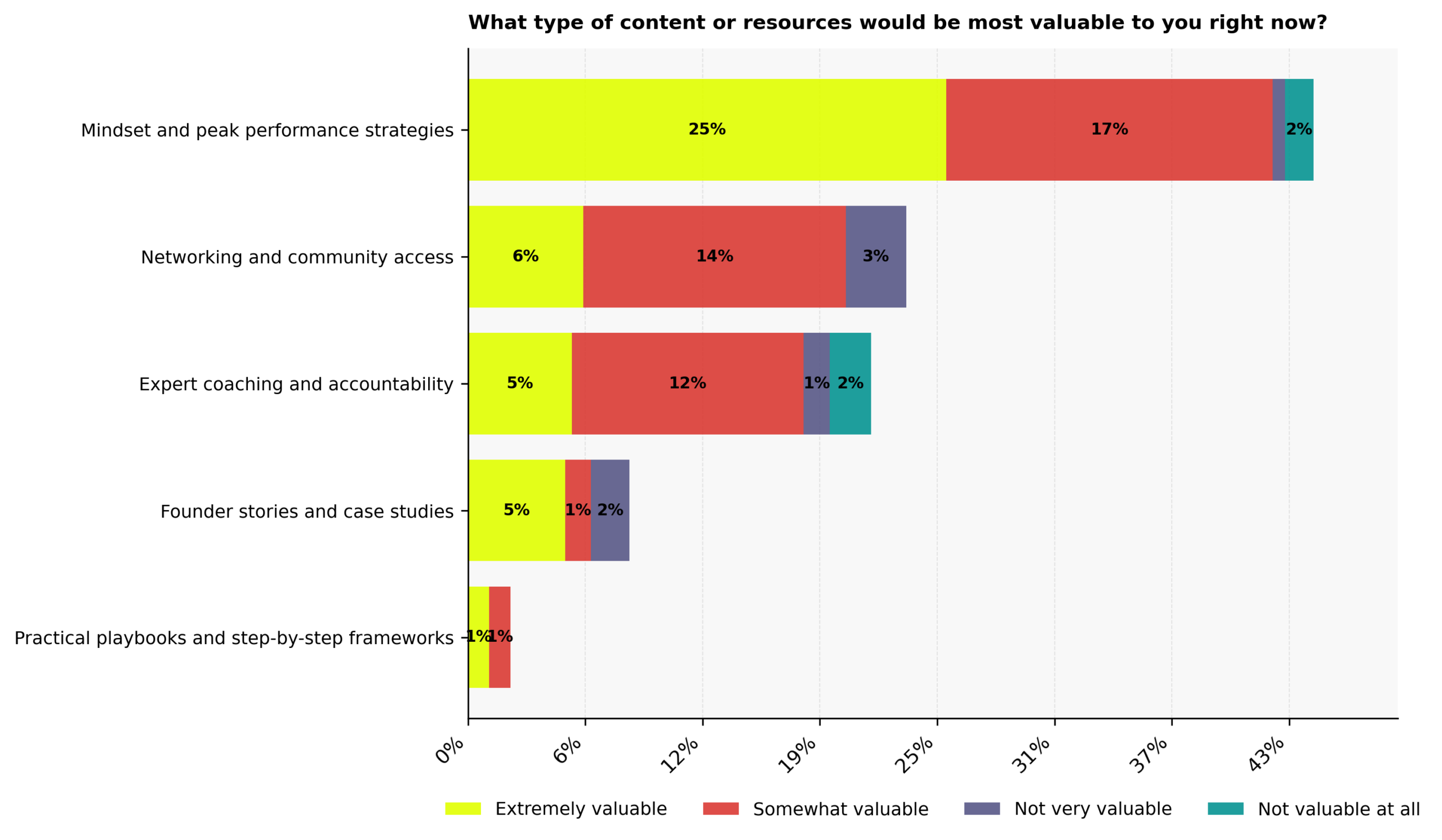
Having content or resources that can help to build, grow, or streamline a business is crucial for startups. But not everyone values the same options, as every business is different. For our audience, 29% name mindset and peak performance strategies as the type of content or resources that would be most valuable to them right now, with 25% agreeing that this would be extremely valuable, and only 2% seeing this as not valuable at all.
Another 14% feel that networking and community access would be somewhat valuable, 6% that it would be extremely valuable, and only 3% that it would not be very valuable. Expect coaching and accountability are next on the list, with 12% viewing this resource as somewhat valuable, 5% as extremely valuable, and just 2% not very valuable.
For the minority, founder stories and case studies would be extremely valuable to 5%, somewhat valuable to 1%, and not very valuable to 2%. A further 1% feel that practical playbooks and step-by-step frameworks would do the trick, revealing that it would be extremely valuable, and 2% agree here, citing that it would be somewhat valuable.
These statistics point to founder entrepreneurs who place the greatest value on resources that support personal growth and performance, rather than tactical business guides.
Key takeaways on the challenges, opportunities, and realities of entrepreneurship
Overall, our findings reveal that entrepreneurship in the United States is driven by far more than financial rewards. It’s obvious that founder entrepreneurs are pursuing long-term impact, personal growth, and the opportunity to build something meaningful, even while facing significant challenges along the way. From leadership and team-building struggles to concerns around burnout, profitability, and scaling, the entrepreneurial journey remains demanding and complex.
At the same time, founders are embracing new opportunities through AI, strategic partnerships, and ongoing personal development. The results also reinforce the importance of mindset, resilience, and access to the right support systems in achieving sustainable success.
Ultimately, entrepreneurship continues to attract those who are ambitious and willing to navigate uncertainty in pursuit of creating lasting value, independence, and a legacy that extends beyond the business.
About the Data
Sourced using Artios from an independent sample of 1,901,057 opinions of founder entrepreneurs in the USA across X, Quora, Reddit, Bluesky, TikTok, and Threads. Responses are collected within a 95% confidence interval and 5% margin of error. Results are derived from what people describe online, from opinions expressed online, not actual questions answered by people in the sample.