Entrepreneurship keynote speeches are a powerful way for business leaders to gain fresh perspectives, challenge their thinking, and discover ideas they can apply to their own organizations. But as expectations evolve, so too do the qualities that define a memorable and valuable keynote.
To find out what 413,159 opinions of business leaders in the US were about entrepreneur keynote speeches, we utilized AI-driven audience profiling to synthesize insights from online discussions over 12 months, ending on July 6th, 2026, to a high statistical confidence level. Our results reveal how business leaders discover speeches, what topics resonate most, and which qualities make speakers stand out.
Sourced using Artios from an independent sample of 413,159 opinions of business leaders in the USA across X, Quora, Reddit, Bluesky, TikTok, and Threads. Responses are collected within a 95% confidence interval and 5% margin of error. Results are derived from what people describe online, from opinions expressed, and not actual questions answered by people in the sample.
41% of business leaders now prefer AI summaries over full talks, and 6% use AI to find speeches to attend; however, AI has had no real change on how 41% find entrepreneurship keynote speeches, and 12% avoid AI-curated content
AI is making inroads:

Studies by McKinsey reveal that 50% of consumers already use AI-powered search, and 50% of Google searches already have AI summaries. Understandably, then, business leaders are also using AI when looking for entrepreneurship keynote speeches. Nearly half (47%) of our audience relies on AI, either to discover valuable speeches or to summarize them and provide convenient key takeaways in a time-efficient way.
These figures are broken down further into 6% who regularly use AI to find speeches they would like to attend, while 41% prefer reading through AI summaries rather than dedicating time to complete talks.
However, for an equal 41%, AI hasn’t notably changed how they find keynote speeches, and 12% avoid AI-curated content entirely. As AI search continues to grow, these behaviors are likely to evolve, with more business leaders expected to use AI as a starting point for discovering and evaluating keynote content.
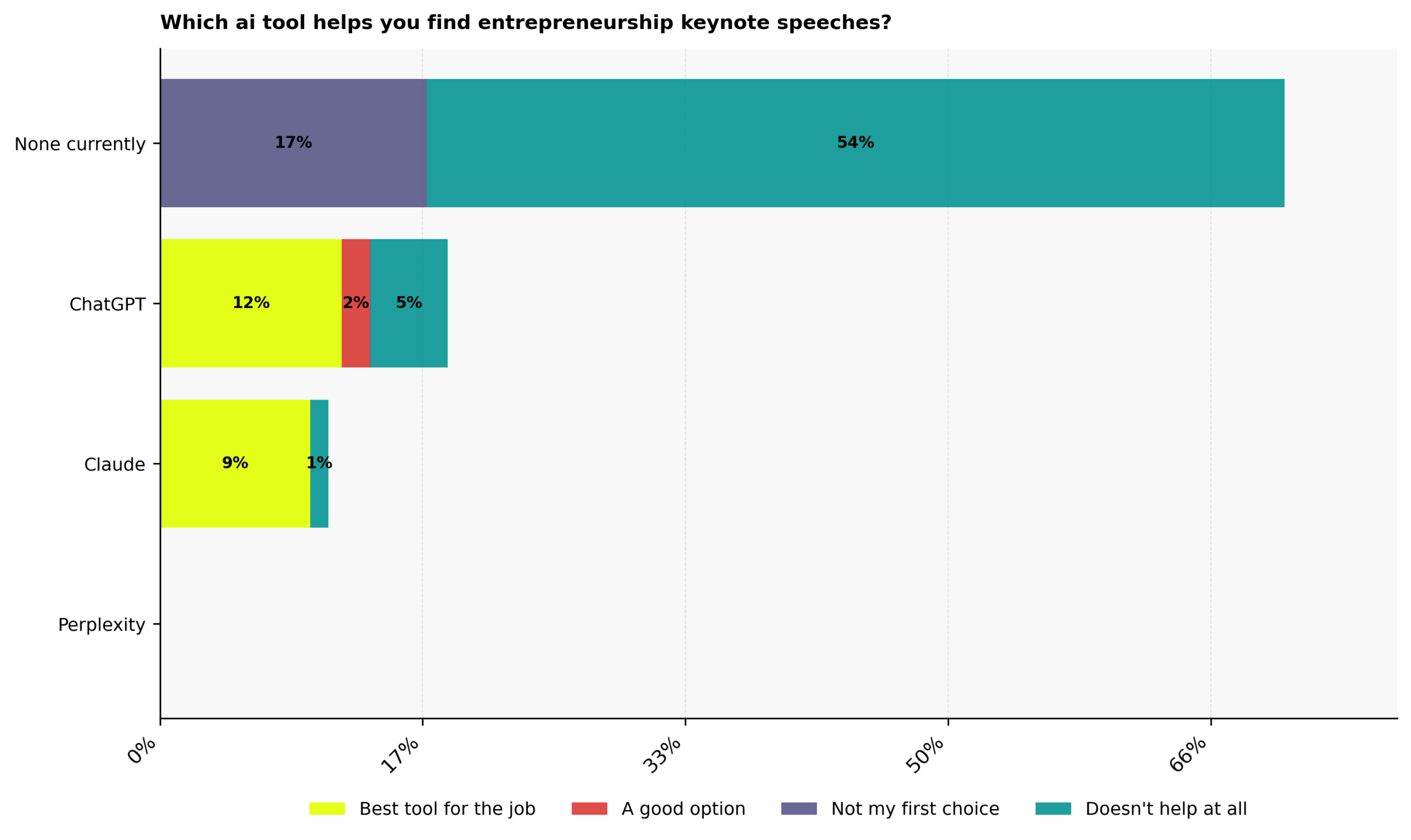
For 12% of business leaders. ChatGPT is the best tool for finding entrepreneurship keynote speeches, 2% agree it's a good option, but it doesn’t help 5% at all; while Claude is the best tool for 9%, it doesn’t help 1% in their search, and 71% of leaders are currently not using any AI tools in their quest for speeches
AI adoption is slow but steady:
Pew Research data shows that, as of 2025, around 34% of adults in the United States (and 58% of adults under 30) have used ChatGPT. This is roughly double the number of adults who used the platform in 2023.
When it comes to business leaders specifically, these professionals are using AI tools for far more than just simplifying their workflows. Some also use these tools to find entrepreneurship keynote speeches that are highly relevant to their interests, projects, and visions.
ChatGPT is the most widely chosen tool in 2026. 12% of our audience feels that ChatGPT is ideal for finding keynote speeches to attend, and another 2% consider it a good option, while only 5% deem it unhelpful for this task. Second on the list is Claude, which 9% feel is the best tool for the job, and only 1% believe is not helpful at all.
The remaining 72% don’t currently use any AI tools to help them identify value-adding entrepreneurship keynote speeches. Of this group, AI would not be the first choice for finding such speeches for 17%, and a significant 54% did not believe AI tools would be at all helpful for doing so.
While Perplexity, an American-based AI platform, is also listed, none of our audience are currently using it, nor have they shared any opinions on its applications for keynote speech identification.
3% of business leaders absolutely occasionally use AI to research entrepreneurship keynote speech topics, 19% would consider doing so occasionally, and 11% say this isn’t their usual approach, while 2% absolutely use AI for research regularly, 12% consider doing so, and it’s not the usual approach for 16%, and not at all for 2%, 4% don’t use AI yet but are open to it, yet 29% are not interested in doing so
AI research is not yet the norm:

With the US Chamber of Commerce finding that 58% of small businesses use generative AI in some capacity and 96% of small business owners planning to adopt new technologies, the impacts of artificial intelligence are clear. The number of small businesses using AI has grown by 40% since 2024, as well, showing an adoption rate that has more than doubled from 2023.
Among our audience of business leaders, just over 33% use AI to do due diligence on entrepreneurship speech topics, with 3% relying heavily on it and 19% willing to consider it. 11% report that this was not their usual approach, and less than 1% would not use AI to look up speech topics at present.
A similar 32% report regularly using AI for this purpose, with 2% agreeing fully with this categorization, 12% taking it into consideration, and 16% preferring different approaches. Only 2% won’t regularly use AI to research speech topics and content.
Of those who were not interested, 19% were confident in this statement, and 6% admitted that they may consider using AI in the future. A further 4% usually use different methods to investigate topics, and less than 1% expressed that they would never rely on artificial intelligence for this specific use case. A minor contingent expressed openness to using AI for speech topic research. 1% would consider it, 3% preferred other methods, and a fraction of a percentage would not use it at all.
Ultimately, a large share of our audience already uses AI tools to look up keynote speech topics, and a notable share is also open to using these tools for this purpose in the future. Only a small minority would not consider this an option, indicating a general upward trend in AI’s adoption for learning about relevant entrepreneurship keynote topics.
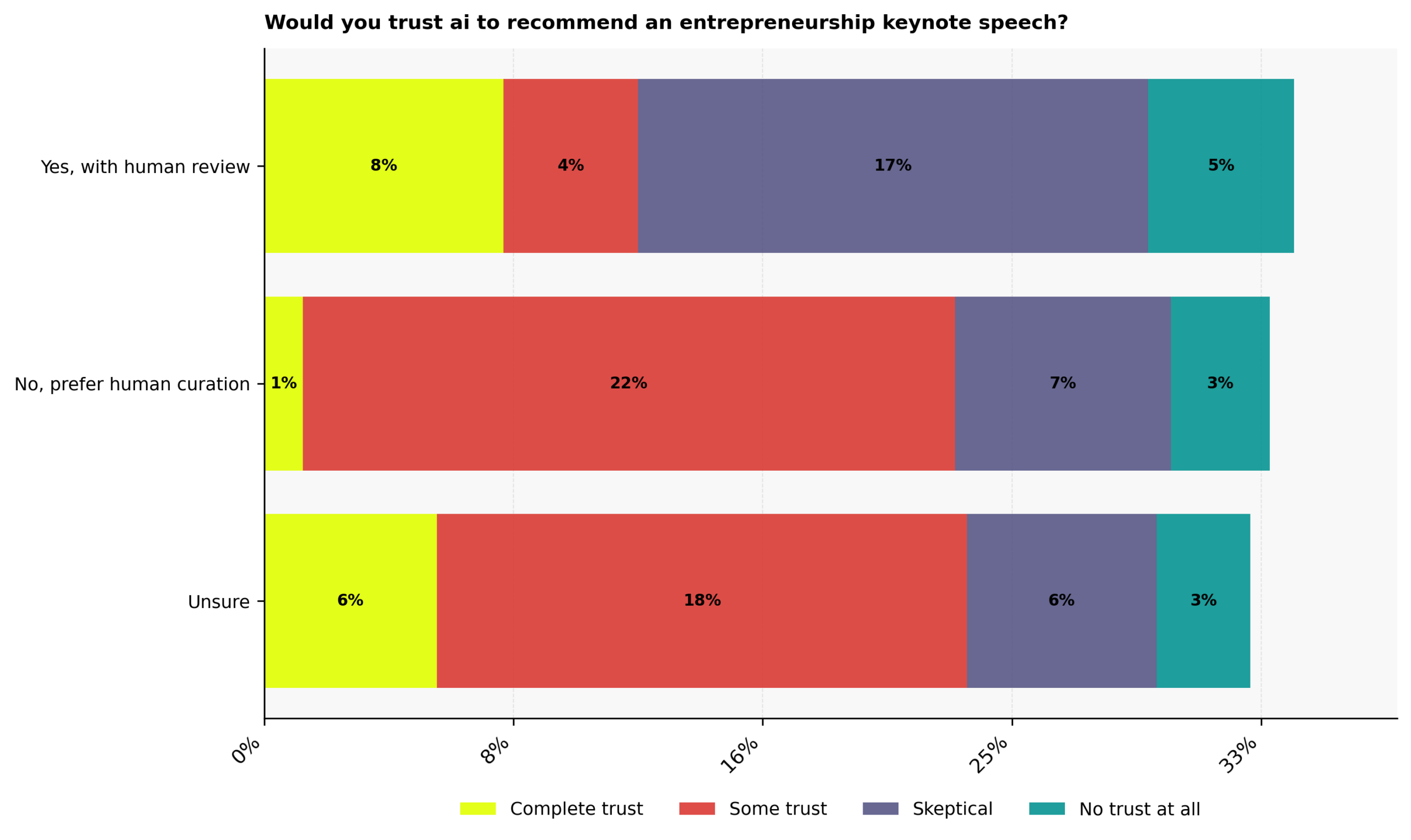
8% of business leaders have complete trust in AI to recommend an entrepreneurship keynote speech if there is some human oversight, 4% have some trust in this regard, but 17% are skeptical, and 5% have no trust in this shared option, 33% all prefer human curation over AI, and a further 33% are unsure whether they trust AI for speech recommendations
Trust is not a given:
While research from YouGov shows that 35% of adults in the United States use AI tools weekly, only 5% place a high degree of trust in AI. Conversely, 41% distrust these tools, and 68% would not allow AI to take any actions without their explicit approval.
Amongst our audience of business leaders who accept AI’s recommendations on keynote speeches, only 8% place complete trust in this guidance, and 4% are willing to trust it to a degree. The majority (17%) are skeptical, and a further 5% accept these recommendations but do not trust them at all.
The next group of leaders is unsure of how much they trust AI’s speech recommendations and counsel. Just 6% completely trust such suggestions, and 18% trust them to varying degrees, but not fully. Within this category, 6% of our audience still hold skepticism towards AI-based recommendations, and 3% don’t place any trust in them.
The remainder prefer human-curated keynote speeches to AI’s recommendations. Of these, just 1% trust AI-recommended speeches completely, while 6% are skeptical and 3% hold no certainty in these options at all. Interestingly, 22% voiced some trust for AI suggestions, but still favor a human’s judgement over algorithmic selections.
82% of business leaders agree that inspiration and motivation are absolutely essential in an entrepreneurship keynote speech, and 1% appreciate this, 11% feel that practical strategies to apply are absolutely essential, 3% want their current approach to be validated the most, and 2% prioritize entertainment value
One major want dominates:

Entrepreneurship keynote speakers do far more than just deliver talks at entrepreneur-focused events. They distill information, knowledge, and experience into clear, concise messages that set the tone for events and help attendees understand the key topics and aims. They also motivate and engage audiences, provide valuable insights and actionable strategies.
The overwhelming majority of business leaders in our audience hope to gain inspiration and motivation from these presentations. 82% cite these benefits as being absolutely essential, with another 1% noting that they appreciate feeling motivated and inspired after attending a speech.
Others are seeking practical strategies they can apply to their own enterprises as soon as possible.
For 11%, this is a crucial consideration, and fewer than 1% appreciate it. Another 3% of business leaders attend keynote speech events seeking validation of their current approaches, and 2% are primarily interested in the entertainment value they offer.
Evidently, motivation is by far the primary perk entrepreneurs hope to gain from their chosen events, with the majority prioritizing a mindset shift over practical guidelines and entertainment.
Book or resource recommendations are an absolutely essential entrepreneurship keynote speech takeaway for 26% of business leaders, and are very helpful for 3%, a mindset shift is an absolutely essential takeaway for 21%, networking inspiration is very helpful for 10%, and 2% share the same opinions about a specific actions plan, while 21% agree that new industry knowledge is very helpful, but it’s not a priority for 18%, and it’s not needed at all for 2%
Takeaway needs vary

Business leaders in 2026 have a diverse range of goals when attending entrepreneurship keynote speeches.
The largest share of our audience attends speeches to fulfill their need for new resources and book recommendations. For 26%, securing these suggestions was absolutely essential, and another 3% would find it quite helpful in supporting their future growth. Another 21%’s primary need at speeches is a mindset shift, with all of these opinions citing this shift as being of the utmost importance.
However, gaining new industry knowledge divides opinions. 19% agree this is very helpful, but a near-equal 18% feel it’s not a priority at the moment. Another 2% felt that new industry knowledge is not needed at all.
Smaller minorities also attend keynote speeches to gain networking inspiration and learn more about specific plans of action. Of the 10% seeking networking opportunities, all say this would be very helpful to them. Further, the 2% of opinions citing a specific action plan as their leading need all indicate that this benefit is very advantageous.
Innovation and disruption are the entrepreneurship keynote speech themes that resonate the most with 15% of business leaders, and they somewhat resonate with 60%, but not with 5%, overcoming failure and diligence resonates extremely well with 9%, and for 11%, leadership under pressure somewhat resonates
Some themes hit harder than others:

With recent studies citing strategic innovation and business model disruption as among the most powerful tools for driving long-term resilience and success, it stands to reason these topics are in high demand among today’s entrepreneurs.
80% of business leaders cite innovation and disruption as the keynote speech themes that resonate most strongly. Among this group, 60% find these topics resonate to some degree, 15% to resonate extremely well, and only 5% find they don’t really make a strong impression.
Leadership under pressure is also a topic under discussion. While only a fraction of a percentage find this concept resonates exceptionally strongly with them, the remaining 11% of business leaders note that it resonates on some level, reinforcing the importance of developing coping strategies to navigate high-pressure business environments.
The remaining 9% list overcoming failure and resilience as their top-priority keynote topic.
All these responses indicate that this is a highly engaging focus, emphasizing a clear need for resilience-building skills among entrepreneurs.
26% of business leaders find that practical AI adoption is a major topic gap in entrepreneurship keynote speeches, but 19% don’t think this is a gap at all, a further 10% feel that resilience after failure is somewhat missing as a topic, yet 21% don’t think it's a big gap, and there’s no gap at all in this topic for 24%
Not all topics have big gaps:

Business leaders identified two key gaps in most entrepreneurship keynote speeches to date. The first is resilience after failure, which is an essential skill for all entrepreneurs, considering that the failure rate for startups is around 90%. 10% note that this topic is somewhat missing from speeches, and 21% agree that, while it’s not a major gap, its coverage could be improved. A further 24% have not found resilience after failure to be a missing topic in the speeches they attended.
The second topic gap is practical AI adoption for business applications. 26% of the business leaders in our audience identify this as a significant gap in the keynote speeches they listen to. By contrast, 19% did not feel that they encountered a lack of coverage on this concept.
Considering that only 30% of workers in the US have received formal AI training, despite three-quarters of businesses planning to adopt AI in the near future, speeches focusing more heavily on this topic could be the key to equipping entrepreneurs and employees with the skills they need to remain competitive in rapidly shifting markets.
Actionable AI-era strategies would be valuable for 25% of business leaders if they were included in entrepreneurship keynote speeches. But they’re not a top priority for 20%, and not needed for 9%, 1% want fresh, non-generic content, and 24% agree this would be valuable, but 14% are not prioritizing this, while industry-specific relevance is not a priority or needed for 6%
Missing elements are not major:
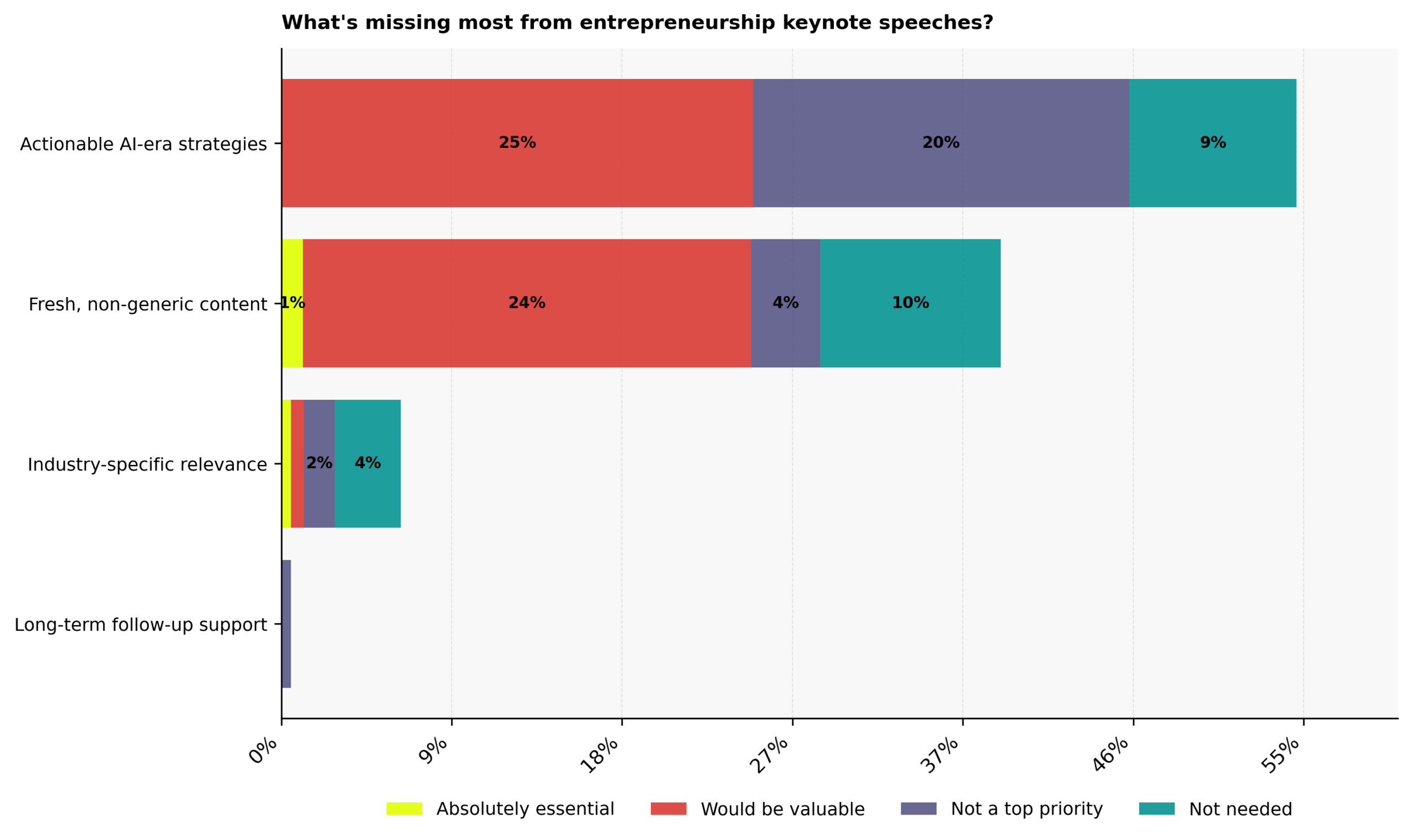
Our audience has found a few vital topics missing from the entrepreneurship keynote speeches they attend. Actionable AI-era strategies are the most-cited gap, which makes sense given the rapid adoption of AI across the US’s key industries and sectors. 25% concur that more coverage on AI-era strategies would be valuable, and 20% of business leaders found that while this focus was largely missing, it is not a top priority for them. 9% felt that more focus on these strategies was not needed, preferring to upskill in other ways.
Many of our audience also believe that unique, pioneering content is largely missing from most speeches. 1% view the inclusion of fresh new content as being of absolute importance, and 24% feel it would provide them with more value during keynote events. On the other end of the spectrum, 10% don’t feel that more coverage on this topic is necessary, and 4% don’t view it as a high priority.
The remainder report seeing less industry-specific relevance in keynote speeches than is ideal. Fewer than 1% of each group felt it was valuable or essential, while 2% felt it wasn’t a pressing need, and 4% did not view it as a necessity at all. Only a fraction of a percentage of business leaders felt that long-term follow-up support was being largely omitted during speeches, with all of these opinions categorized as low-priority by their owners.
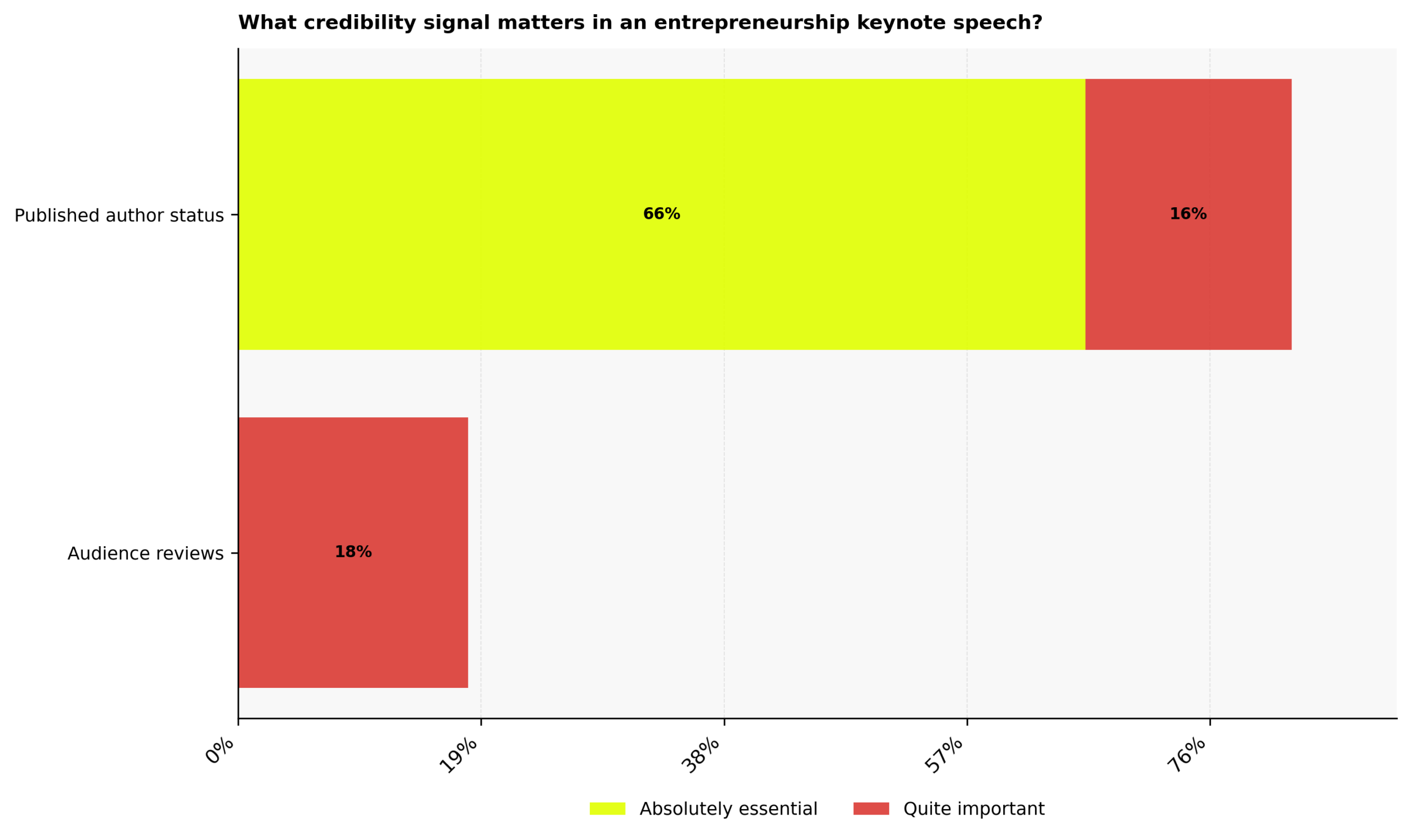
Published author status is an absolutely essential credibility signal in an entrepreneurship keynote speech for 66% of business leaders, and quite important for 16%, while audience reviews are quite important in establishing credibility for 18%
Credibility comes from two sources:
Credibility is one of the most compelling trust signals that keynote speakers can impart to their audiences. By transferring their authority, expertise, and success to their audience, credible speakers equip business leaders with the skills and resources they need to make strategic and creative decisions with confidence.
According to business leaders, a speaker’s status as a published author is the most convincing signal they can offer to solidify their credibility. 66% agree that published author status is absolutely important, and 16% believe it is quite important, indicating that leaders are more likely to trust speakers with a proven track record of publishing high-quality thought pieces. Randy Gage, an inductee in the Speaker Hall of Fame said, “I would estimate that 70 percent of the bookings I receive are because I’ve had 16 bestselling books.”
Audience reviews can also be compelling. 18% point to this as an important credibility signal. This aligns with the tried-and-tested concept of social proof. Positive reviews from past attendees validate a speaker’s ability to inform and inspire, long before a business leader has even heard their opening line.
A clear actionable takeaway is absolutely essential in making a keynote speech memorable for 36% of business leaders, and for 23% it adds a lot, 22% agree that an emotional connection to the speaker is essential for memorability, and a 11% feel the same about a powerful personal story, with another 4% agreeing this adds a lot, and a further 4% find a surprising statistic or insight adds to the memorability factor
Memorability makes a lasting impression:
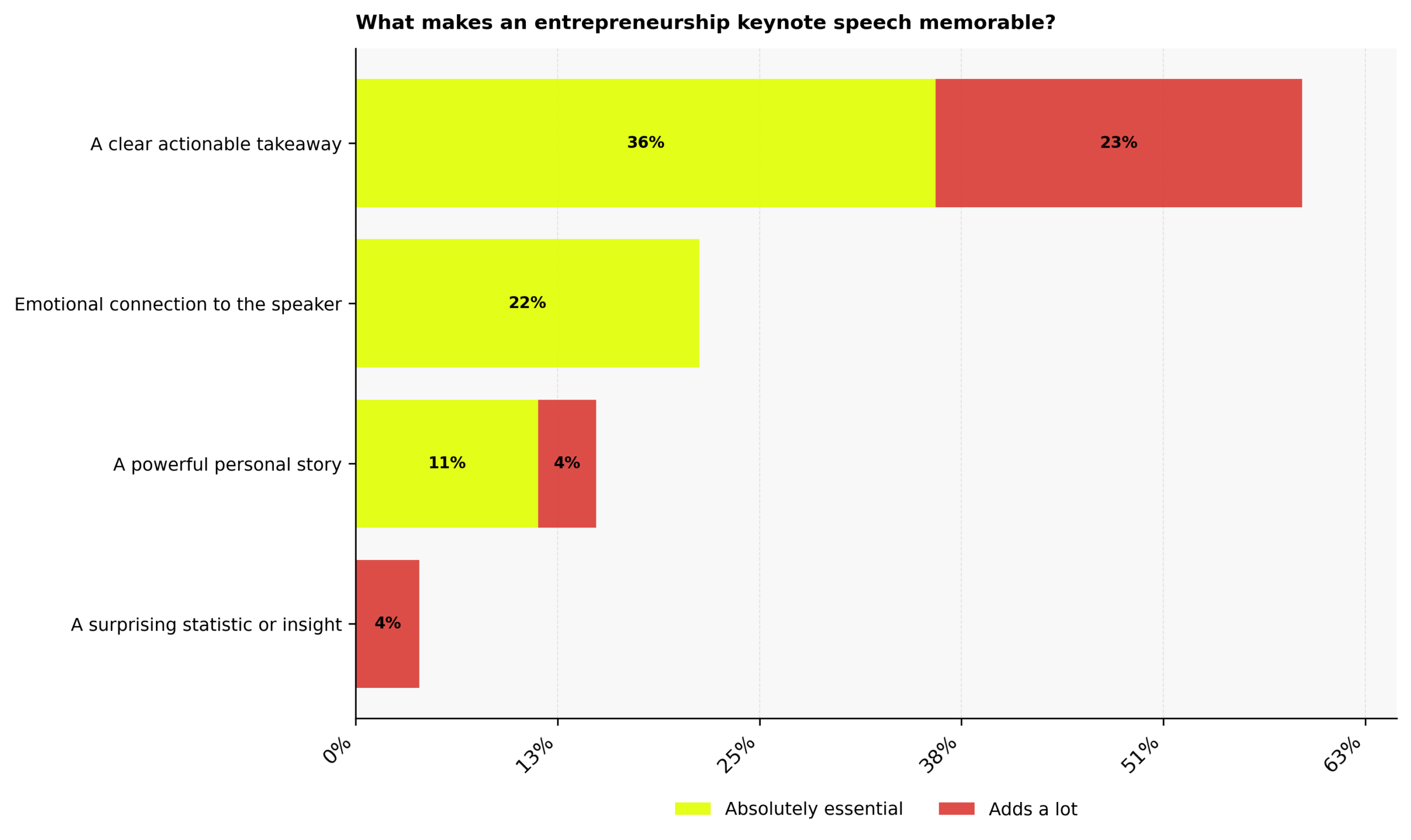
There are many factors that make a keynote speech more memorable, ranging from unexpected insights to emotional content and strategies which listeners can apply to their own businesses. However, among our audience specifically, speeches with clear, actionable takeaways stand out as some of the most distinctive.
Nearly two-thirds (59%) say this factor makes speeches the most memorable for them, and 36% believe actionable takeaways are absolutely essential for success. A further 23% feels that these takeaways enhance speeches considerably and make their messages far easier to retain in the long run.
Emotional connection is also a powerful tool for lasting engagement, and emotionally charged speeches are no exception. 22% of business leaders say it is vital to feel an emotional connection with keynote speakers to remember their talks. This goes hand in hand with powerful personal stories.
Among our audience, 11% view immersive personal stories as critical to memorable keynotes, and 4% feel they add a lot to the experience. Some listeners also value hearing surprising statistics or insights, with 4% stating that unexpected pearls of wisdom enhance the value that they gain from entrepreneurship talks.
28% of business leaders strongly prefer story-based entrepreneurship keynote speeches, and 11% lean towards this preference, 8% absolutely slightly prefer story-based speeches, and 28% lean this way, while 1% slightly prefer data-based speeches the most, and 20% lean this way, but they are not the top pick for 1%, and 3% lean towards strongly preferring data-based speeches
Story-based speeches take the lead:
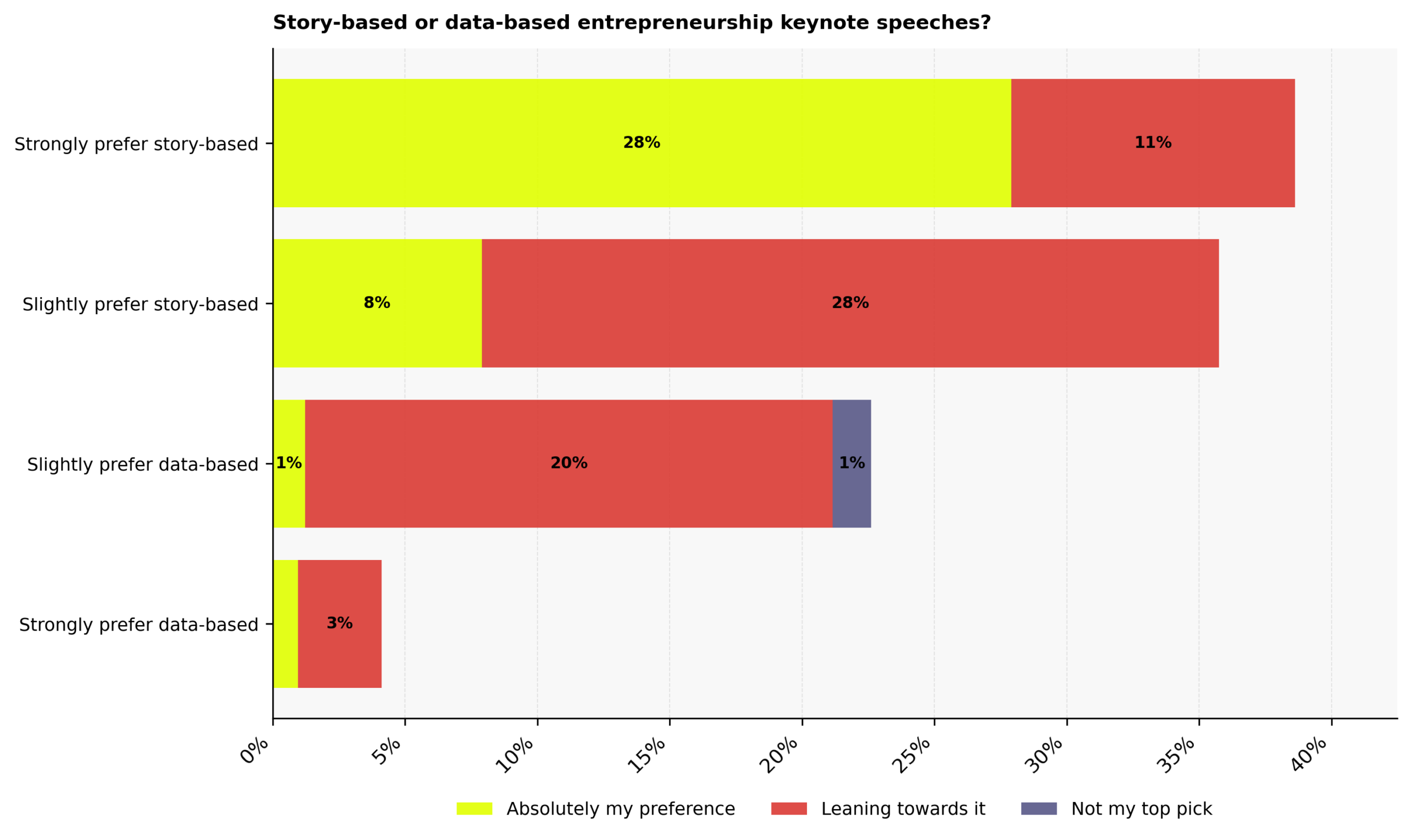
Hard numbers and clear insights and engaging stories both have their appeal, but story-based speeches seem to hold greater weight among business leaders.
Over a third strongly prefer story-based speeches, with 28% absolutely preferring this format and 11% sharing a definite leaning towards it. Another 8% slightly prefer story-led talks, with 28% admitting to some level of favor towards them.
A lesser, but still notable, portion of our audience favors a data-heavy approach to speech delivery instead. 22% reported a slight preference for this approach, 20% lean towards it, and only 1% each cite it as an absolute preference or not their first choice at all. By contrast, less than 3% strongly prefer data-based deliveries, with 3% leaning towards this as their first choice and fewer than 1% slating it as their favorite delivery method.
These results align well with investors’ focus on storytelling as a potent skill, showing that the majority of business leaders appreciate having relevant data woven throughout immersive stories that both inform and captivate.
28% of business leaders prefer safe, proven advice over a bold entrepreneurship keynote speech, 28% prefer balanced perspectives, and 27% find it depends on the audience; in contrast, 18% welcome bold, provocative views
Boldness is a choice:
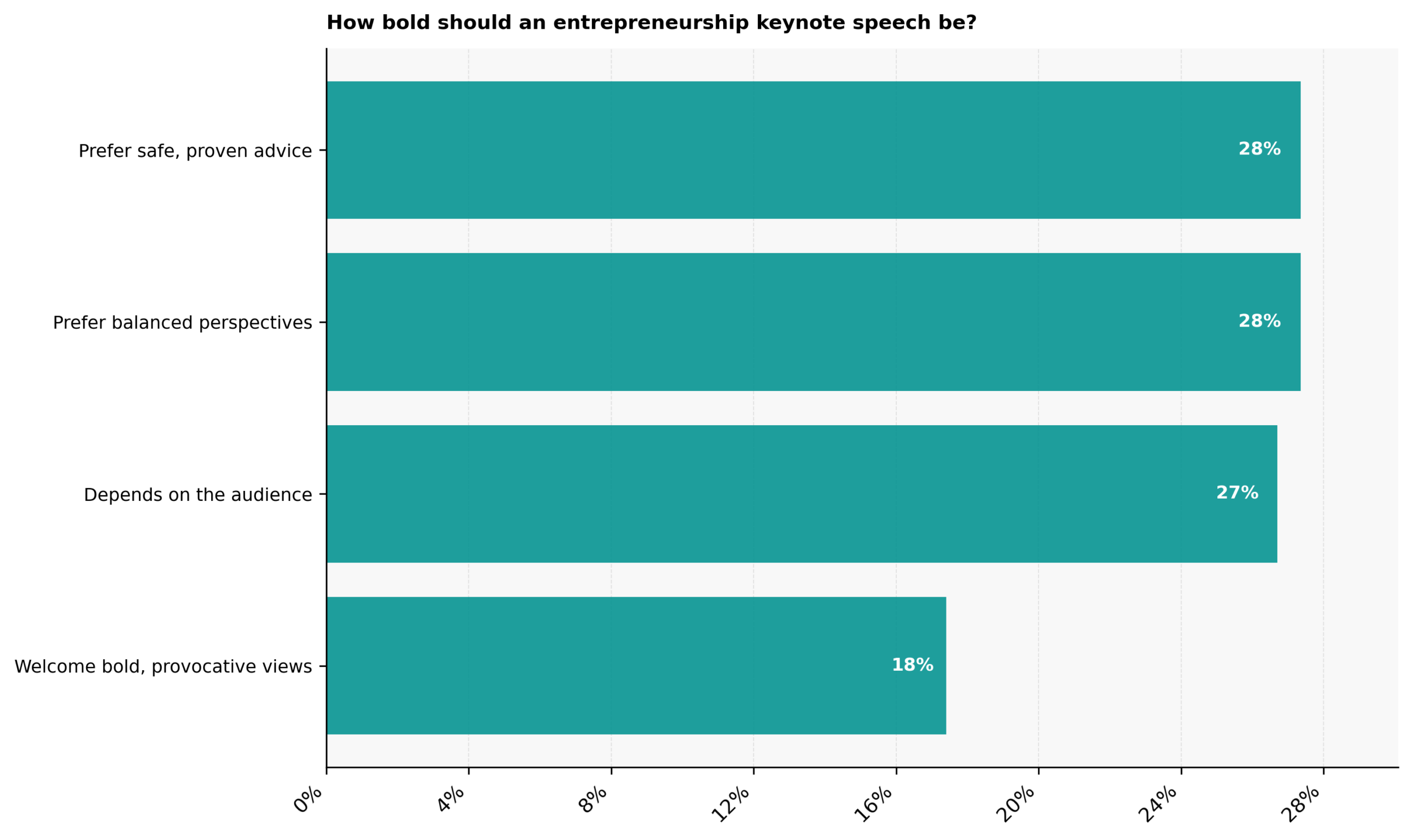
When it comes to how bold and disruptive entrepreneurship keynote speeches should be for the best results, business leaders are divided. 28% prefer safe, tried-and-tested advice that’s proven to achieve its core aims, and just as many voice a preference for balanced perspectives that take a holistic stance on key entrepreneurial topics.
On the other end of the spectrum, 18% appreciate bold, provocative topics and views that shake up their current beliefs and consistently broaden their horizons. The remaining 27% value all levels of boldness, from cautious to audacious. However, they feel the ultimate impacts of these approaches largely depend on the specific audience in attendance.
81% of business leaders want an entrepreneurial keynote speech to include a mix of story and strategy, 11% want a speech structured for audience participation, 4% are looking for a data and research-heavy speech, 2% want a framework or step-by-step speech structure, and another 2% want a story-driven speech with lessons woven in
Speech structure preferences are clear:
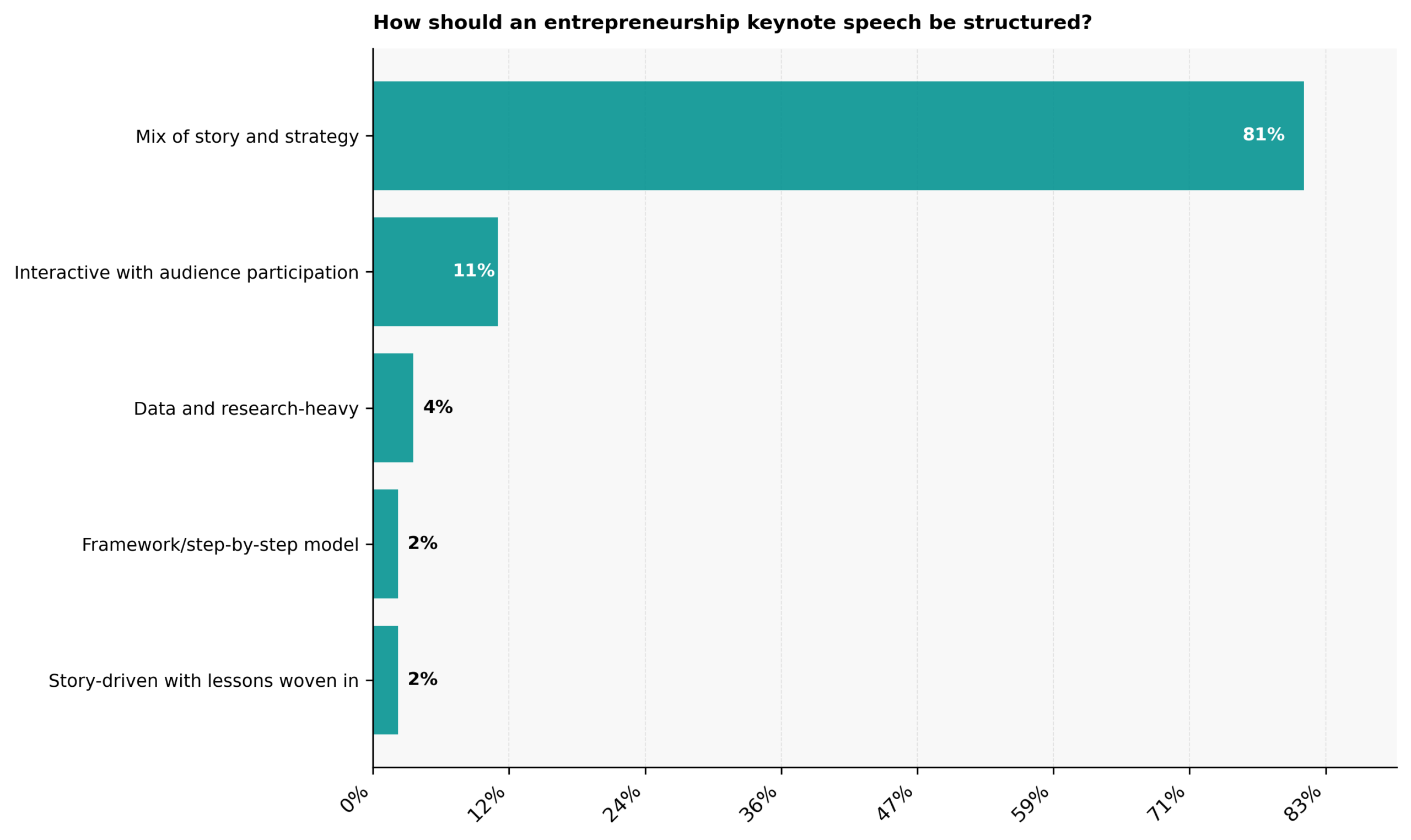
Recent studies and surveys continue to highlight the growing importance of strong public speaking skills, with a particular focus on effective storytelling. A recent McKinsey study of 18,000 business leaders across 150 nations backs this up, emphasizing that public speaking and storytelling are among the most important skills CEOs and entrepreneurs will need to master this decade to continue engaging and motivating their target audiences and talent alike.
Entrepreneurship keynote speeches can help lay the foundations for the development of these skills, not only through their topics and content, but also through their actual structures. Understandably, then, 81% of business leaders prefer a mix of storytelling and strategy in the formats of the speeches they attend. 11% also value an interactive approach, especially when the audience is actively encouraged to participate and contribute.
The aforementioned structures seem to be competing with the popularity of traditional formats such as data-heavy and step-by-step speeches, especially among our audience. Only 4% s note that speeches should have research-focused structures, and just 2% favor framework-led or step-by-step approaches.
Interestingly, story-driven approaches with lessons woven throughout secured just a 2% share, showing that while storytelling structures are often viewed as essential, they may be most impactful when paired with actionable strategy delivery.
33% of business leaders’ top choice for entrepreneurship keynote speech delivery style is conversational and relatable, 10% prefer this, but it’s not a favorite for 1%, 20%’s top choice is a high-energy and energetic delivery, and 7% prefer this, while 4% want an authoritative and direct style, with another 23% preferring it, and just 1% prefer a calm and reflective speech delivery style
Delivery style is not one-size-fits-all:
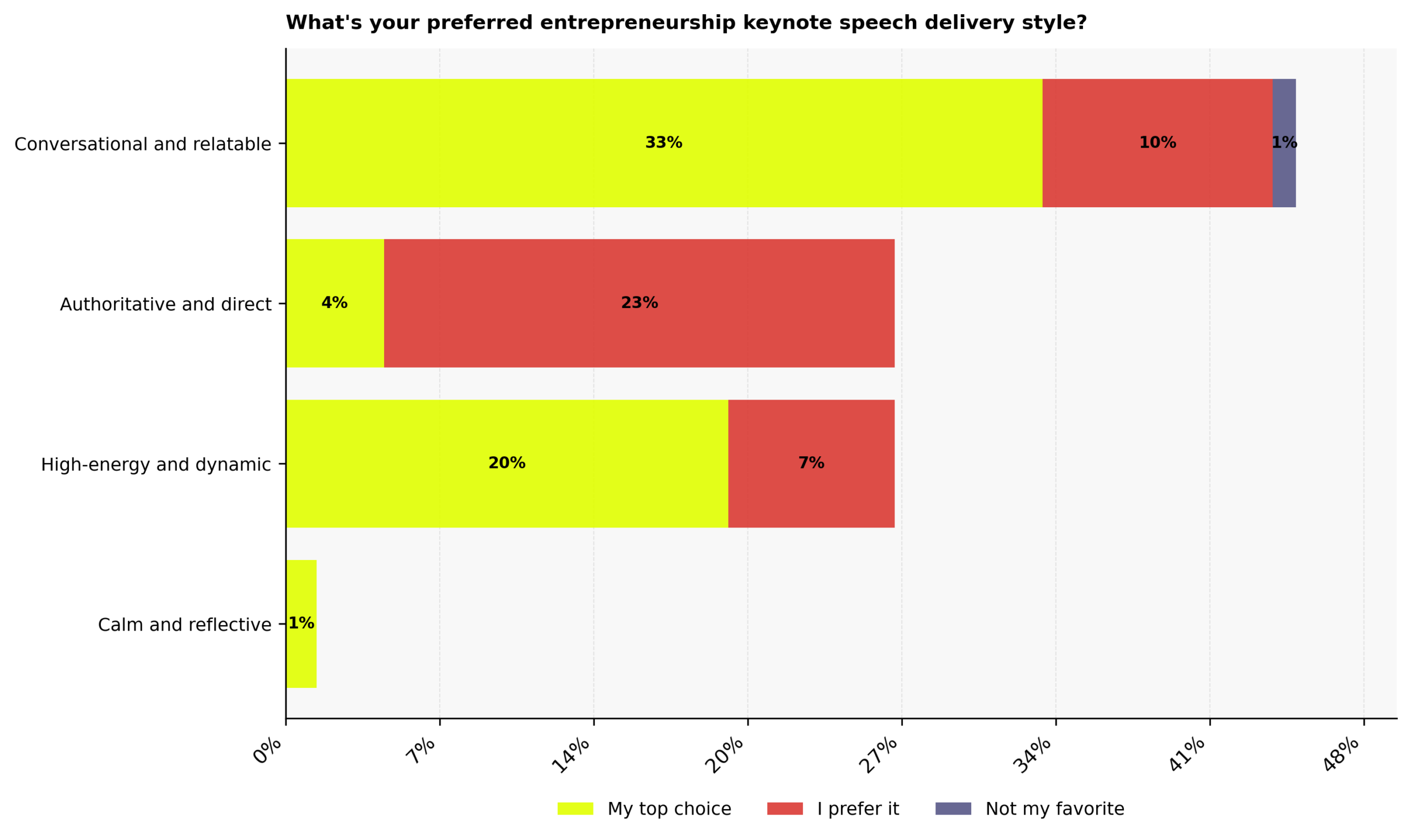
Speech structure and delivery work in close tandem to impart meaningful messages and takeaways in the clearest, most memorable ways possible. In terms of entrepreneurship keynote speech delivery styles, a conversational and relatable approach is the top choice among 33% of business leaders. 10% also prefer this style, and only 1% admit it is not their favorite technique.
Many leaders also appreciate a direct, authoritative delivery that gets straight to the point, though only 4% cite this style as their top choice. 23% of this group, however, shared that they prefer authoritative speech delivery. Although only 1% consider calm, reflective talking styles their top pick, 20% favor dynamic, high-energy deliveries, and another 7% prefer this strategy.
It seems that the best speech delivery styles either allow listeners to form connections with speakers’ personal stories or energy, or share direct, no-frills information and strategies backed by clear authority and expertise.
90% of business leaders prefer to only access entrepreneurship keynote speeches live, and in-person, 6% prefer access that’s live virtual only, 3% want hybrid access, and 1% prefer recorded replays of keynote speeches
Live leads the way:

While live, in-person events remain ever-popular as platforms for keynote speeches, new digital and hybrid options are becoming more readily available in 2026. The global virtual events market is expected to grow exponentially, from $145 billion in 2026 to $472.9 billion by the end of 2033. The North American market is currently dominating this sector, accounting for 40.5% of revenue in 2025 alone.
Despite these significant projections, the majority of our audience still prefer to attend entrepreneurship keynote speeches in person. 90% express a clear preference for live, in-person events, and 1% would rather replay recorded speeches at times that are more convenient for them. Just 6% of business leaders prefer virtual-only live events, and even fewer - a mere 3% - prioritize hybrid access both in the real world and online.
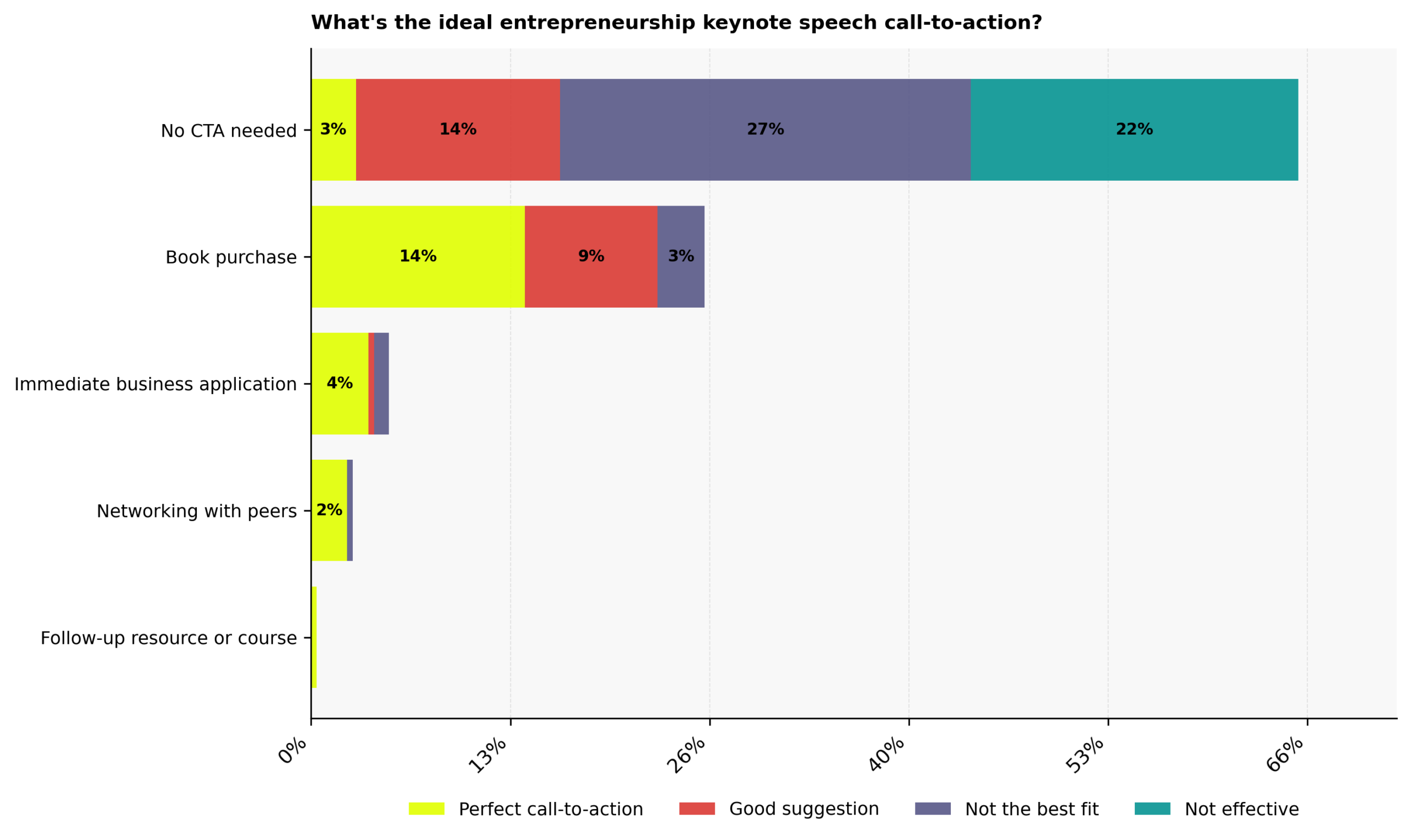
A book purchase is the preferred call-to-action for 14% of business leaders, 9% find this CTA a good suggestion, but 3% don’t think it’s the eBay fit, 4% agree that an immediate business application is the perfect CTA, and 2% share the same opinion about networking with peers, while 3% think No CTA is needed, 14% think having one is a good suggestion, and 49% don’t think it's the best fit or an effective option for a speech
CTA opinions differ:
Calls to action (CTAs) are a foundational element of entrepreneurship keynote speeches. They provide listeners with clear next steps, giving them a framework for implementing the skills they have learned, pursuing additional information, or taking other actions to reach their entrepreneurial goals.
While they’re undeniably important for prompting action, not all CTAs are created equal in the eyes of business leaders, and some don’t consider them important to start with. 3% of our audience says that no CTA is the best format, while 14% feel that leaving out the call-to-action is a solid suggestion. 27% agree it isn’t the best fit for keynote speeches, and 22% don’t believe CTAs have any real benefits at all.
CTAs prompting listeners to purchase a speaker’s book are fairly popular; 14% of our audience say this is the ideal call to action, and 9% believe it’s a good suggestion. Another 3% don’t feel that this format is the ideal fit.
Calls-to-action that suggest immediate business applications are the top choice among 4% of business leaders, with fewer than 1% each feeling that they’re either a solid choice or a substandard fit. 2% appreciate a call to network with like-minded peers, and under 1% didn’t resonate strongly here, while under 1% favor CTAs suggesting follow-up courses and resources.
Real-world case studies are extremely helpful in helping 68% of business leaders apply entrepreneurship keynote speech lessons, accountability tools and resources are extremely helpful for 11%, and 5% share the same sentiments about clear step-by-step guidance, while 16% find peer discussion post-event to be somewhat helpful
Application of lessons shows clear patterns:
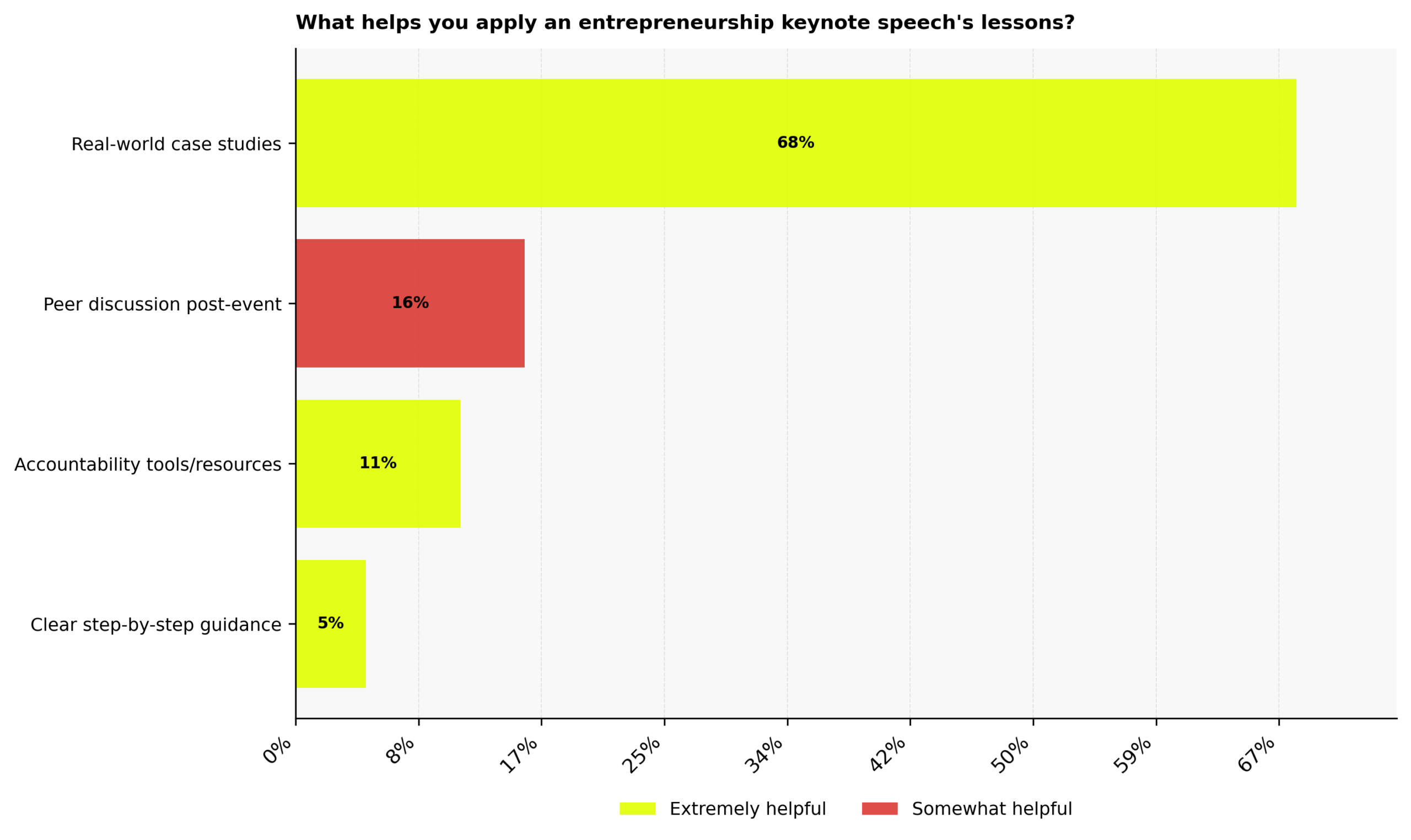
There are a few key ways for keynote speakers to drive their lessons home and support business leaders in applying them effectively. Direct, detailed guidance is an obvious approach, but interestingly, only 5% of business leaders find step-by-step guidance especially helpful.
In contrast, 68% believe real-world case studies are the optimal tools for applying the lessons from the speeches they attend. Given that case studies address specific, relevant managerial and operational challenges entrepreneurs must address, this option provides the contextual data needed for leaders to make more informed, proactive decisions.
Other useful tools include peer-to-peer discussions and accountability resources. Among our audience, 16% feel post-event peer discussions are somewhat helpful for solidifying the skills they learned during keynotes, and 11% find accountability tools and resources extremely helpful in this regard.
58% of business leaders use an entrepreneurship keynote speech for training by bringing a speaker in-house, 39% share key takeaways and summaries, and 1% play recordings for teams, while the remaining 1% don’t use speeches for training
Most training techniques integrate speeches:

Our audience primarily uses entrepreneurship keynote speeches for training purposes in two ways: by bringing speakers in-house or sharing key summaries and takeaways with their workforce.
58% report inviting speakers onto their premises to deliver valuable training talks, while 39% prefer to share the highlights of informative talks with their employees, delivering insights in a more time-efficient way. 1% also play recordings of entrepreneurship keynote talks for their teams to enhance their upskilling efforts, while 1% don’t use keynote speeches for training, preferring other proven methods to empower their teams.
These different use cases reinforce the versatility of keynote speeches in training and their long-term value.
17% of business leaders are very likely to share an entrepreneurship keynote speech, another 17% are somewhat likely to do so, 65% are neutral about sharing these speeches, and just 2% are unlikely to share them
Sharing may be an option for some:

Many business leaders are willing to share keynote speeches they find engaging, insightful, or otherwise valuable. 17% are very likely to share quality speeches with colleagues, peers, and employees, and 17% are somewhat likely to link others in.
Only 2% are unlikely to share these speeches. The remainder (65%) took a neutral stance, perhaps preferring to judge the relevance and value of a given talk before deciding to hit the ‘Share’ button.
These findings clearly illustrate what today's business leaders expect from entrepreneurship keynote speeches. They’re looking for practical value, credible expertise, and content that inspires action rather than simply informing.
While AI is becoming an increasingly important part of how speeches are discovered and consumed, trust, authenticity, and real-world experience remain the factors that ultimately shape engagement. Speakers who combine compelling storytelling with actionable insights, relevant examples, and forward-looking perspectives are best positioned to capture attention and leave a lasting impact on entrepreneurial audiences.
