
Sovereign AI refers to artificial intelligence systems developed, deployed, and governed under a country’s own legal, regulatory, and technological frameworks. It allows nations to retain greater control over the data, infrastructure, and computing resources that support AI, reducing dependence on foreign providers. For entrepreneurs, this affects data security, intellectual property, regulatory obligations, and long-term business independence. As AI becomes more deeply embedded in commercial operations, understanding sovereignty can help business owners assess the strategic risks and opportunities of the technologies they rely on.
Randy Gage, founder of the Breakthrough U entrepreneur accelerator, stated, “Governments are building sovereign AI because they’ve realized dependence is a vulnerability. Entrepreneurs should learn the same lesson. If your entire operation runs on technology you don’t understand, can’t move, and don’t control, you don’t have a business. You have a lease.”
To find out what 1,371,329 opinions of entrepreneurs in the US were about sovereign AI, we utilized AI-driven audience profiling to synthesize insights from online discussions over 12 full months ending September 23rd, 2026, to a high statistical confidence level.
Index
- Methodology and data
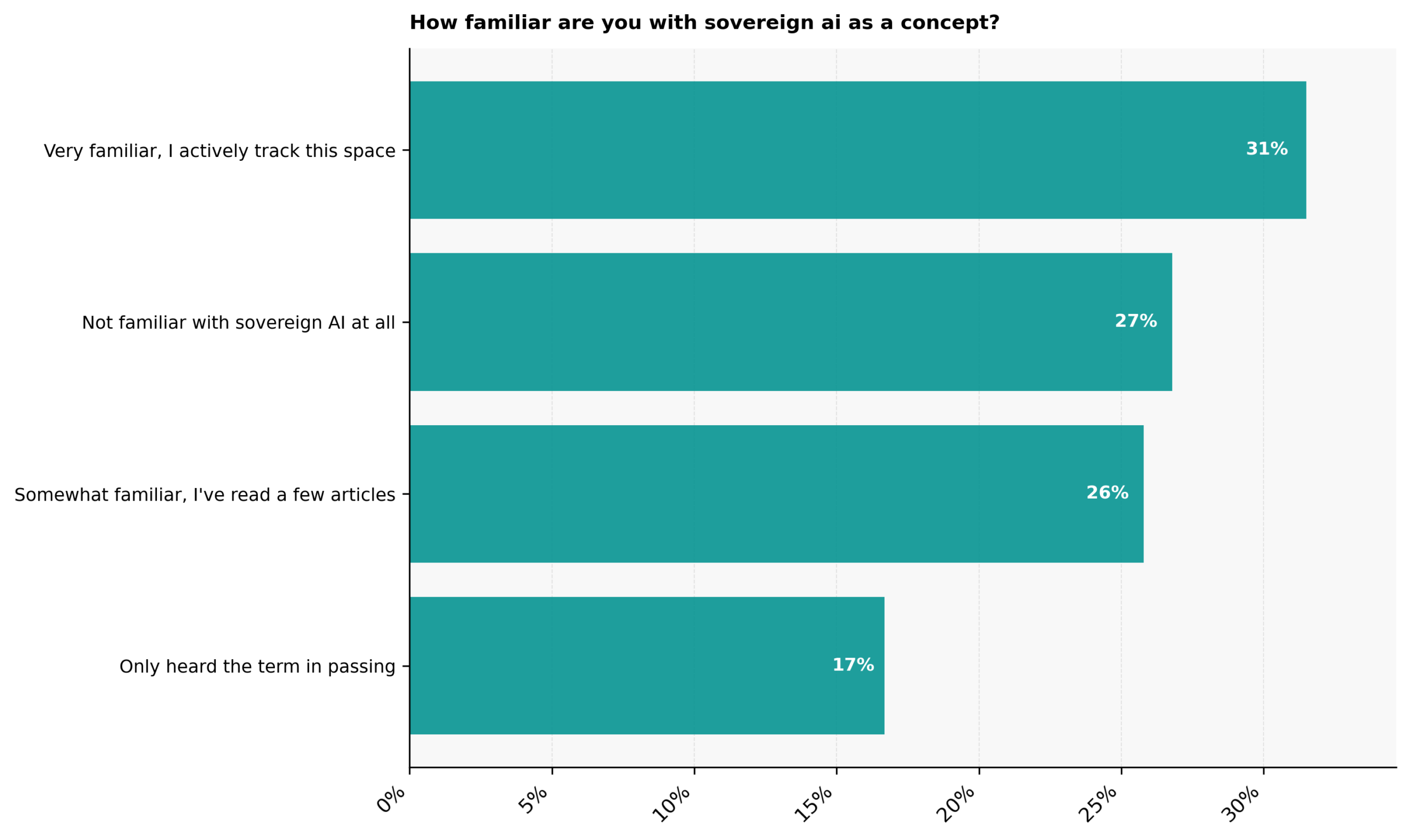
- 31% of entrepreneurs are very familiar with sovereign AI as a concept and track this space, and 26% are somewhat familiar with the concept and have read a few articles; however, 17% have only heard the term in passing, and 27% are not familiar with sovereign AI at all
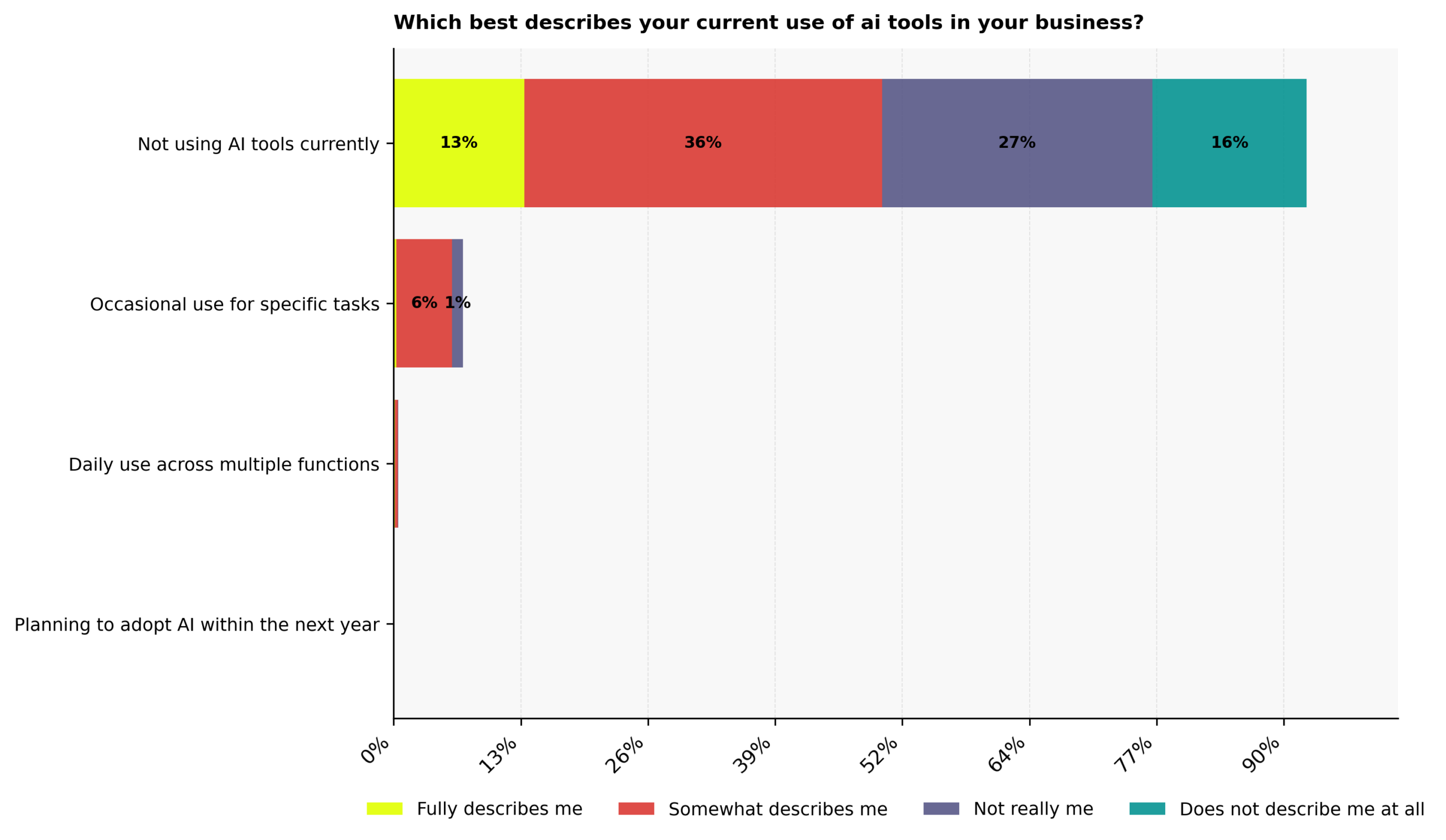
- 13% of entrepreneurs are not using AI tools currently, and this somewhat describes the lack of usage for 36%, but it’s not really a good descriptor for 27%, and it doesn’t describe the AI use of 16% at all, while 6% identify with the statement that they occasionally use AI for specific tasks, and no one voices any opinions on daily AI use across multiple functions or whether they are planning to adopt AI within the next year
- While it’s too early to tell whether AI use has changed 35% of entrepreneurs’ competitive position so far, 30% have seen somewhat improved efficiency and output, and 22% have significantly strengthened their position, but for 12%, AI adoption has created new pressures they are still adapting to
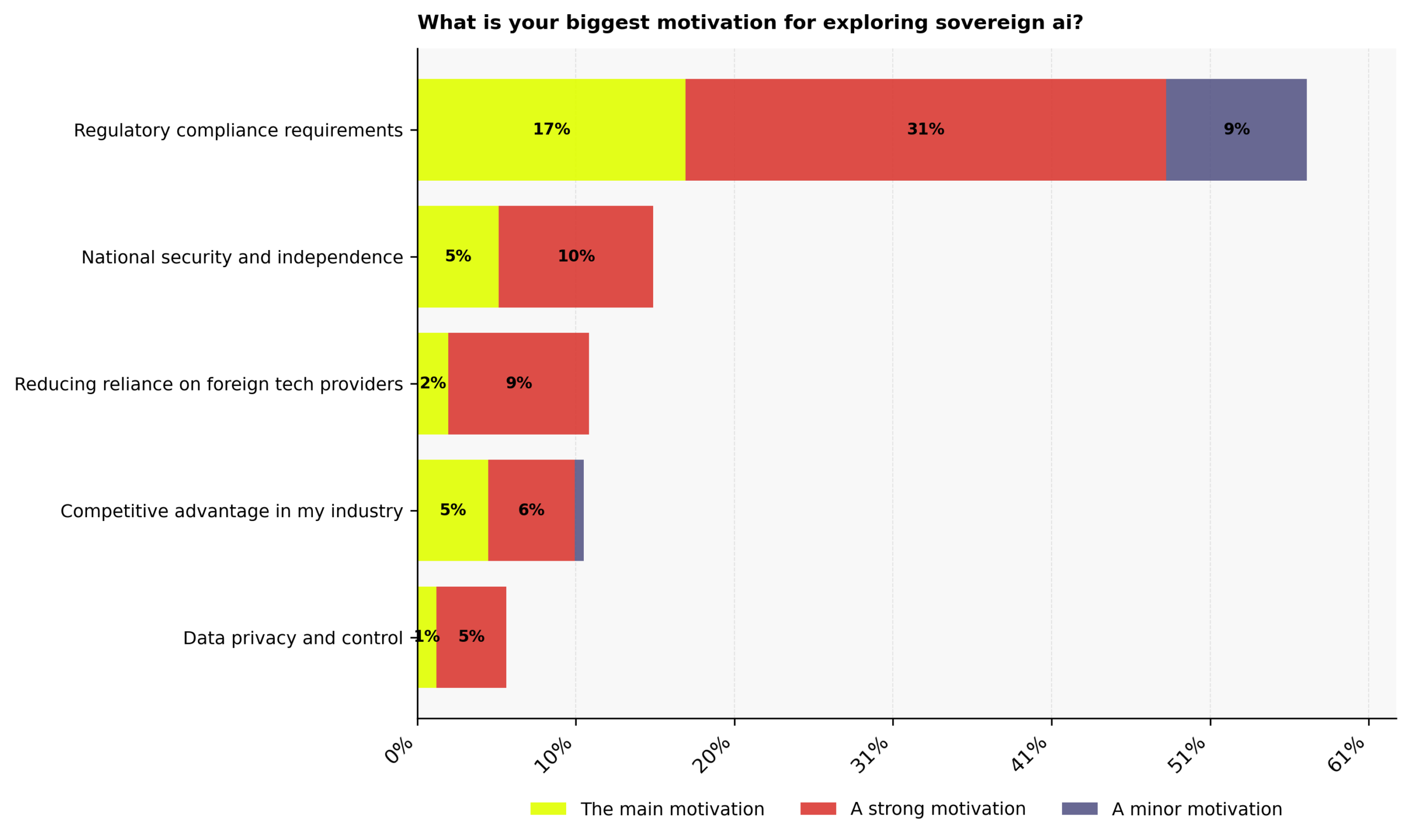
- For 17% of entrepreneurs, the main motivation for exploring sovereign AI is regulatory compliance requirements; this is also a strong motivation for 31%, and a minor motivation for 9%; 5% are mainly motivated to explore sovereign AI by national security and independence, and a further 10% are strongly motivated by this, 5% cite their top motivator as gaining a competitive edge in their industry and this is a strong motivator for 6%, while 2% are mainly motivated by reducing reliance on foreign tech providers, and 9%are strongly motivated by this, and 1%’s main motivation is data privacy and control, followed by 5% who are strongly motivated by this reason for exploring sovereign AI
- For 88% of entrepreneurs, general business competitiveness is the industry need that drives interest in sovereign AI adoption; for 6%, it’s the need to protect intellectual property; for 5%, it’s meeting government or defense contracts; and for 1%, it fills the industry need for safeguarding customer data
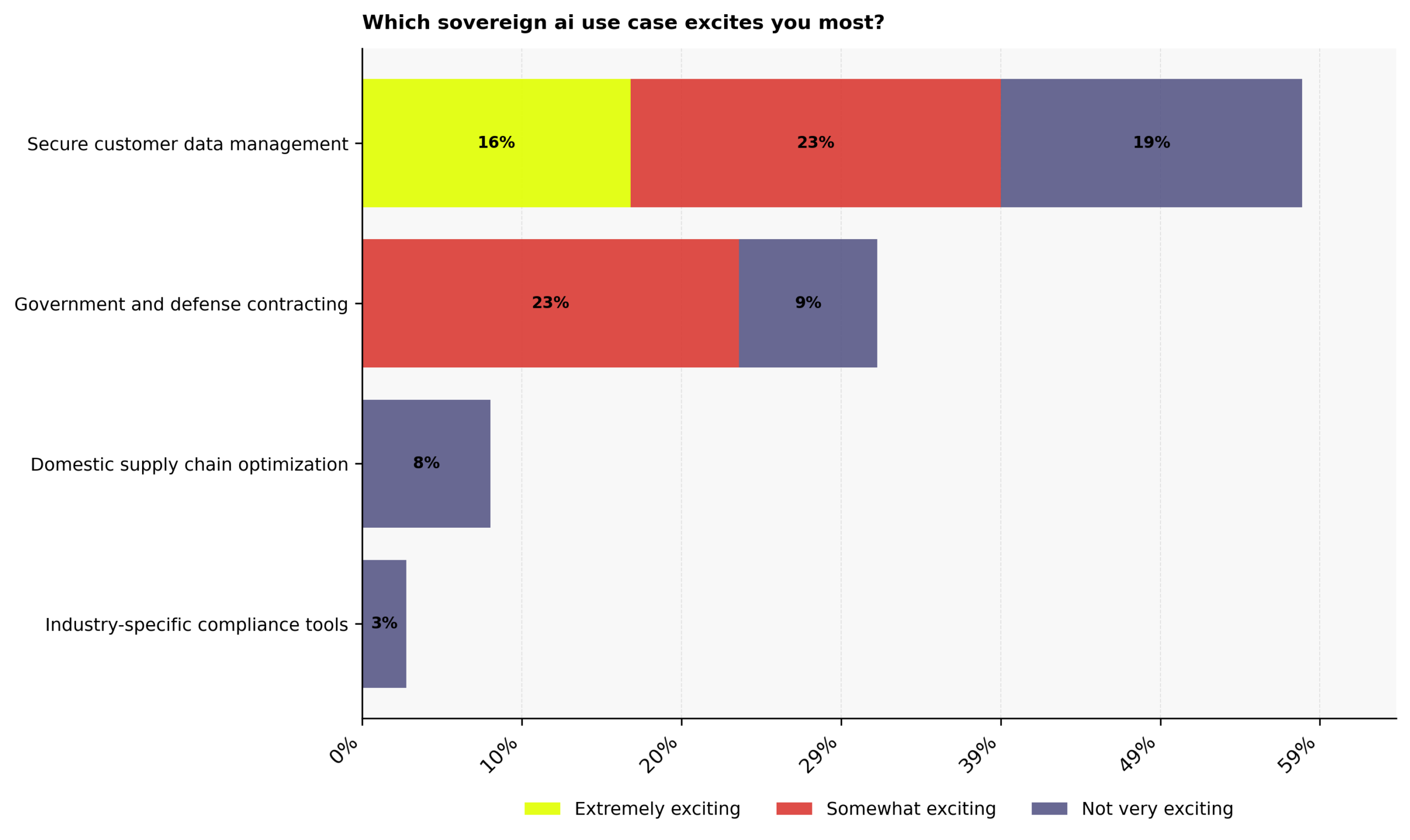
- 16% of entrepreneurs are extremely excited about sovereign AI being used for secure customer data management, and 23% find this somewhat exciting, but 19% don’t find this very exciting; 8% share the same lack of excitement about AI use in domestic supply chain optimization, 3% regarding industry-specific compliance tools, and 9% in government and defense contracting, but 23% find AI use in this type of contracting somewhat exciting
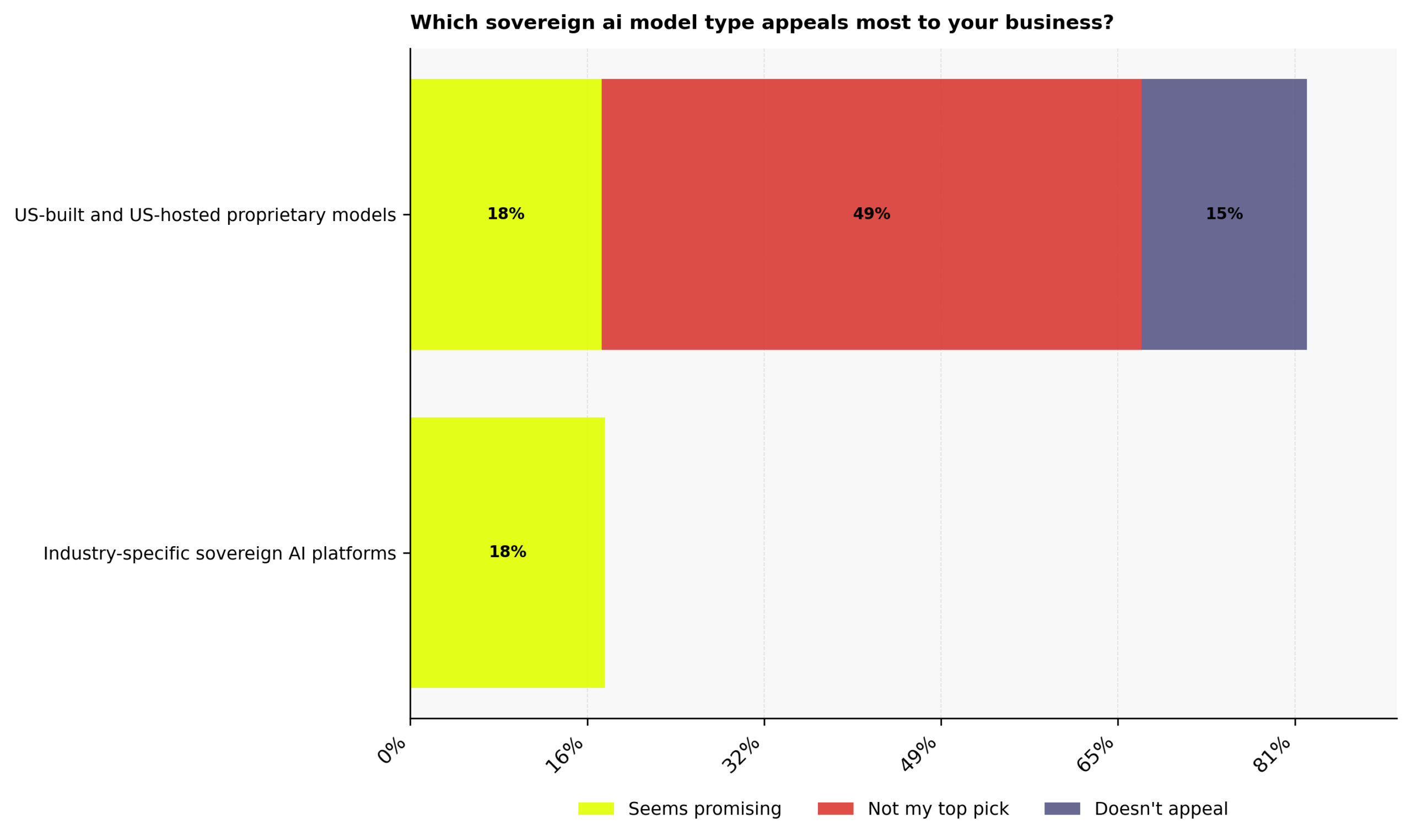
- 18% of entrepreneurs agree that US-built and US-hosted proprietary models seem promising sovereign AI model types for their business, but this isn’t the top pick for 49%, and it doesn’t appeal to 15%, while the remaining 15% think that industry-specific sovereign AI platforms seem promising
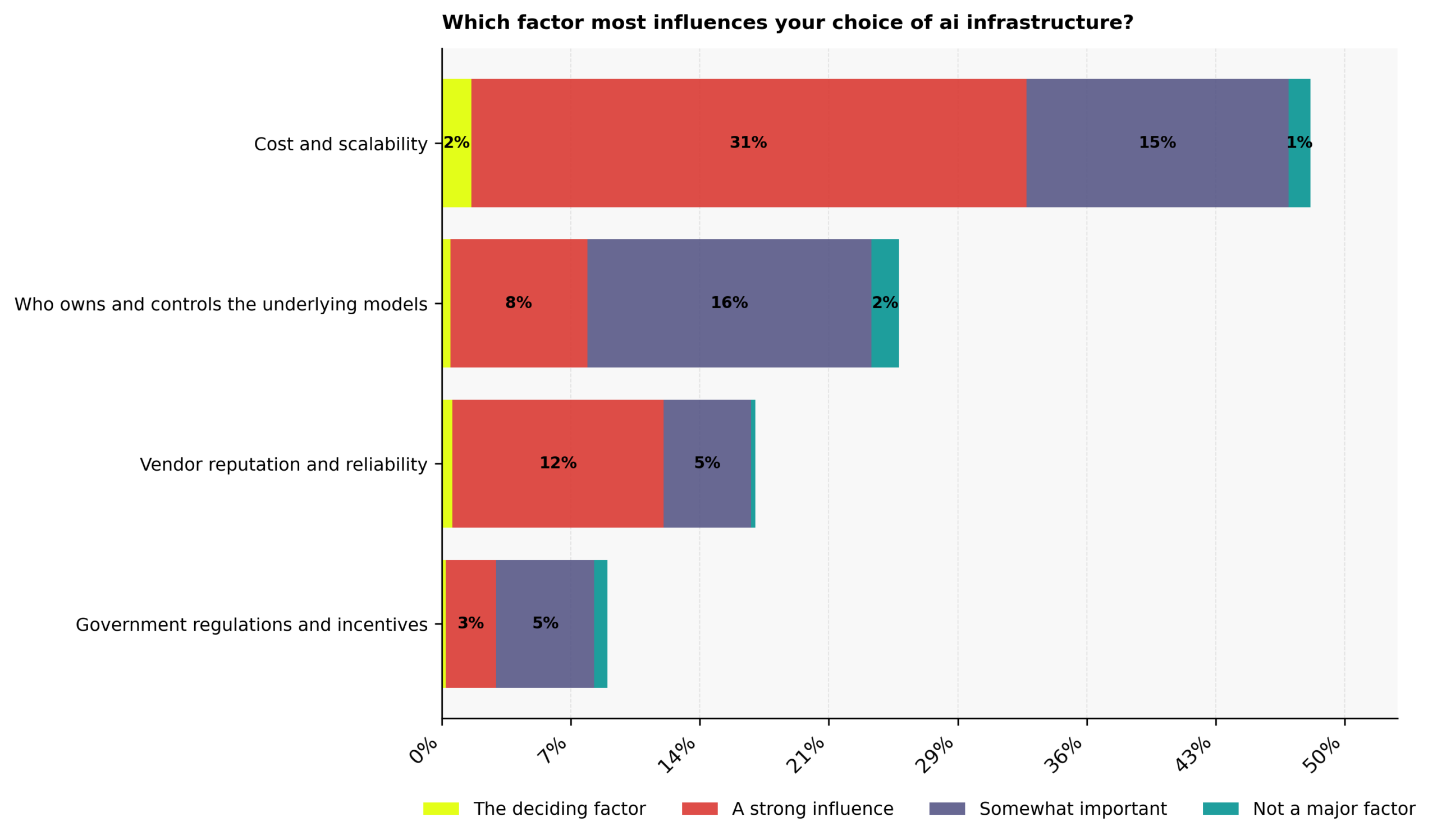
- Cost and scalability are the deciding factors for 2% of entrepreneurs when choosing AI infrastructure, a strong influence for 31%, and somewhat important for 15%, but not a major factor for 1%; who owns and controls underlying models strongly influences 8%, is somewhat important for 16%, but not for 2%; vendor reputation and reliability strongly influence 12% of entrepreneurs’ choice of AI infrastructure, and are somewhat important for 5%, while government regulations and incentives strongly influence 3%, and are somewhat important for 5%
- For 7% of entrepreneurs, cost-effectiveness at scale is an absolutely essential sovereign AI feature, and it’s quite important for 18%; interoperability with existing tools is quite important for 28%; 25% put the same importance on transparent AI model training data; and 23% agree full data ownership and control is also quite important
- For 75% of entrepreneurs, data localization is somewhat important to their business strategy, but it’s not a dealbreaker; 22% don’t factor it into their current strategy, and for 3%, data localization is important only for certain sensitive data
- 89% of entrepreneurs are neutral about foreign control over AI infrastructure and haven’t given it much thought, and 3% are not concerned at all; however, 8% are somewhat concerned about foreign control, but it is not a priority, and just 1% are extremely concerned, as this control shapes their decisions
- Strong customer support and training is an absolutely essential sovereign AI vendor trait for 59% of entrepreneurs, and it’s quite important for 36%; proven government or defense clients are absolutely essential for 3%, and for 2%, US-based data centers and ownership are quite important
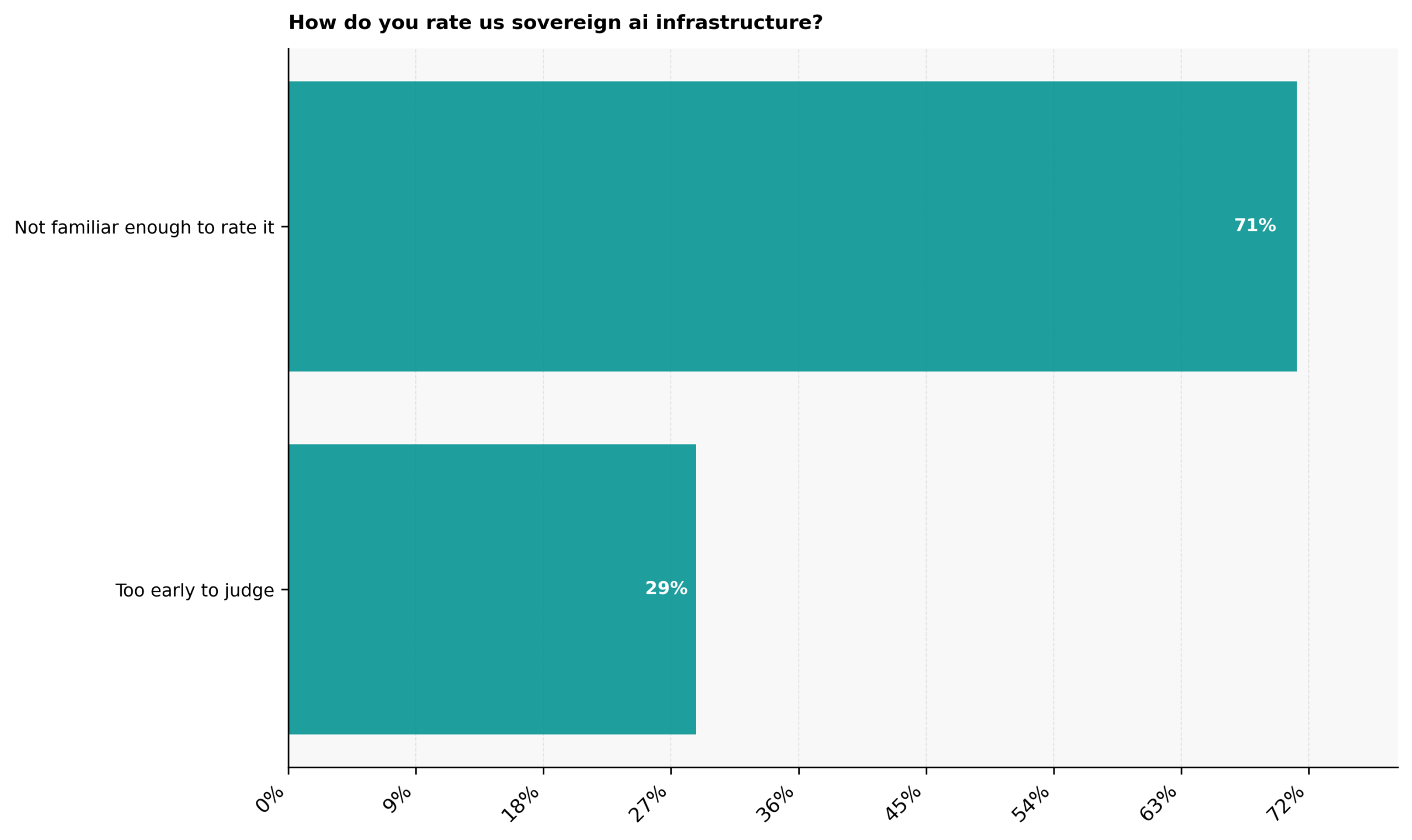
- 71% of entrepreneurs are not familiar enough with US sovereign AI infrastructure to be able to rate it, and 29% agree that it’s too early to judge it
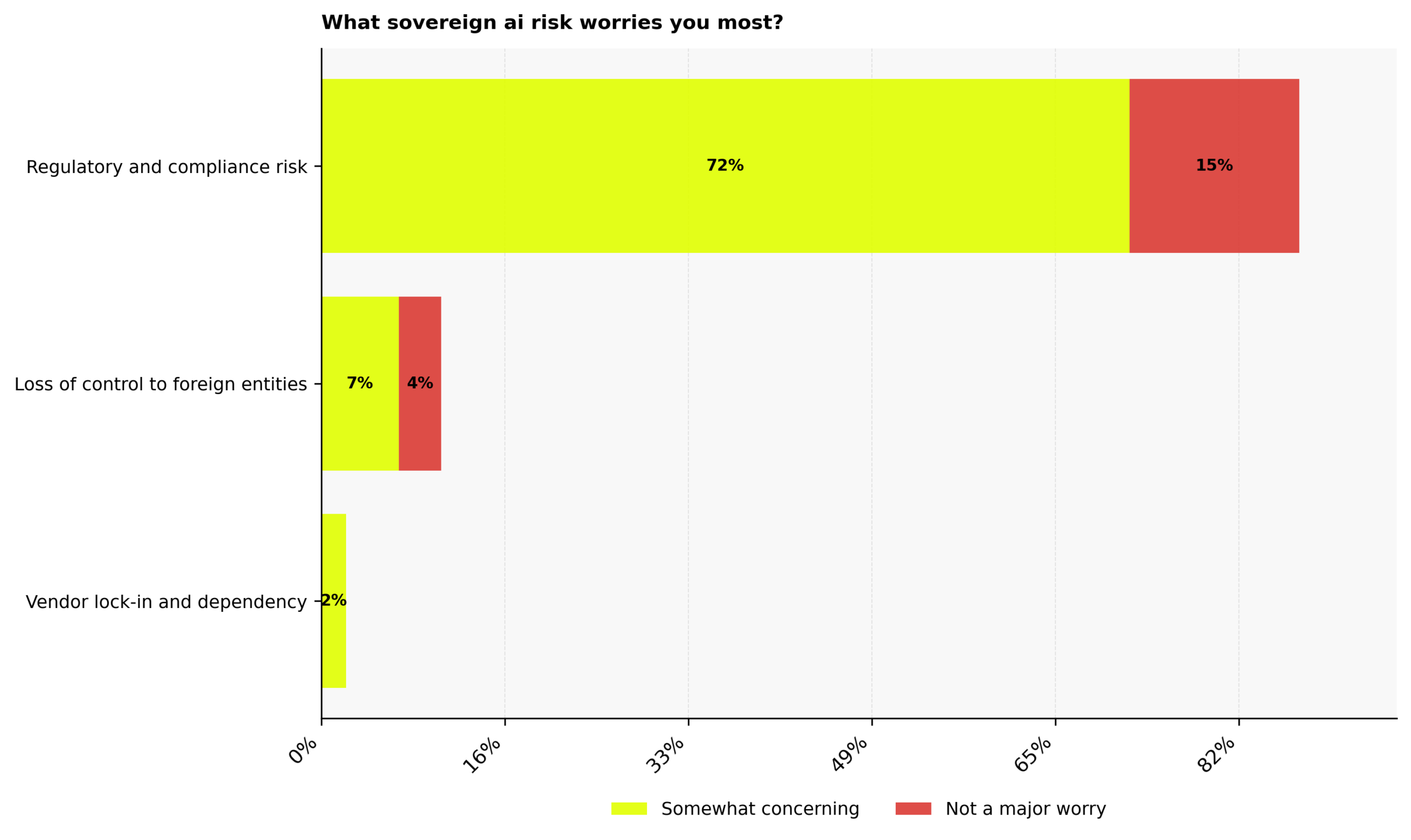
- Regulatory and compliance risk is somewhat concerning for 72% of entrepreneurs but not a major worry for 15%; 7% are somewhat concerned about a loss of control to foreign entities due to sovereign AI, yet 4% don’t see this as a major worry, and just 2% consider vendor lock-in and dependency as somewhat concerning
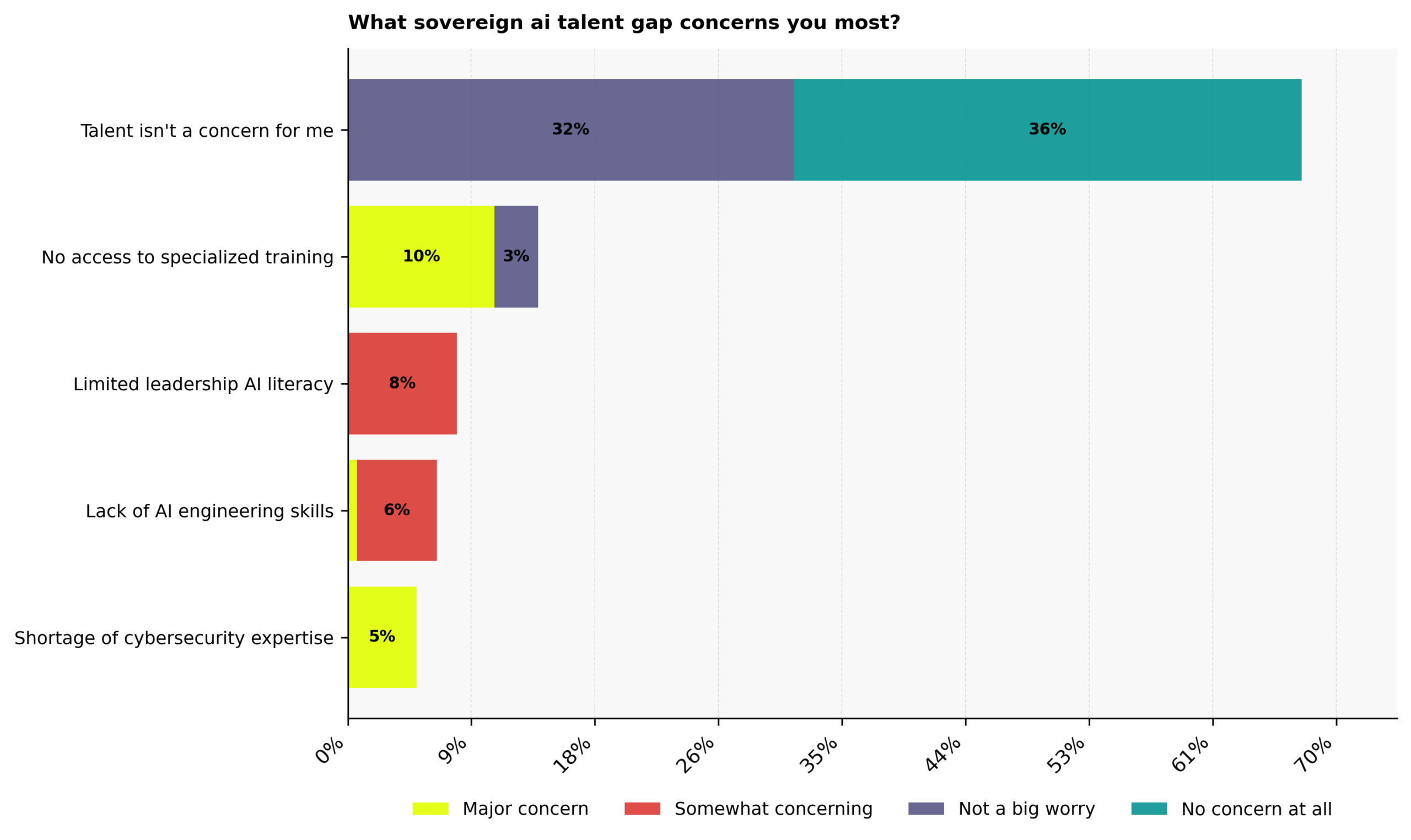
- For 32% of entrepreneurs, a lack of sovereign AI talent is not a big worry, and it’s of no concern for 36% at all, but 10% find that no access to specialized training is a major talent gap concern; yet 3% are not worried about it; 8% find limited leadership AI literacy somewhat concerning, 6% share the same sentiment about a lack of AI engineering skills, and 5% are most concerned about a shortage of cybersecurity expertise
- 49% of entrepreneurs think that it is absolutely essential that government fund and build national AI infrastructure; 26% agree this is somewhat important, but 12% don’t think it’s really needed, and 7% think the government should stay out of this area of sovereign AI development; 2% are unsure what government role would be appropriate; and 4% think they should stay out altogether, while no one voices an opinion on whether the government should stay minimally involved and let markets decide
- 12% of entrepreneurs think that private US tech companies are the best choice for building America’s sovereign AI systems, 29% agree they are a good option, but 28% don’t think they are ideal, and 19% think they are a bad idea; there is also uncertainty around who should build them, with 4% not finding this ideal and 6% agreeing it’s a bad idea, while no one mentions federal government agencies or public-private partnerships as options for building sovereign AI systems
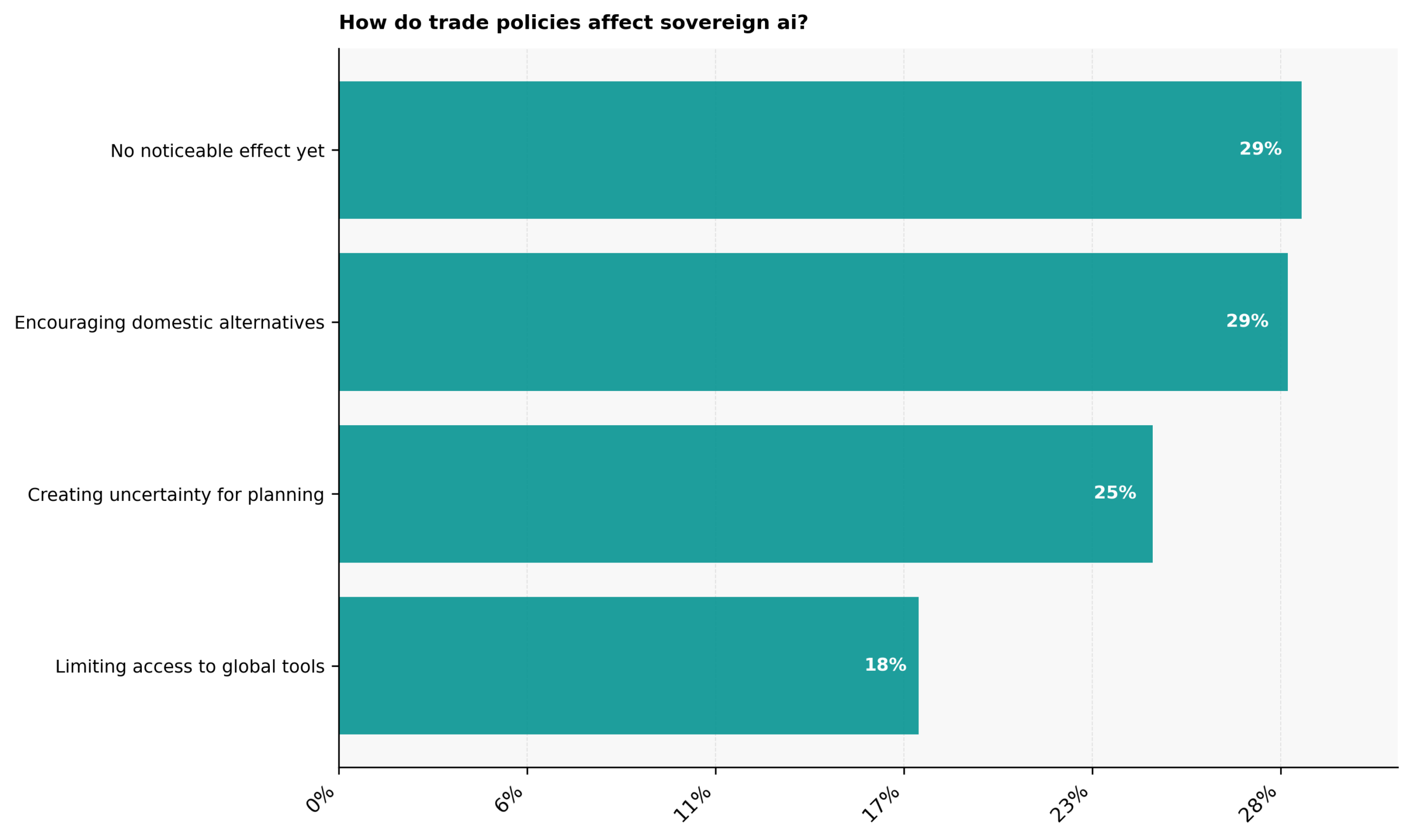
- While 29% of entrepreneurs have not yet seen trade policies having a noticeable effect on sovereign AI, the same number (29%) have seen that these policies are encouraging domestic alternatives; 25% have noted that sovereign AI is creating uncertainty for planning, and 28% note that it is limiting access to global tools
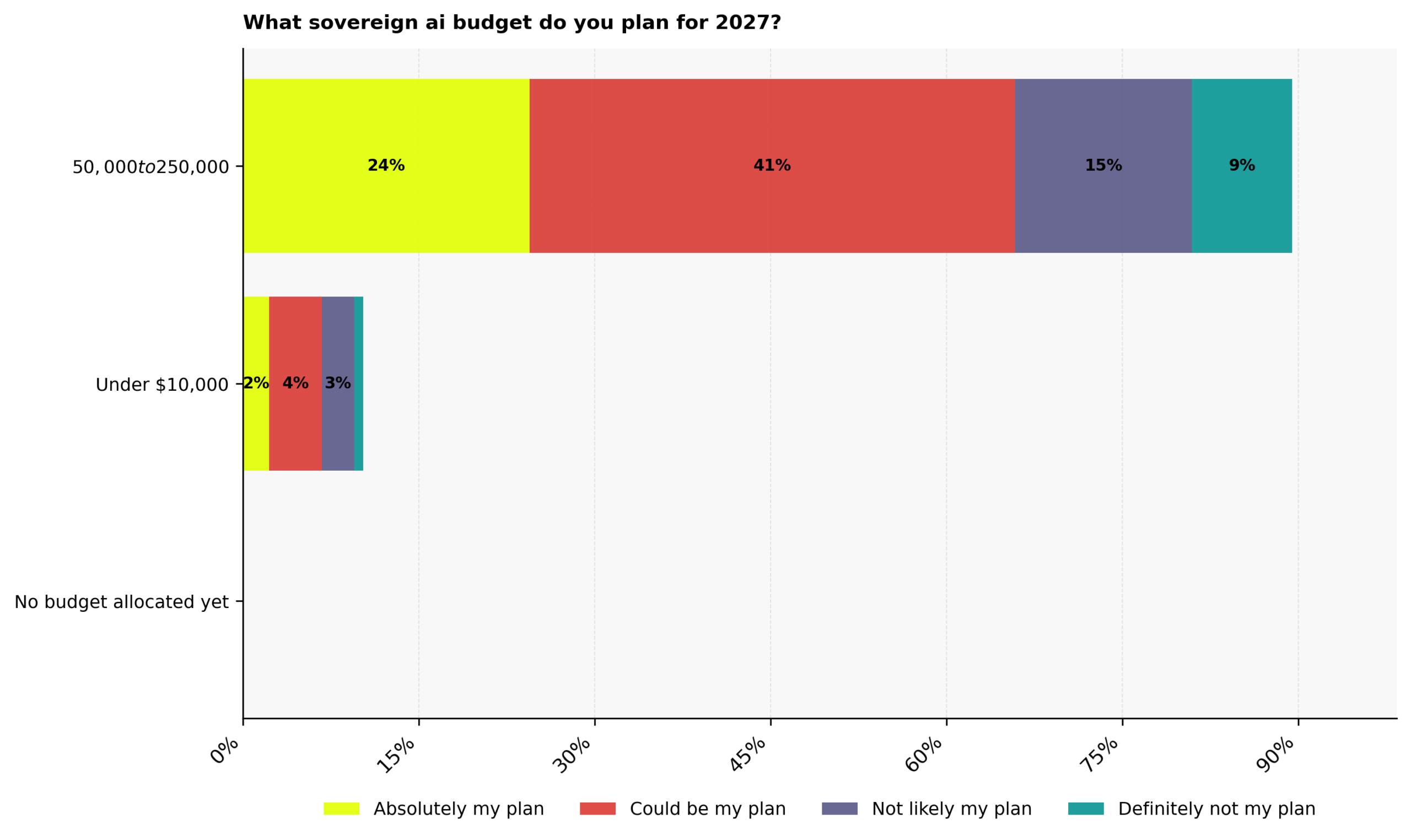
- 24% of entrepreneurs absolutely plan to spend between $50,0000 and $250,000 on sovereign AI in 2027; this could be the plan for 41%, but it’s not a likely plan for 15%, and it’s definitely not what 9% plan to spend; while 2% absolutely plan to spend under $10,000 on sovereign AI, 4% could do so, but 3% are not likely to spend this
- 93% of entrepreneurs are not currently planning to fund sovereign AI adoption, while 7% plan to fund adoption with venture capital or private investment funds
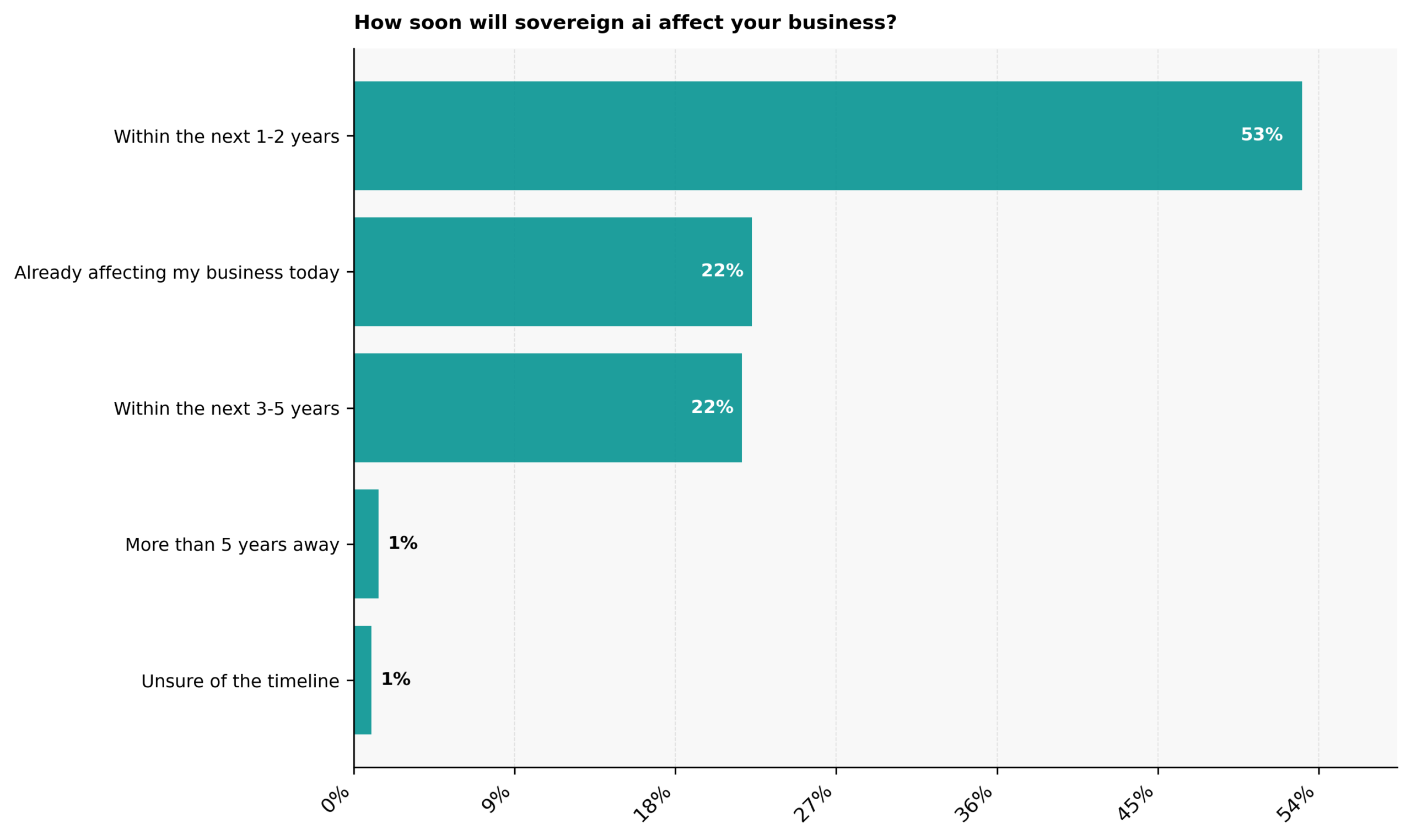
- 53% of entrepreneurs think that sovereign AI will affect their business within the next 1 to 2 years, 22% within the next 3 to 5 years, and 1% in more than 5 years’ time, but for another 22%, sovereign AI is already affecting their business, and 1% are not sure of the timeline in which it will have an impact
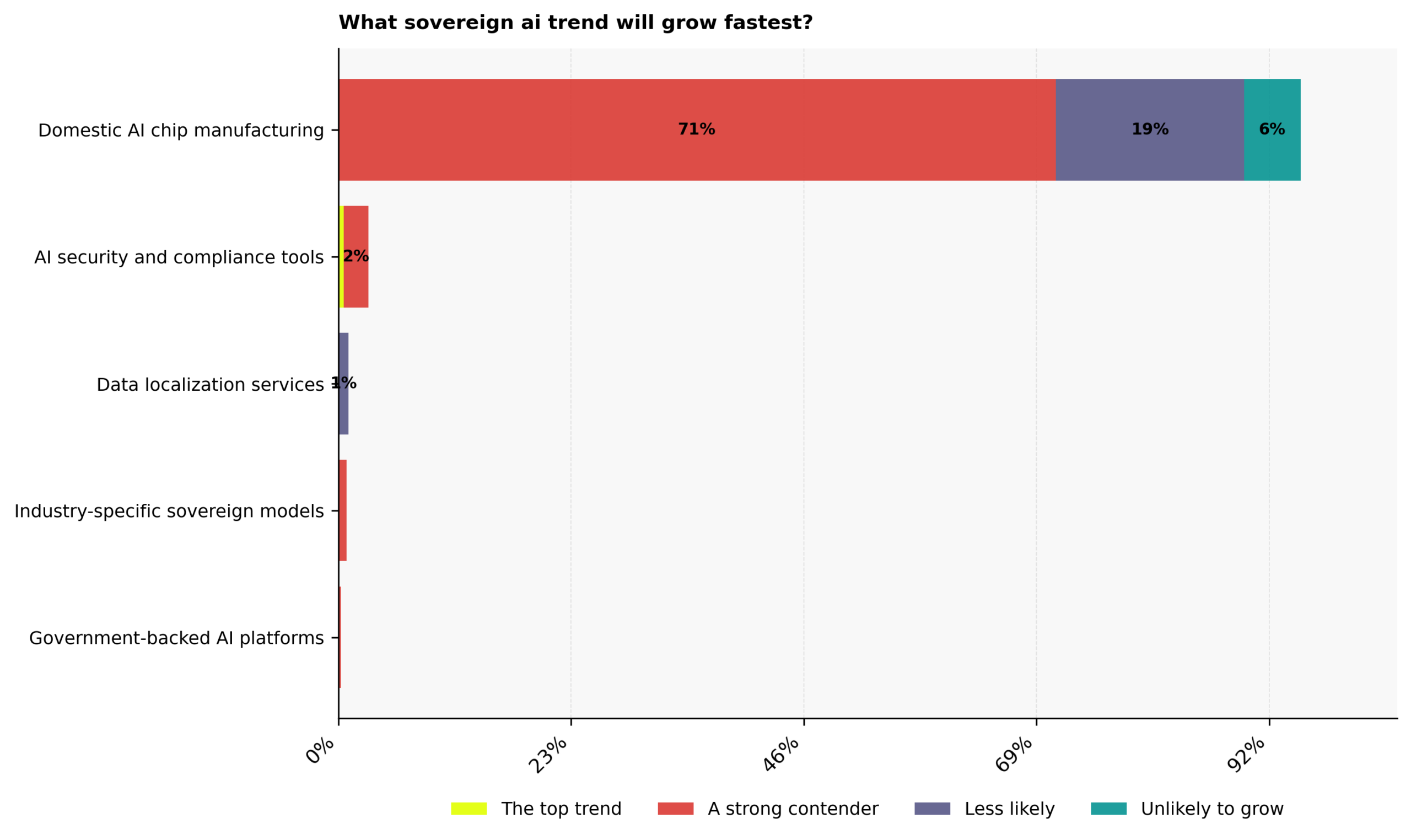
- 71% of entrepreneurs think that domestic AI chip manufacturing is a strong contender for the fastest-growing sovereign AI trend, but 19% think this is less likely to trend fast, and 6% think it’s unlikely to grow; just 2% think that AI and security compliance tools are a strong contender for the fastest-growing trend, and 1% think data localization services are less likely to grow fast
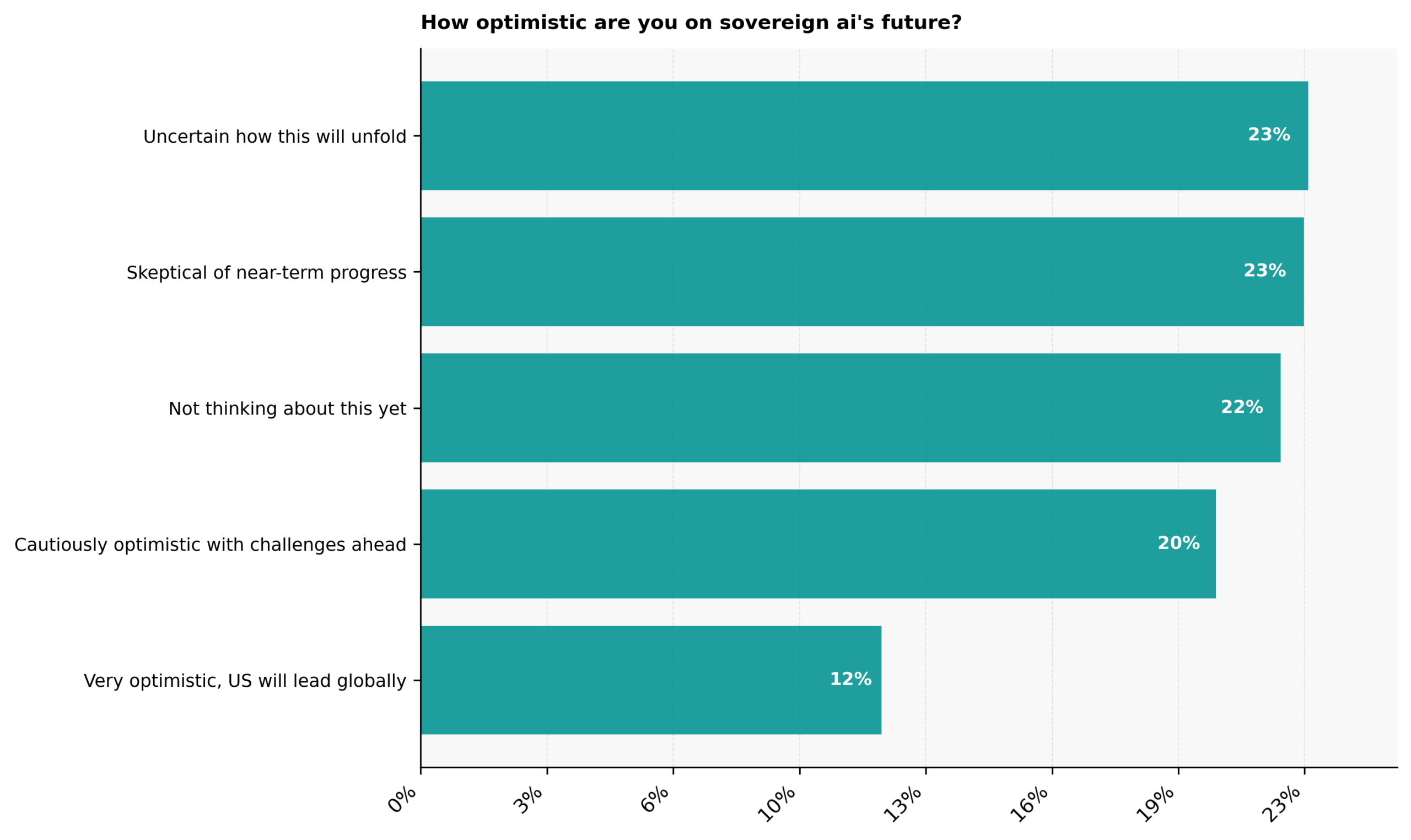
- 23% of entrepreneurs are uncertain how sovereign AI will unfold, another 23% are skeptical of near-term progress, and 22% are not thinking about the future; however, 20% are cautiously optimistic but see challenges ahead, and 12% are very optimistic about sovereign AI’s future and think the US will lead globally
- Opportunities and challenges of sovereign AI for US entrepreneurs
Methodology and data
Sourced using Artios from an independent sample of 1,371,329 opinions of entrepreneurs in the USA across X, Quora, Reddit, Bluesky, TikTok, and Threads. Responses are collected within a 95% confidence interval and a 5% margin of error. Results are derived from what people describe online, from opinions expressed, not actual questions answered by people in the sample.
How familiar are entrepreneurs with sovereign AI as a concept?
31% of entrepreneurs are very familiar with sovereign AI as a concept and track this space, and 26% are somewhat familiar with the concept and have read a few articles; however, 17% have only heard the term in passing, and 27% are not familiar with sovereign AI at all
Familiarity reveals knowledge gaps:
Sovereign AI is becoming an increasingly important strategic priority for several reasons. Many regions worldwide and business leaders are directly increasing productivity, competitiveness, and economic progress through AI systems. AI deployers are also increasingly being held legally liable for AI failures such as hallucinations and biases.
Economic impacts are another essential factor. Countries and organizations that rely heavily on foreign AI models effectively outsource the economic value of their data, while retaining sovereignty keeps their GDP and financial impacts far more within their control.
The benefits of sovereign AI may be clear, but US-based entrepreneurs’ familiarity with the concept still varies considerably.
31% are actively tracking the sovereign AI space and consider themselves very familiar with the concept. A close 26% are somewhat familiar with it and have read a few publications on the topic to date.
However, not all entrepreneurs are confident in their understanding of sovereign AI. 17% have only heard the term in passing and have yet to explore the concept or its potential benefits in any real detail. The remaining 27% aren’t familiar with sovereign AI at all, emphasizing a notable knowledge gap that could limit entrepreneurs’ preparedness for future shifts in AI-enabled business tech.
Which best describes entrepreneurs’ current use of AI tools in business?
13% of entrepreneurs are not using AI tools currently, and this somewhat describes the lack of usage for 36%, but it’s not really a good descriptor for 27%, and it doesn’t describe the AI use of 16% at all, while 6% identify with the statement that they occasionally use AI for specific tasks, and no one voices any opinions on daily AI use across multiple functions or whether they are planning to adopt AI within the next year
AI use is still low:
AI usage among US businesses is rising. Data from the US Chamber of Commerce’s Technology Engagement Center report shows that 58% of small businesses used generative AI as of 2025, a 40% increase from the previous year. The report also shows that as many as 96% of small business owners are actively planning to adopt emerging AI technologies, and that 80% credit these technologies, along with others, with helping them handle supply chain disruptions and inflation pressures while improving access to capital.
While these numbers are encouraging, many entrepreneurs have not yet adopted AI tools into their business workflows. Among our audience, 13% are not using any AI tools at present, and 36% agree to some extent that this describes their tool use. In contrast, 27% note that their businesses don’t quite fit this no-AI category, and 16% say this category doesn’t describe them at all.
Some entrepreneurs use AI only occasionally, preferring to rely on it for specific tasks or responsibilities. Only a fraction of a percentage of our audience fully aligns with this category, while 6% agree that it’s a somewhat fitting description of their AI usage, and just 1% don’t fully agree with it.
Overall, fewer than 1% of entrepreneurs use AI daily across multiple business functions, and this group says it only somewhat describes their current adoption and use of these tools.
Given that the Chamber of Commerce report finds high-tech organizations continue to outperform low-tech small businesses in both sales and profits, increasing these usage rates could help many entrepreneurs build more resilient, profitable operations in the long run.
How has AI adoption changed entrepreneurs’ competitive position so far?
While it’s too early to tell whether AI use has changed 35% of entrepreneurs’ competitive position so far, 30% have seen somewhat improved efficiency and output, and 22% have significantly strengthened their position, but for 12%, AI adoption has created new pressures they are still adapting to
AI adoption has a mixed effect:
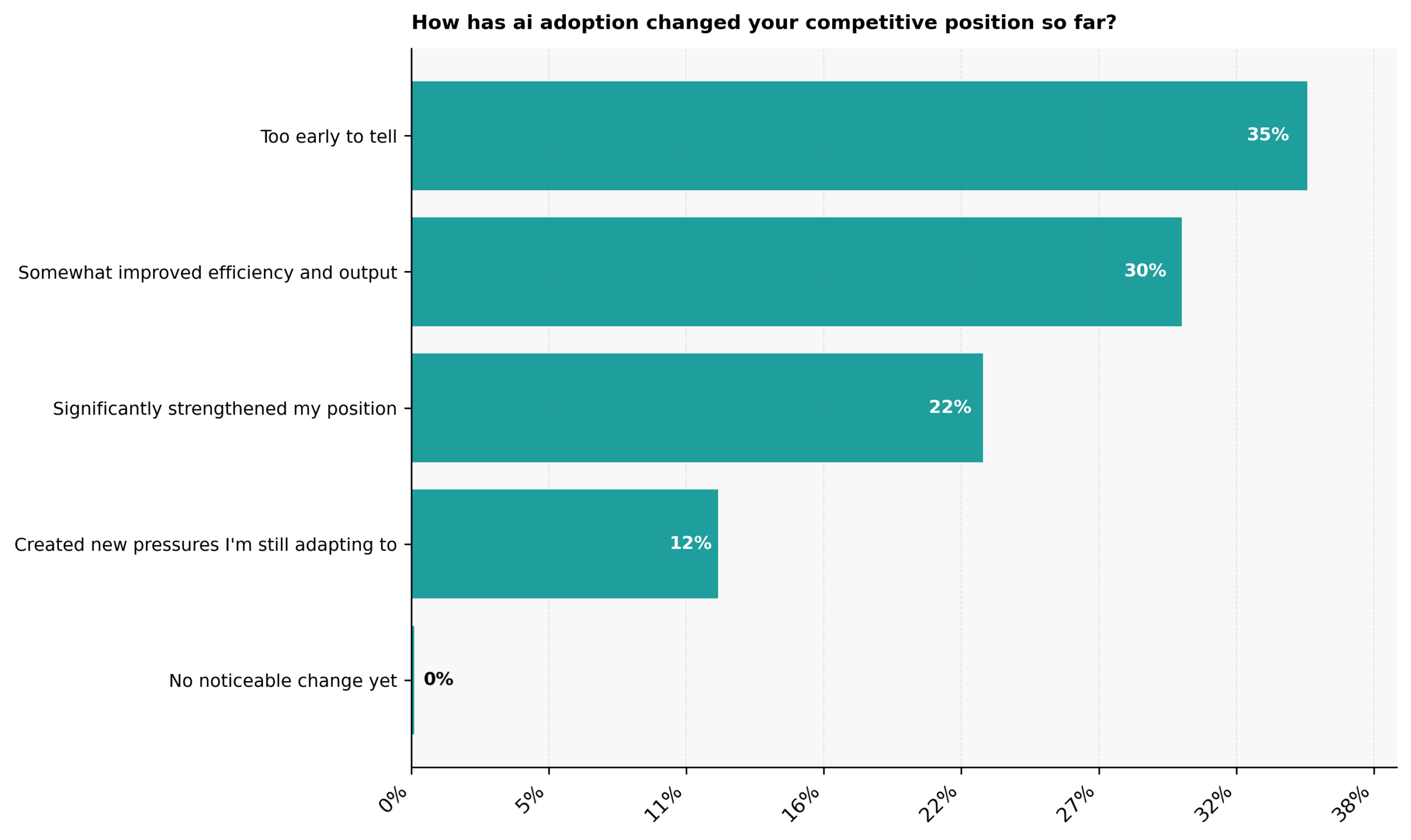
According to the World Economic Forum, AI is having widespread impacts on how entrepreneurs are founding, operating, and scaling their startups. However, taking into account the modest pace of adoption among our audience, it’s understandable that 35% of entrepreneurs feel that it’s still too early to tell how adopting AI has changed their competitive positions to date. Encouragingly, 30% note that AI adoption has somewhat improved their businesses’ efficiency and outputs, and 22% believe AI has notably strengthened their positions within their respective markets.
Conversely, only 12% of entrepreneurs have found that AI adoption has created new challenges and pressures to which they are still learning how to adapt. Lastly, no one reported seeing no noticeable changes yet, making it clear that AI is driving major shifts in startups’ competitive positions and overall productivity, albeit to varying degrees.
What is the biggest motivation for entrepreneurs exploring sovereign AI?
For 17% of entrepreneurs, the main motivation for exploring sovereign AI is regulatory compliance requirements; this is also a strong motivation for 31%, and a minor motivation for 9%; 5% are mainly motivated to explore sovereign AI by national security and independence, and a further 10% are strongly motivated by this, 5% cite their top motivator as gaining a competitive edge in their industry and this is a strong motivator for 6%, while 2% are mainly motivated by reducing reliance on foreign tech providers, and 9%are strongly motivated by this, and 1%’s main motivation is data privacy and control, followed by 5% who are strongly motivated by this reason for exploring sovereign AI
Motivations are myriad:
Entrepreneurs have a wide range of motivating factors when considering sovereign AI adoption. While gaining a competitive advantage, securing more privacy and control over their systems and data, and reducing reliance on foreign partners are all compelling, one motivator stands out: meeting strict regulatory compliance requirements.
For 17% of entrepreneurs, this is their primary motivation for exploring sovereign AI solutions, and 31% consider it a strong and enduring motivation. Only 9% agree that regulatory compliance is a minor motivation at best, a low figure compared with the 48% strongly driven by compliance obligations.
Many entrepreneurs also prioritize increasing their national security and independence through sovereign AI systems. 5% of our audience cite this as their main motivation, and another 10% see it as a strong motivator. Of those most focused on reducing reliance on foreign tech providers, 2% say this is their top priority, and 9% consider it a notable motivator.
The remaining entrepreneurs seek either a competitive advantage in their industries or greater data privacy and control. 5% deem gaining a competitive edge their main goal and 6% feel it is a strong motivation, while fewer than 1% feel that it’s only a minor driver in their decisions.
Conversely, 1% are primarily motivated to secure more data privacy and control. 5% are strongly compelled by this factor too, and although it may not be their main motivation for adopting sovereign AI, it’s still among the most important.
Which industry need drives entrepreneurs’ interest in sovereign AI most?
For 88% of entrepreneurs, general business competitiveness is the industry need that drives interest in sovereign AI adoption; for 6%, it’s the need to protect intellectual property; for 5%, it’s meeting government or defense contracts; and for 1%, it fills the industry need for safeguarding customer data
Competition is the biggest driver:
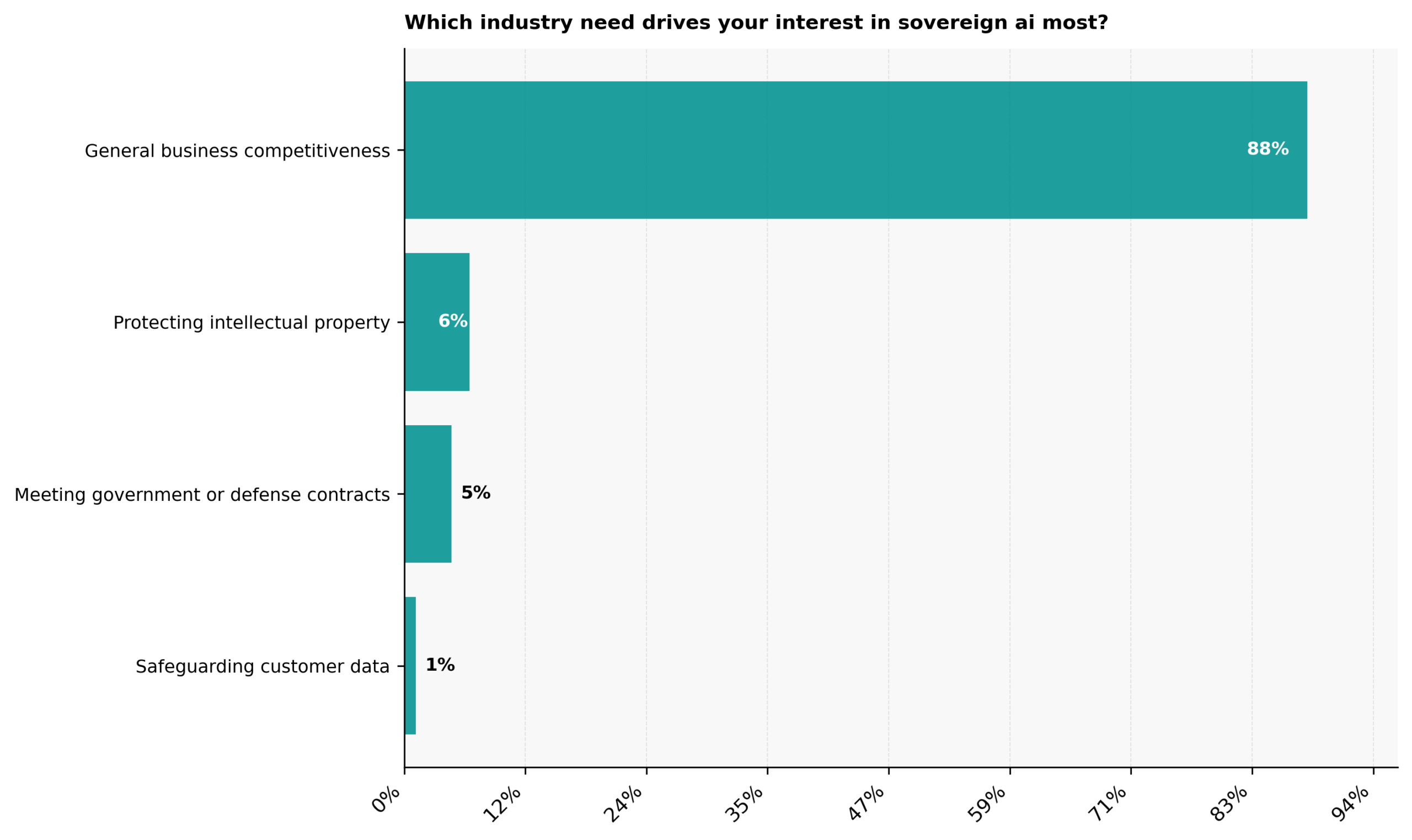
When looking at which industry needs are primarily driving entrepreneurs’ interest in sovereign AI, general business competitiveness is the leading motivator. 88% agree their need for more competitive operations is the main driver behind their interest in adopting new automation technologies.
A much smaller 6% say their interest is driven, for the most part, by a need to protect their businesses’ intellectual property. This stands to reason, given that protecting proprietary data and operational insights is essential to keep them secure against unauthorized or malicious use when processed through third-party AI platforms, which is a growing risk for companies across industries today.
Similarly, 5% say meeting the requirements of valuable government and defense contracts is their most compelling need. In comparison, only 1% are most interested in protecting customers’ data against rising threats like phishing, ransomware, leaks, and other data-related cybercrimes.
Which sovereign AI use case excites entrepreneurs most?
16% of entrepreneurs are extremely excited about sovereign AI being used for secure customer data management, and 23% find this somewhat exciting, but 19% don’t find this very exciting; 8% share the same lack of excitement about AI use in domestic supply chain optimization, 3% regarding industry-specific compliance tools, and 9% in government and defense contracting, but 23% find AI use in this type of contracting somewhat exciting
Excitement levels are not unanimous:
With demand for data sovereignty in AI systems growing by the year, organizations are seeking out a range of different strategies to balance sovereignty with their compliance targets.
In terms of prospective use cases, the majority of our audience is most enthusiastic about using sovereign AI for secure customer data management. 16% consider this use case extremely exciting, and 23% are excited about it to some degree, compared to 19% who are not particularly interested in this particular application. This is a particularly strong use case for sovereign AI, as third-party customer data management models, especially cloud-based ones, add data risks that sovereign systems can mitigate.
Many entrepreneurs also consider government and defense contracting applications to be promising potential applications. 23% view these use cases as somewhat exciting, while just 9% are not especially inspired by them.
Other applications, such as domestic supply chain optimization and industry-specific compliance management, attract less enthusiasm. 8% of our audience is less than excited by the prospect of using sovereign AI to optimize their local supply chains, and 3% admit that these tools’ use cases for industry-specific compliance have yet to inspire their eagerness.
Which sovereign AI model type appeals most to entrepreneurs’ businesses?
18% of entrepreneurs agree that US-built and US-hosted proprietary models seem promising sovereign AI model types for their business, but this isn’t the top pick for 49%, and it doesn’t appeal to 15%, while the remaining 15% think that industry-specific sovereign AI platforms seem promising
Two models show some promise:
Sovereign AI is rapidly entering government systems, with 52% of government leaders now actively planning to invest in it within the next 12 to 18 months. 58% of leaders also view robust sovereign data governance, control, and quality as non-negotiable requirements for sovereign AI platforms, indicating widespread plans to incorporate them into government-level data governance efforts.
While sovereign AI has substantial applications in such large-scale systems, its potential doesn’t end there. Governments and entrepreneurs are aligning on shared priorities, including tight control over data and governance and building enduring trust with customers, clients, and the public.
US-hosted proprietary models offer the highest levels of control and visibility over data governance processes, which may be why most of our audience feels US-built and hosted models appeal most to their businesses. 18% believe these model types are promising for their needs, though 49% say they aren’t their first choice, and 15% don’t find them appealing at all.
A smaller 18% of entrepreneurs find most appeal in industry-specific sovereign AI platforms. However, while this is a clear minority, the full 18% feel these models are promising, showing generally positive sentiment toward industry-focused solutions designed to address their specific data governance needs.
Which factor most influences entrepreneurs’ choice of AI infrastructure?
Cost and scalability are the deciding factors for 2% of entrepreneurs when choosing AI infrastructure, a strong influence for 31%, and somewhat important for 15%, but not a major factor for 1%; who owns and controls underlying models strongly influences 8%, is somewhat important for 16%, but not for 2%; vendor reputation and reliability strongly influence 12% of entrepreneurs’ choice of AI infrastructure, and are somewhat important for 5%, while government regulations and incentives strongly influence 3%, and are somewhat important for 5%
AI infrastructure choices are influenced by four main factors:
IBM estimated that the average cost of computing would rise by up to 89% between 2023 and 2025, with 70% pinpointing generative AI as a key driver of this trend. The impact is clearly manifesting across industries today, with every executive included in IBM’s research reporting that their organizations have canceled or postponed one or more generative AI projects due to concerns around their costs.
With that in mind, cost and scalability are two of the biggest factors influencing entrepreneurs’ choices when it comes to AI infrastructure. 49% say cost and scalability are their most influential decision-making factors; 2% consider them the ultimate deciding factors; 31% see them as strong influences; 15% view them as somewhat important; and just 1% don’t see them as a major factor at all.
Ownership and control also hold weight during the decision-making process. Fewer than 1% of our audience considers who owns and controls underlying AI models as their primary deciding factor, but 8% view this as having strong influence and 16% cite it as having at least some degree of importance. Just 2% are not concerned with the entities who own and control their potential selections.
The reputation and reliability of an AI vendor matter less, but are still significant. Again, fewer than 1% of entrepreneurs consider this a make-or-break factor, although 12% are notably influenced by reputation, 5% consider it somewhat important, and fewer than 1% are neutral.
Additionally, while government incentives and regulations can significantly affect AI adoption and integration, only 3% believe they are strongly influential, and fewer than 1% consider them a deciding factor. At the other end of the spectrum, 5% view government regulations and incentives as somewhat important, and fewer than 1% see them as little to no concern.
What sovereign AI feature matters most to entrepreneurs?
For 7% of entrepreneurs, cost-effectiveness at scale is an absolutely essential sovereign AI feature, and it’s quite important for 18%; interoperability with existing tools is quite important for 28%; 25% put the same importance on transparent AI model training data; and 23% agree full data ownership and control is also quite important
Some features hold more appeal than others:
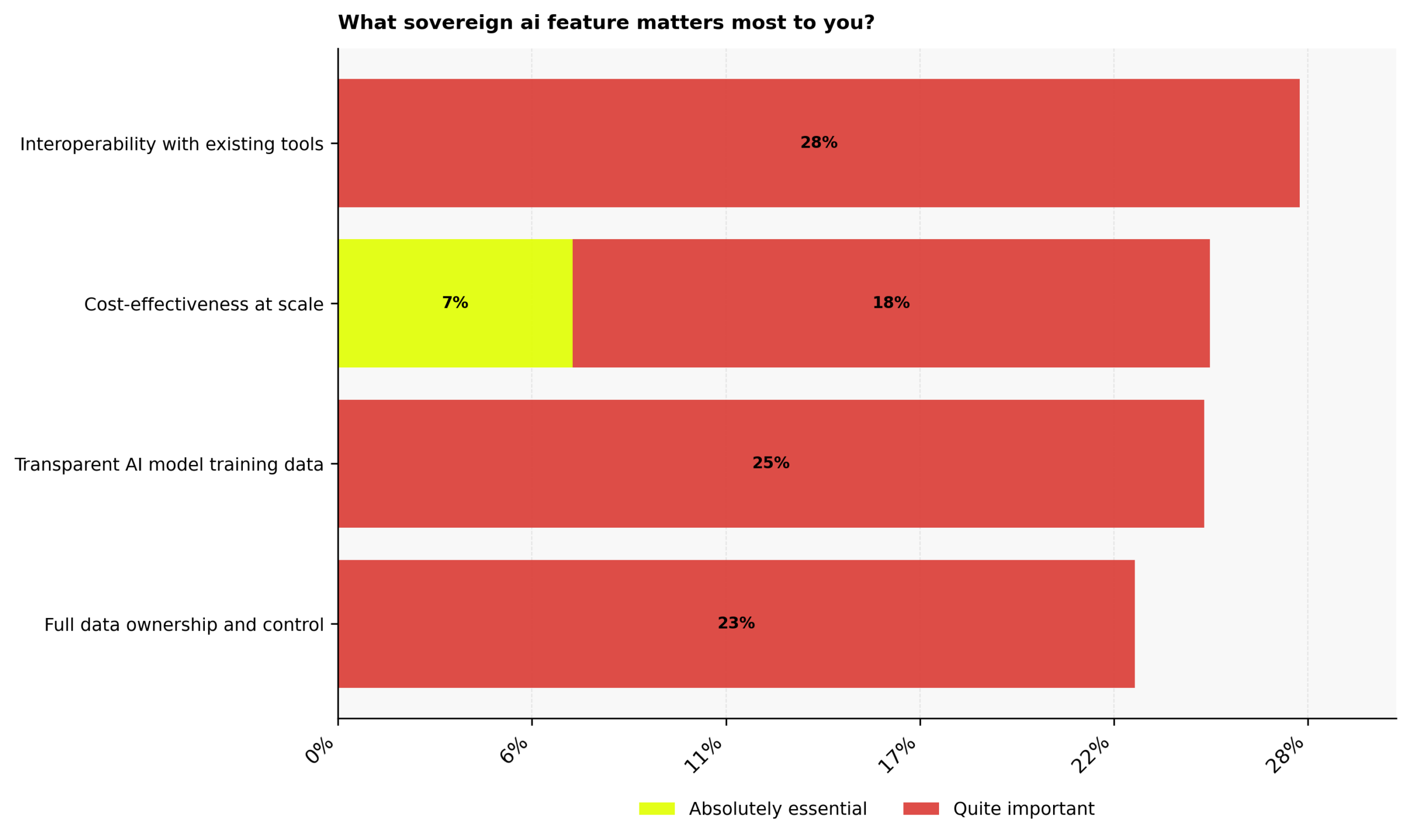
Our audience’s opinions on their top-priority sovereign AI feature are evenly divided. The slight majority, 28%, feel that interoperability with existing tools and business systems matters most, with the full contingent deeming this feature quite important. In total, a quarter (25%) view cost-effectiveness at scale as their top priority; 7% feel that this is an absolutely essential benefit, compared to 18% who believe that it’s quite important.
Another 25% seek transparent AI model training data, with the full group viewing this transparency as notably compelling in their ultimate choice. Full ownership and control of proprietary business data also matters, with 23% of entrepreneurs saying this is an important feature in the sovereign AI systems they are considering adopting.
How important is data localization to entrepreneurs’ business strategy?
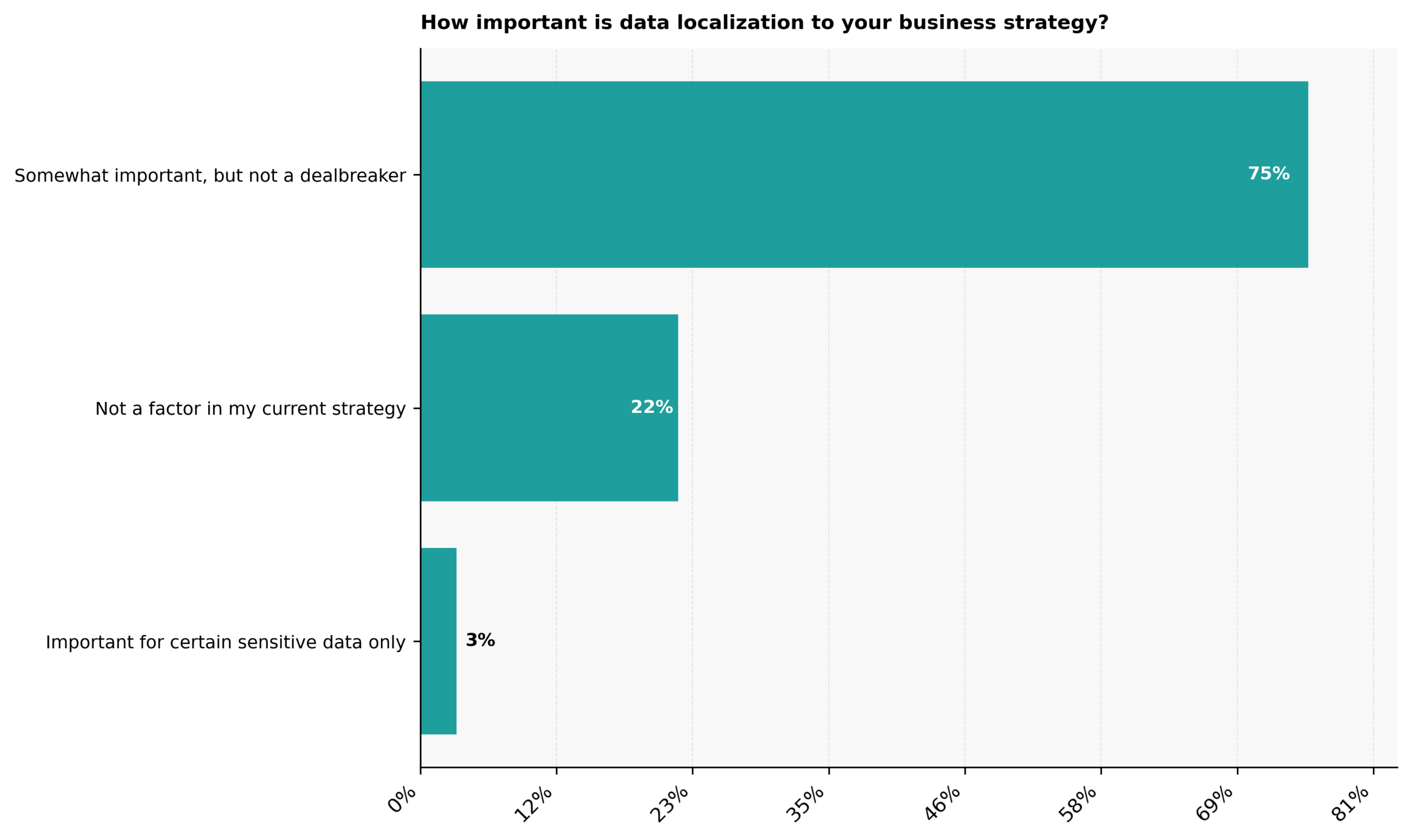
For 75% of entrepreneurs, data localization is somewhat important to their business strategy, but it’s not a dealbreaker; 22% don’t factor it into their current strategy, and for 3%, data localization is important only for certain sensitive data
Data localization is not high up on the priority list:
Data localization policies have been gaining traction as concerns around national sovereignty and data security rise, requiring businesses to house and process their data on local servers rather than offshore options. While they are designed to provide overarching protection, authorities such as Harvard Kennedy School’s Belfer Center worry that they are causing economic harm and are insufficient to meaningfully improve security.
Despite skepticism from experts, many entrepreneurs view data localization as having at least some degree of importance within their overall business strategies. 75% state that data localization is somewhat important, but they don’t view its presence or absence as dealbreakers.
An additional 22% haven’t incorporated it into their current strategies, and only 3% believe it’s an important undertaking to adopt, but only to protect certain forms of sensitive data.
How concerned are entrepreneurs about foreign control over AI infrastructure?
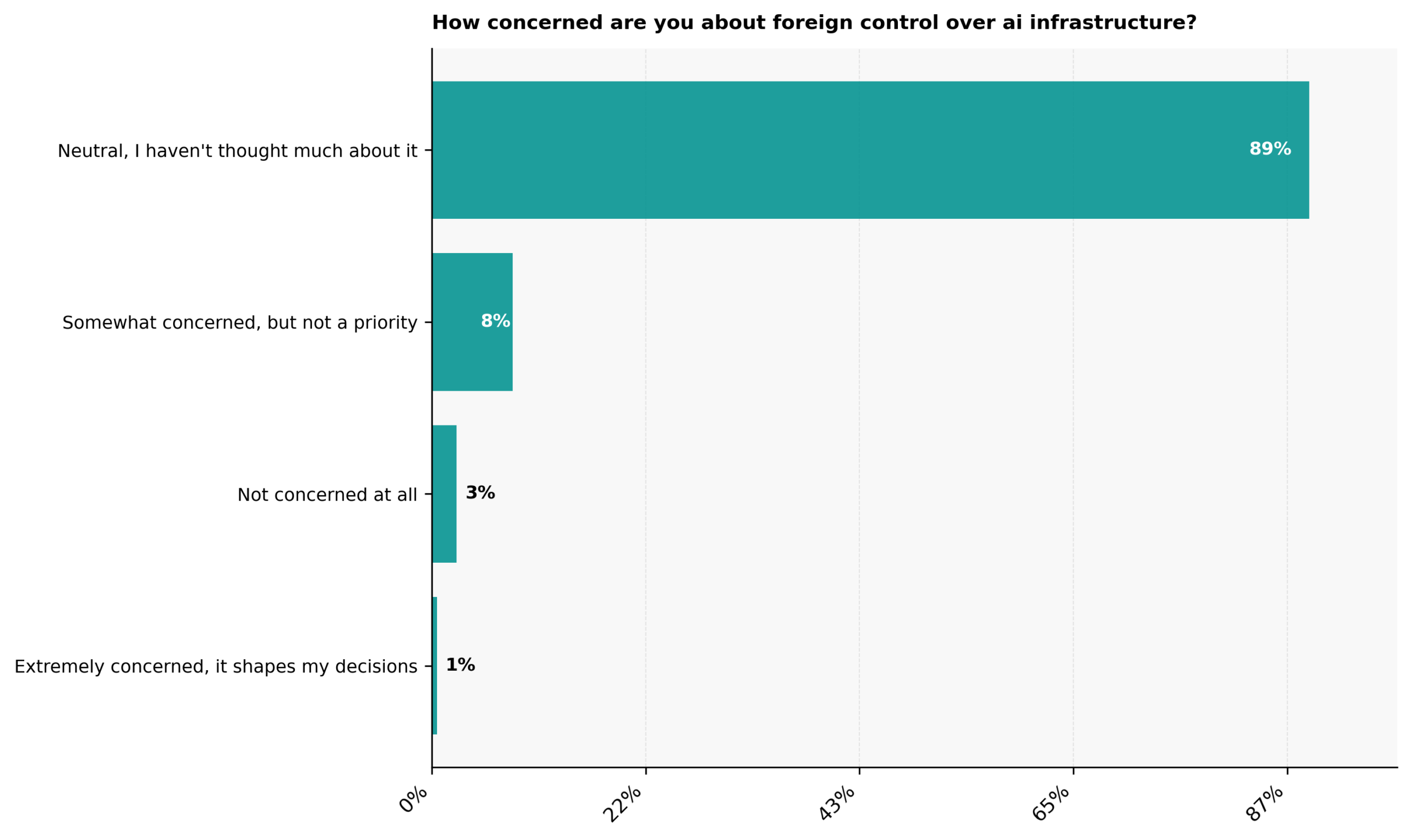
89% of entrepreneurs are neutral about foreign control over AI infrastructure and haven’t given it much thought, and 3% are not concerned at all; however, 8% are somewhat concerned about foreign control, but it is not a priority, and just 1% are extremely concerned, as this control shapes their decisions
Control concerns are minimal:
Foreign control over AI infrastructure may carry notable risks, from compromised data sovereignty and operational disruptions to the introduction of foreign biases, increased strategic vulnerability, and a loss of potential value creation. Organizations that rely on foreign AI systems may also lose access with little warning if regional access is blocked or revoked for any number of reasons.
These risks are considerable, but most entrepreneurs remain unfazed by foreign control over AI infrastructure. 89% are neutral on the topic and don’t give it much consideration, compared with 1% who are extremely concerned about foreign control as it shapes many of their relevant decisions.
Conversely, 8% of our audience are somewhat concerned but don’t view foreign AI infrastructure control as a priority, and 3% aren’t at all concerned about the risks or implications. Ultimately, the majority who take a neutral stance may be more concerned with compliance, cost-efficiency, and the real-world performance of their sovereign AI systems than with the potential risks of external control.
Which sovereign AI vendor trait matters most to entrepreneurs?
Strong customer support and training is an absolutely essential sovereign AI vendor trait for 59% of entrepreneurs, and it’s quite important for 36%; proven government or defense clients is absolutely essential for 3%, and for 2%, US-based data centers and ownership are quite important
One vendor trait stands out:
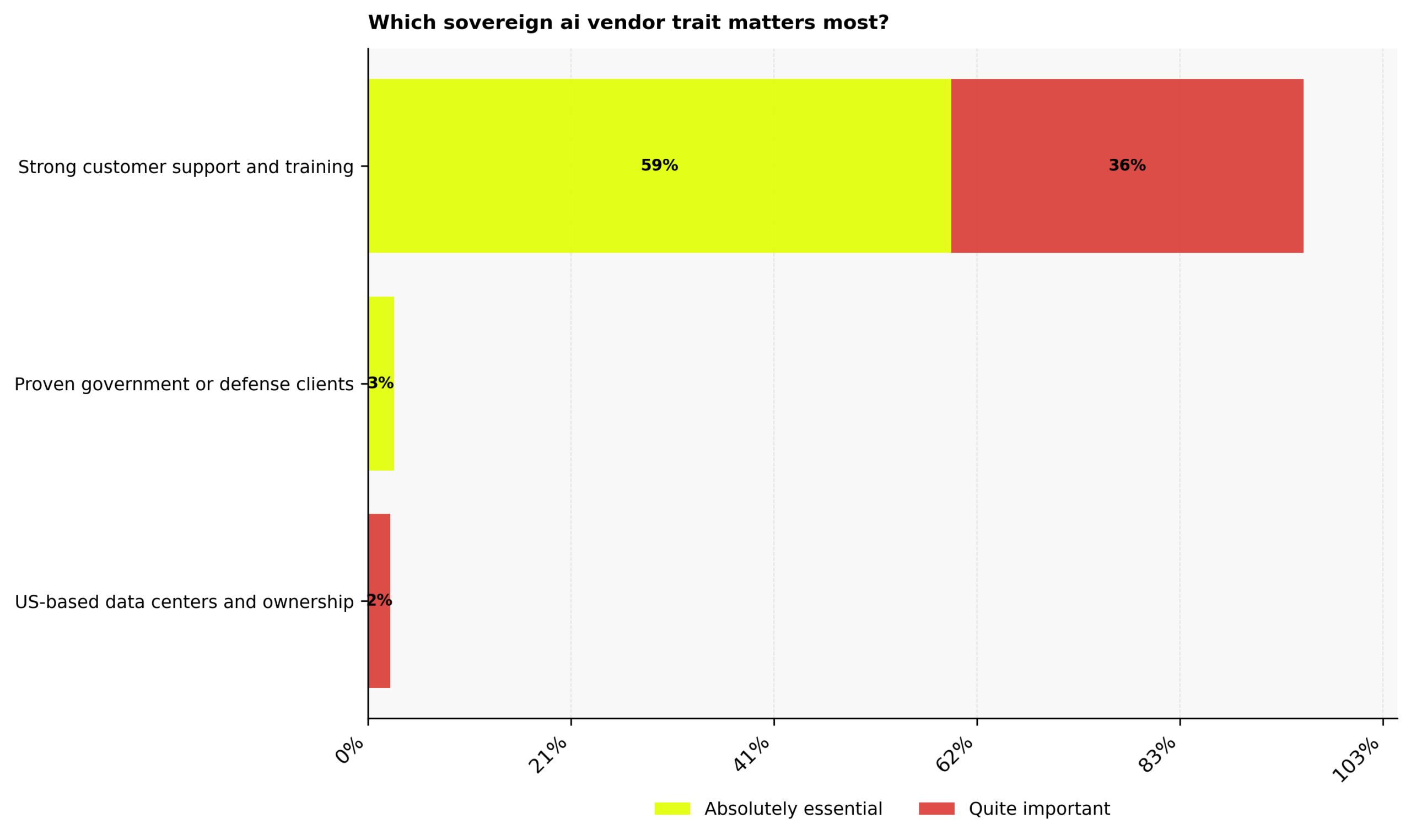
When evaluating entrepreneurs’ preferences in how sovereign AI vendors deliver their services, strong customer support and training stand out as a desirable trait. 59% view comprehensive customer support and training as absolutely essential, and another 36% see it as highly important for delivering maximum value.
Smaller proportions of our audience also hold proven track records with government and defense clients and US-based ownership and data centers in high regard.
3% feel it’s imperative that their sovereign AI vendors can demonstrate quality past work for government and defense organizations, and 2% believe it’s quite important to partner with US-based vendors that operate dedicated data centers on home soil.
How do entrepreneurs rate US sovereign AI infrastructure?
71% of entrepreneurs are not familiar enough with US sovereign AI infrastructure to be able to rate it, and 29% agree that it’s too early to judge it
Ratings are not yet available:
North America currently leads the global sovereign AI cloud and infrastructure market, with a dominant market share of about 38%. The United States alone accounts for about 92% of the region’s market share, representing more than 77% of global AI infrastructure spend, estimated at $69.2 billion in Q4 of 2025.
Although the US provides and administers a substantial share of the world’s sovereign AI infrastructure, local entrepreneurs still don’t feel knowledgeable enough about these services to rate them with confidence. 71% aren’t familiar enough with US-based sovereign AI infrastructure to assess its quality or capabilities. The remaining 29% think it’s too early to judge these factors and others, and they need more time to make an accurate, well-rounded assessment.
What sovereign AI risk worries entrepreneurs most?
Regulatory and compliance risk is somewhat concerning for 72% of entrepreneurs but not a major worry for 15%; 7% are somewhat concerned about a loss of control to foreign entities due to sovereign AI, yet 4% don’t see this as a major worry, and just 2% consider vendor lock-in and dependency as somewhat concerning
Risks are largely unconcerning:
In a review by MIT Sloan Management Review, 60% of respondents note that growing geopolitical risks have made them more likely to investigate sovereign technology solutions. However, only 15% prioritized AI sovereignty at their board or CEO levels, and fewer than 13% view it as a key driver of future growth rather than an additional, ongoing expense.
Several factors may explain the gap between the number of decision-makers considering sovereign solutions and the proportion willing to make implementation a priority. Based on our audience’s sentiments, regulatory and compliance risks could be a major factor hindering adoption.
72% of entrepreneurs cite regulatory and compliance risks as somewhat concerning risks of sovereign AI adoption, compared with only 15% who don’t find them a major worry.
Losing control of systems and data to foreign entities is another clear concern, though it worries far fewer entrepreneurs. 7% of our audience cited this risk as somewhat concerning, while 4% don’t view it as a major worry at present. Vendor dependency and lock-in also seem to be a topic of concern, albeit a minor one. Only 2% view these potentialities as somewhat concerning.
This shows far greater apprehension over the possible penalties of regulatory non-compliance among most entrepreneurs, while worries about foreign control and vendor challenges remain relatively low.
What sovereign AI talent gap concerns entrepreneurs most?
For 32% of entrepreneurs, a lack of sovereign AI talent is not a big worry, and it’s of no concern for 36% at all, but 10% find that no access to specialized training is a major talent gap concern; yet 3% are not worried about it; 8% find limited leadership AI literacy somewhat concerning, 6% share the same sentiment about a lack of AI engineering skills, and 5% are most concerned about a shortage of cybersecurity expertise
Some talent gaps are more concerning than others:
The Sovereign AI Race: USA (2025) report estimated that the number of American AI users would grow by approximately 21 million that year, bringing the national total to 133 million users. The latest 2026 edition of the report also separates the capacity of sovereign AI systems into five distinct layers, one of which is talent acquisition. According to the report, the US hired 34% of the top talent in this sector in 2026, behind only China, which secured 41% of top researcher talent.
Because talent is a core foundation of the sovereign AI race, gaps in available talent create significant barriers for organizations trying to advance their sovereign system implementation. However, despite this, most entrepreneurs in our audience aren’t concerned about the most prominent sovereign AI talent gaps. For 32%, talent isn’t a major concern, and another 36% say talent gaps aren’t a concern at all.
Still, some entrepreneurs admit to concerns about talent availability and acquisition. 10% cite limited access to specialized training as a major concern, compared with 3% who don’t see it as a real worry. 8% view limited AI literacy among leadership as somewhat concerning, and 6% are somewhat worried by a lack of AI engineering skills, with fewer than 1% citing this as a major concern.
Some entrepreneurs are also concerned about potential shortages of cybersecurity expertise, with 5% agreeing that this is a major concern for them.
While talent gaps, such as a lack of specialized training, limited AI literacy, and limited cybersecurity expertise, seem impactful, most entrepreneurs are confident they can secure the talent, skills, and expertise they need for long-term success.
How do entrepreneurs view US government policy on sovereign AI development?
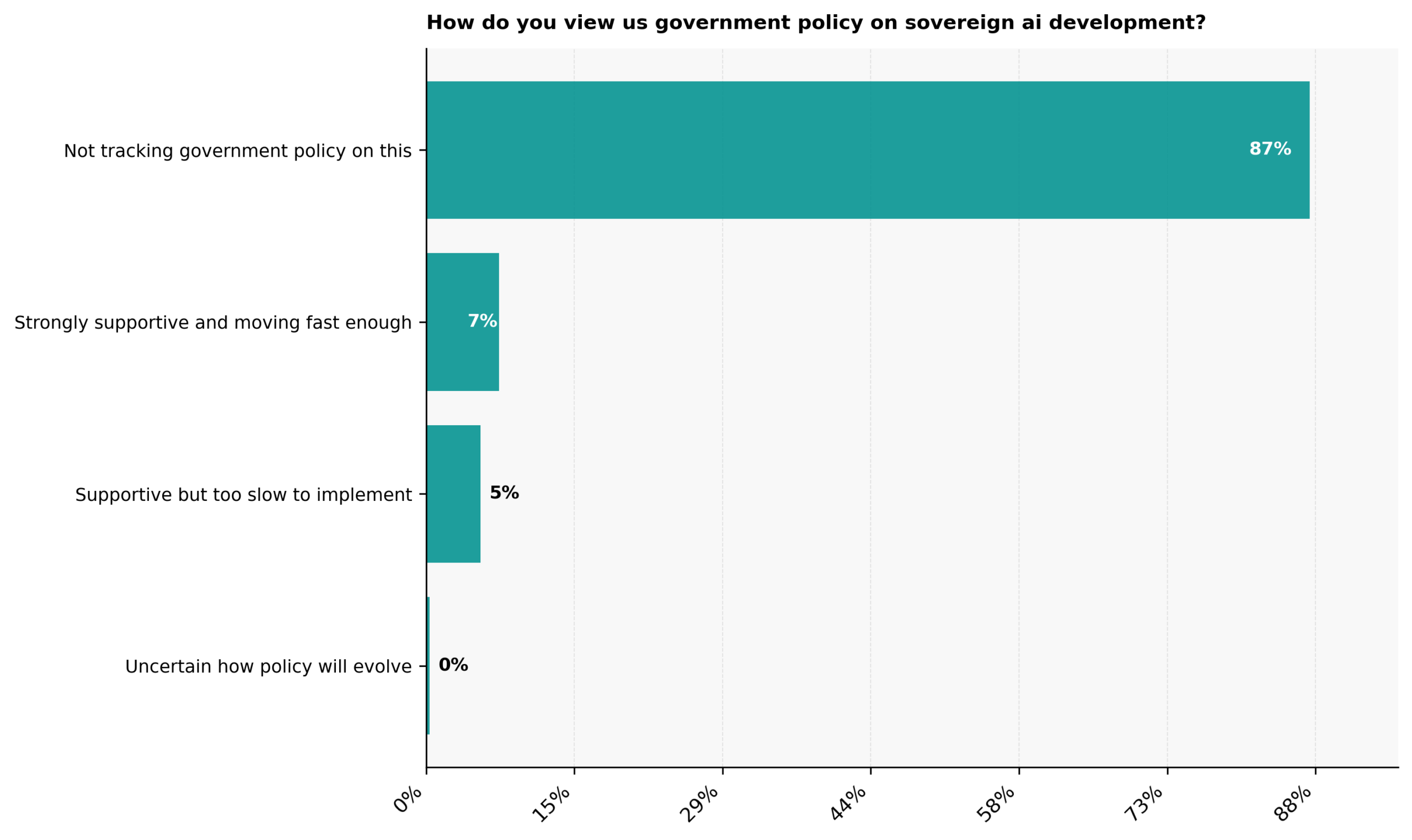
87% of entrepreneurs are not tracking government policies on sovereign AI development; however, 7% are strongly supportive of these policies and think they are moving fast enough, but 5% are supportive and don’t think they are moving fast enough, and no one voices an opinion on being uncertain how these policies will evolve
Policy support remains mixed:
The US government has introduced strong policies to promote AI security and innovation, aiming to work with the private sector to modernize relevant information systems and safeguard them against external risks.
These policies, detailed in Executive Order 14409, were published in June 2026, which may explain why many entrepreneurs are not yet aware of them. 87% of our audience admit they are not currently tracking government policies on sovereign AI development, and none feel confident about how policy will evolve in the future, perhaps because of this general lack of awareness of current developments and progress.
At the other end of the spectrum, 7% strongly support the government’s sovereign AI policies and feel they are moving fast enough to proactively address current and future risks and advances. Another 5% support the recent policy but believe the government has not implemented it quickly enough to fully support widespread AI adoption and sufficient data protections.
What role should government play in sovereign AI development according to entrepreneurs?
49% of entrepreneurs think that it is absolutely essential that government fund and build national AI infrastructure; 26% agree this is somewhat important, but 12% don’t think it’s really needed, and 7% think the government should stay out of this area of sovereign AI development; 2% are unsure what government role would be appropriate; and 4% think they should stay out altogether, while no one voices an opinion on whether the government should stay minimally involved and let markets decide
Government involvement is uncertain:
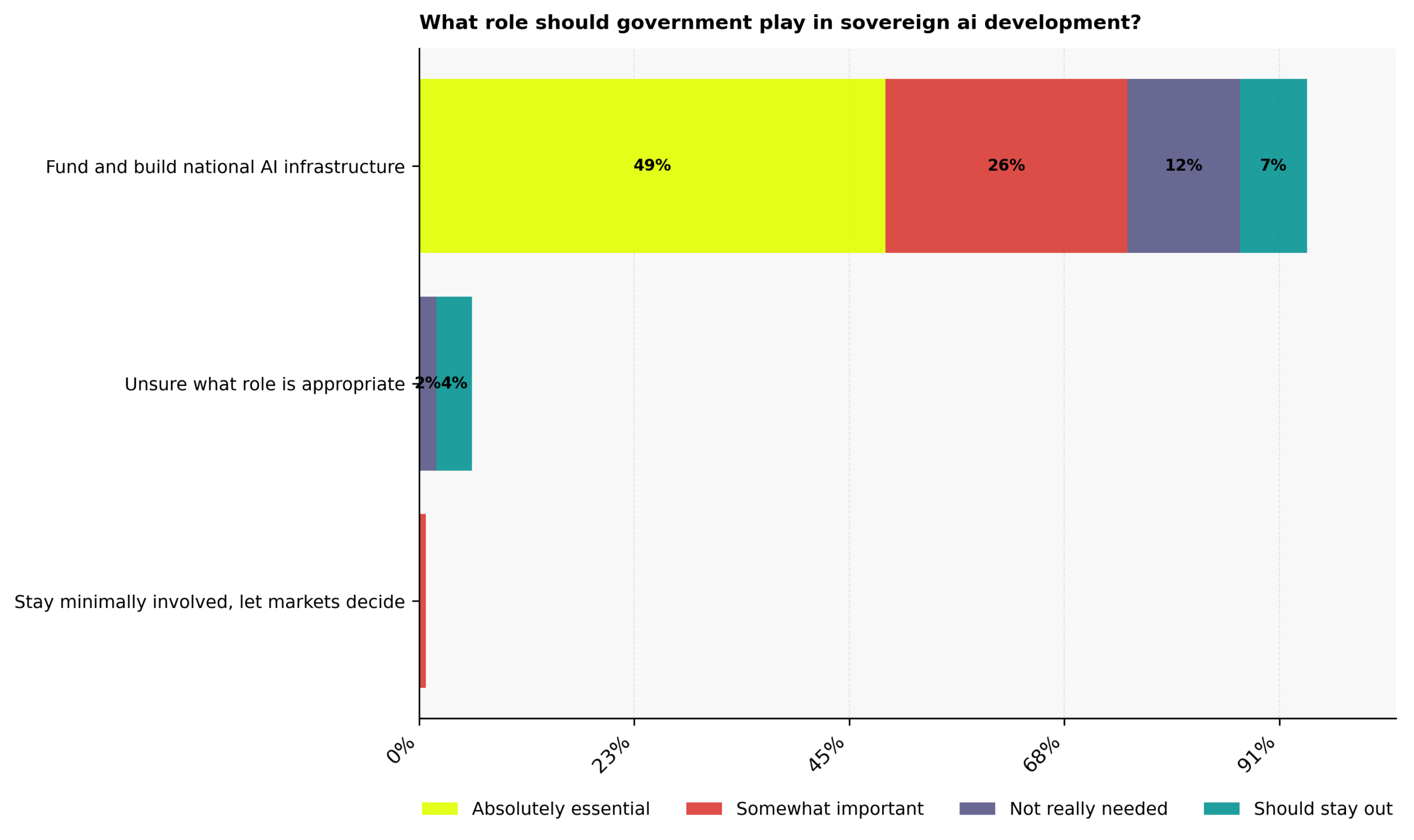
Most entrepreneurs feel the government should focus primarily on funding and building US-based AI infrastructure, with nearly half (49%) saying this is absolutely essential. 26% believe building new infrastructure is somewhat important, 12% don’t think it’s necessary, and 7% believe the government should not be involved in these projects at all.
Fewer than 1% believe governments should remain minimally involved and instead let markets decide the trajectory of sovereign AI development. Additionally, 6% are not yet sure which roles the government should adopt, with 4% feeling the government should stay uninvolved and 2% feeling its involvement is not really needed for success.
Who should build America’s sovereign AI systems according to entrepreneurs?
12% of entrepreneurs think that private US tech companies are the best choice for building America’s sovereign AI systems, 29% agree they are a good option, but 28% don’t think they are ideal, and 19% think they are a bad idea; there is also uncertainty around who should build them, with 4% not finding this ideal and 6% agreeing it’s a bad idea, while no one mentions federal government agencies or public-private partnerships as options for building sovereign AI systems
Local system opinions are divided:
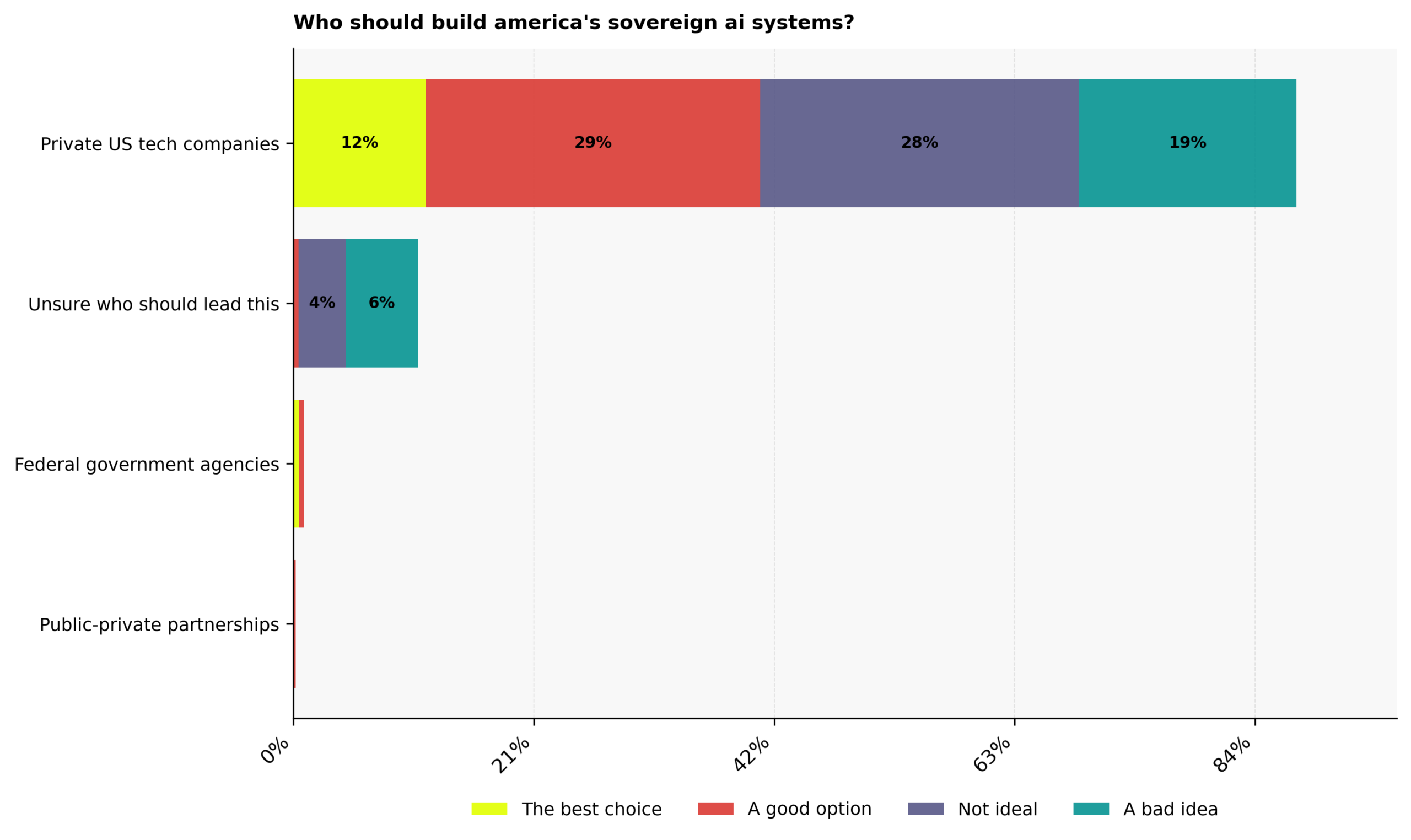
Many in our audience feel private US technology companies should build America’s future sovereign AI systems. 12% consider these private companies the ideal choice, and 29% view them as solid options. However, a near-equal 28% don’t see them as optimal for this role. Additionally, 19% feel that outsourcing the construction of these systems to private companies is a bad move.
Fewer than 1% of entrepreneurs support the idea of federal government agencies building these systems, with a fraction of this portion either strongly for or generally supportive of this concept. Private-public partnerships seem least attractive, with only a fraction of a percentage voicing support.
The remaining entrepreneurs are still unsure of who should lead these projects. Fewer than 1% say that this categorization describes them well, 4% are on the fence, and 6% disagree.
How do trade policies affect sovereign AI for entrepreneurs?
While 29% of entrepreneurs have not yet seen trade policies having a noticeable effect on sovereign AI, the same number (29%) have seen that these policies are encouraging domestic alternatives, 25% have noted that sovereign AI is creating uncertainty for planning, and 28% note that it is limiting access to global tools
Impact on trade policies is noted:
According to the World Economic Forum, the most successful sovereign AI strategies rely on maximum self-reliance and are tailored to a nation’s specific strengths and needs. The most competitive countries in this regard make deliberate, strategic, incremental decisions about domestic infrastructure investments while selecting interdependent foreign partners with a high degree of restraint.
These strategic investments and foreign partnerships work hand in hand with trade policies, which can impact sovereign AI for both nations and entrepreneurs in many key ways. For our audience, 29% have not seen any noticeable effects yet, while just as many (29%) say these policies are encouraging them to seek domestic alternatives.
25% of entrepreneurs admit that trade policies are creating uncertainty around their sovereign AI plans, which has made planning more complex and more challenging. 18% also note that these policies have limited their access to global tools, which may slow some organizations’ progress towards sovereignty as they are forced to seek out local solutions instead.
What sovereign AI budget do entrepreneurs plan for 2027?
24% of entrepreneurs absolutely plan to spend between $50,0000 and $250,000 on sovereign AI in 2027; this could be the plan for 41%, but it’s not a likely plan for 15%, and it’s definitely not what 9% plan to spend; while 2% absolutely plan to spend under $10,000 on sovereign AI, 4% could do so, but 3% are not likely to spend this
Spending is divided into two categories:
Per-employee spending on AI grew by 50% from 2025 to date, showing that many organizations are setting aside considerable budgets for sovereign AI. On average, US firms spent about $1,358 per employee in 2025, which may rise to $2,068 per employee this year.
Entrepreneurs in our audience are also allocating a large portion of funds to sovereign AI for 2027. 24% absolutely plan to allocate between $50,000 and $250,000 for this purpose, and 41% feel reasonably confident that their budgets will align with this range. However, 15% think this level of expenditure is unlikely, and 9% note that their budgets definitely won’t fall within this category.
Far fewer entrepreneurs plan to spend less than $10,000 on their sovereign AI workflows. 2% say this with absolute certainty and 4% note that this could be their plan. Conversely, 3% say that this level of spending isn’t likely, and fewer than 1% disagree with this budget range entirely.
Encouragingly, none of our audience have not yet allocated a budget for sovereign AI, showing a clear trend toward consistent investment.
How would entrepreneurs fund sovereign AI adoption?
93% of entrepreneurs are not currently planning to fund sovereign AI adoption, while 7% plan to fund adoption with venture capital or private investment funds
Funding comes from two sources:
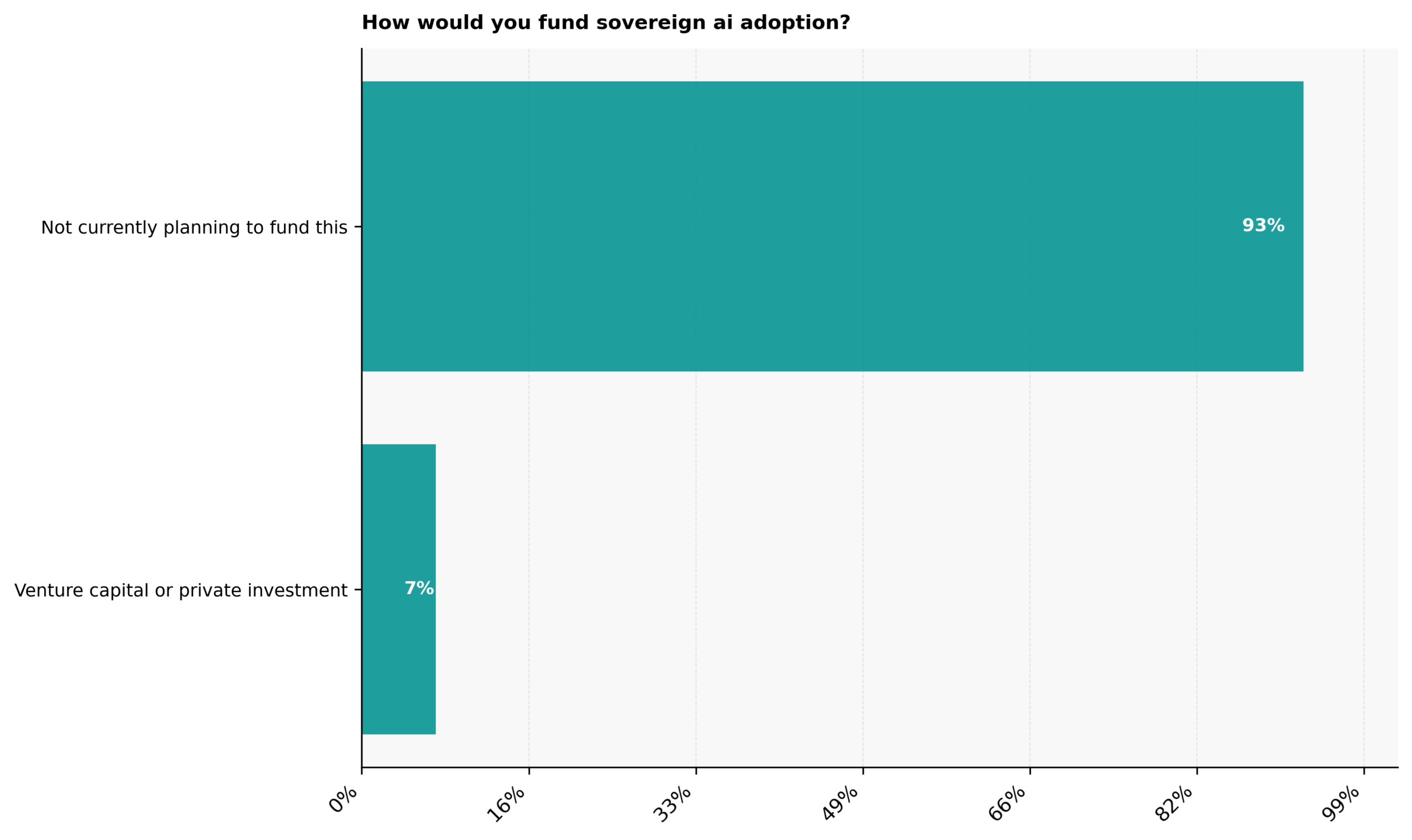
At 93%, the vast majority of entrepreneurs do not have any current plans to fund sovereign AI adoption within their organizations. Only 7% are actively planning for this adoption, and say that they will turn to venture capital or private investments to realize these plans.
Funding options such as private investment and venture capital may provide the substantial upfront funds needed to build and deploy high-value infrastructure and AI models without negatively impacting entrepreneurs’ organizations’ cash flow or operational capacities. Private investors could also provide invaluable strategic expertise and industry resources, which may accelerate deployment and its associated benefits in rapidly shifting markets.
How soon will sovereign AI affect entrepreneurs’ businesses?
53% of entrepreneurs think that sovereign AI will affect their business within the next 1 to 2 years, 22% within the next 3 to 5 years, and 1% in more than 5 years’ time, but for another 22%, sovereign AI is already affecting their business, and 1% are not sure of the timeline in which it will have an impact
Impact is either here or predicted:
According to Gartner, sovereign AI is already impacting businesses through shifts in data residency regulations, vendor compliance requisites, and procurement limitations. The organization projects the market will fully mature around 2030, resulting in a sector worth over $600 billion.
Many entrepreneurs in our audience are also reporting the effects of sovereign AI on their businesses. For 22%, it is already impacting their businesses, and 53% expect to face some degree of impact within the next year or two.
Aside from the 1% who are uncertain about these timelines, the remainder expect to experience the effects later. 22% expect impacts within the next 3 to 5 years, and 1% believe the effects of sovereign AI are at least 5 years away, if not longer.
What sovereign AI trend will grow fastest according to entrepreneurs?
71% of entrepreneurs think that domestic AI chip manufacturing is a strong contender for the fastest-growing sovereign AI trend, but 19% think this is less likely to trend fast, and 6% think it’s unlikely to grow; just 2% think that AI and security compliance tools are a strong contender for the fastest-growing trend, and 1% think data localization services are less likely to grow fast
One trend outpaces all others:
With the global sovereign AI market expected to grow at a CAGR of 20.5% between 2026 and 2033, this growth is largely being driven by increased government investment, rising demand for data and digital sovereignty, and expanding implementation of secure AI solutions for sensitive tasks and workflows.
Beyond these key trends, our audience also expects domestic AI chip manufacturing to be one of the fastest-growing sovereign AI trends. 71% agree this is the strongest contender for rapid growth, while 19% feel that it’s less likely than other trends, and 6% believe that it’s unlikely to grow.
Fewer expect AI security and compliance tool adoption to be the strongest trend. Under 1% of entrepreneurs are confident that this will be the top trend in the near future, and just 2% feel that it’s a strong contender. 2% deem it somewhat unlikely that data localization services will be the top performer, and fewer than 1% each believe that industry-specific sovereign models and government-supported AI platforms are noteworthy contenders for the top spot.
How optimistic are entrepreneurs about sovereign AI’s future?
23% of entrepreneurs are uncertain how sovereign AI will unfold, another 23% are skeptical of near-term progress, and 22% are not thinking about the future; however, 20% are cautiously optimistic but see challenges ahead, and 12% are very optimistic about sovereign AI’s future and think the US will lead globally
Optimism levels fluctuate:
Sovereign AI adoption may offer organizations a range of prospective benefits, but it also introduces new complexities and risks across multiple key operational areas. With this in mind, entrepreneurs’ optimism about the future of sovereign AI varies widely.
23% feel uncertain about how sovereign AI adoption and use will unfold in the foreseeable future, and just as many (23%) remain skeptical about near-term progress. A close 22% aren’t considering the implications or potential of sovereign AI’s future yet, and 20% feel cautiously optimistic but still believe challenges ahead must be addressed proactively for long-term success.
At 12%, the smallest group is very optimistic about the future of sovereign AI and is confident that the United States will lead the world in digital and data sovereignty, sovereign system investments, and regulatory framework optimization in the years to come.
Opportunities and challenges of sovereign AI for US entrepreneurs
These findings suggest that US entrepreneurs recognize sovereign AI’s potential importance but have not yet developed a consistent understanding of its implications or widely committed to adoption. Key considerations include regulatory compliance, business competitiveness, and cost-effective infrastructure, while strong customer support and compatibility with existing systems also influence vendor choices.
Although many expect sovereign AI to affect their businesses, uncertainty remains around its future development, government policy, and implementation.