
Business accelerator programs have become a central part of the startup ecosystem, offering founder entrepreneurs a structured way to develop ideas, refine strategies, and scale more effectively. What was once seen as a niche support tool is now a widely recognized pathway for building momentum, gaining access to expertise, and navigating the complexities of growth.
As the rate of innovation increases and competition intensifies, founders need guidance and practical support that drives real progress. Accelerator programs are evolving to meet this demand, combining mentorship, funding opportunities, and hands-on learning to create environments where businesses can move forward with clarity and confidence.
To find out what 66,418 opinions of founder entrepreneurs in the US were about business accelerator programs, we utilized AI-driven audience profiling to synthesize insights from online discussions for 12 months, ending on April 8, 2026, to a high statistical confidence level. The results reveal how founder entrepreneurs are engaging with accelerator programs, what they value most, and how these programs are shaping the future of business.
Index
- 80% of founder entrepreneurs are familiar with business accelerator programs as a growth tool
- 85% of founder entrepreneurs say that they typically benefit from business accelerator programs at any stage, as they deliver value throughout
- Only 2% of founder entrepreneurs say that uncertainty about quality is a minor reason for not pursuing business accelerator programs
- In-person cohort-based business accelerator programs are considered the most effective format by 72% of founder entrepreneurs
- 26% of founder entrepreneurs say that a 6-month engagement in business accelerator programs is the ideal choice
- 30% of founder entrepreneurs say that mindset is the foundation of all effective business accelerator programs
- There’s a 50/50 split in the opinions of founder entrepreneurs regarding whether peer learning is a minor benefit or not a priority in business accelerator programs
- 76% of founder entrepreneurs say that access to funding through business accelerator programs is the top benefit
- Team growth is how 88% of founder entrepreneurs say they typically measure the ROI of business accelerator programs
- For 73% of founder entrepreneurs, business accelerator programs sometimes lead to long-term mentor connections
- 64% of founder entrepreneurs say that real-world application opportunities within current business accelerator programs are not a problem at all
- 37% of founder entrepreneurs say that AI is central to how leading business accelerator programs operate
- 99% of founder entrepreneurs in our audience are in the technology and software industry
- 52% of founder entrepreneurs in our audience are based in San Francisco
- Closing the Gap Between Perception and Performance
- About The Data
How Familiar Are Founder Entrepreneurs With Business Accelerator Programs As A Growth Tool?
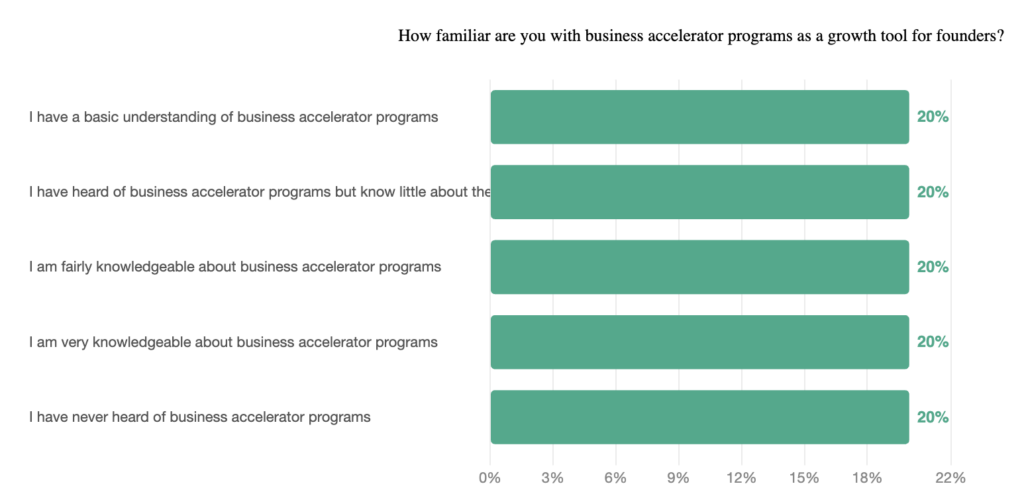
80% of founder entrepreneurs are familiar with business accelerator programs as a growth tool
There is no shared starting point:
Familiarity with business accelerator programs as a growth tool among founder entrepreneurs in our audience is fragmented, though overall, 80% have some knowledge of them.
20% describe themselves as very knowledgeable, 20% fairly knowledgeable, and 20% say they have a basic understanding. Another 20% have only heard of them and know little, while 20% have never heard of business accelerator programs at all.
An Opportunity for Stronger Positioning and Clarity
The even spread of opinions creates five distinct entry points into the same decision. Some founders are evaluating providers, others are still trying to understand what these programs actually do. It changes how programs need to position themselves, shifting from simple promotion to education and proof.
At the same time, the market is expanding quickly. The sector is expected to grow from $5.11 billion in 2025 to $6.07 billion in 2026, driven by rising startup formation, stronger funding access, and wider availability of structured mentorship. Growth is accelerating, but understanding is still catching up, which leaves plenty of room for clearer positioning.
At What Stage Of Their Journey Do Founder Entrepreneurs Typically Benefit Most From Business Accelerator Programs?
85% of founder entrepreneurs say that they typically benefit from business accelerator programs at any stage, as they deliver value throughout
Fit matters more than timing:
The stage at which founder entrepreneurs benefit most from business accelerator programs shows a clear preference for flexibility. 85% say these programs are the best fit at any stage, with a further 8% describing them as a good fit across the journey. By contrast, the growth stage sees very limited support, with just 1% calling it the best fit, 5% a good fit, and 1% less ideal.
This points to a shift in how founders are thinking about accelerators. Instead of treating them as a step in a fixed journey, they are using them as a tool to unlock progress when it is needed most. That could be early validation, refining a model, or pushing through a period of stalled growth.
Research from the Wharton School reinforces this. Accelerator programs improve startup performance across the board, though outcomes depend heavily on program design. What founders are really buying into is structure, support, and momentum, rather than a specific phase.
What Is The Most Common Reason Founder Entrepreneurs Do Not Pursue Business Accelerator Programs?
Only 2% of founder entrepreneurs say that uncertainty about quality is a minor reason for not pursuing business accelerator programs
Reasons for not pursuing programs are minimal:
Overall, there are very few barriers preventing founder entrepreneurs from pursuing business accelerator programs, with only 2% citing uncertainty about program quality as a minor reason for not participating. Conversely, 55% of our audience say this is not a reason at all, and it wouldn’t prevent them from participating.
A lack of awareness of available business accelerator programs is also not a reason for pursuing them for 40%, and 3% feel the same about high commitment requirements, proving that the most commonly perceived barriers have little real impact on founders’ decisions to engage with these programs.
These positive results are likely driven by the strong availability and visibility of such initiatives in the US, which is home to at least 150 unique accelerator programs, making them more accessible, better understood, and easier for founders to evaluate and trust.
Which Format Of Business Accelerator Programs Do Founder Entrepreneurs Find Most Effective?
In-person cohort-based business accelerator programs are considered the most effective format by 72% of founder entrepreneurs
Shared environments drive stronger progress:
The most effective format for founder entrepreneurs in business accelerator programs centers on in-person, cohort-based models. 25% say they are extremely effective, and 47% say they are quite effective, giving them a clear lead over other formats.
This preference comes down to how learning and progress happen. Cohort environments create pace and accountability. Founders gain exposure to diverse perspectives, real-time feedback, and shared challenges, accelerating the development of ideas more quickly than working in isolation. There is also a momentum effect, where seeing others move encourages faster action.
Hybrid models receive more moderate support, with 1% calling them extremely effective and 15% quite effective. This is interesting given that 52% of U.S. workers were operating in hybrid setups in late 2025. What works for everyday work does not carry the same impact in high-intensity growth settings.
One-on-one mentorship attracts more limited backing, with 4% and 7% respectively, suggesting it works best as a complement to group learning rather than a replacement.
What Program Length Do Founder Entrepreneurs Consider Ideal When Evaluating Business Accelerator Programs?
26% of founder entrepreneurs say that a 6-month engagement in business accelerator programs is the ideal choice
The right timeline depends on how much needs to change:
The ideal program length when evaluating business accelerator programs highlights a clear trade-off for founder entrepreneurs. A 6-month program draws mixed reactions, with 26% calling it ideal and 18% a good option, while 34% see it as the least ideal.
That split reflects a balance between depth and commitment. Six months gives founders enough time to test ideas, refine strategy, and build something meaningful. At the same time, it requires a level of focus that not everyone is ready to commit to for that long.
Shorter programs feel easier to engage with. A 3-month format is seen as ideal by 11%, with only 2% saying it is not preferred. These programs offer a concentrated burst of progress, which can be easier to fit around other demands.
Ongoing programs attract less support, with 8% of our audience calling them ideal. Without a clear endpoint, it becomes harder to measure progress. Many founders seem to prefer a defined structure that creates urgency and a clear sense of completion.
For Founder Entrepreneurs, How Important Is Mindset Development As A Component Of Business Accelerator Programs?
30% of founder entrepreneurs say that mindset is the foundation of all effective business accelerator programs
Mindset earns its place when it drives action:
The ideal program length when evaluating business accelerator programs highlights a clear trade-off for founder entrepreneurs. A 6-month program draws mixed reactions, with 26% calling it ideal and 18% a good option, while 34% see it as the least ideal.
That split reflects a balance between depth and commitment. Six months gives founders enough time to test ideas, refine strategy, and build something meaningful. At the same time, it requires a level of focus that not everyone is ready to commit to for that long.
Shorter programs feel easier to engage with. A 3-month format is seen as ideal by 11%, with only 2% saying it is not preferred. These programs offer a concentrated burst of progress, which can be easier to fit around other demands.
Ongoing programs attract less support, with 8% of our audience calling them ideal. Without a clear endpoint, it becomes harder to measure progress. Many founders seem to prefer a defined structure that creates urgency and a clear sense of completion.
For Founder Entrepreneurs, How Important Is Mindset Development As A Component Of Business Accelerator Programs?
30% of founder entrepreneurs say that mindset is the foundation of all effective business accelerator programs
Mindset earns its place when it drives action:
The importance of mindset development as a component of business accelerator programs is far from settled among founder entrepreneurs. 35% of our audience see it as a minor part, 35% as a moderate component, and 30% view it as the foundation of all effective programs.
The Growing Case for Mindset as a Performance Driver in Accelerators
The difference comes down to how mindset is applied. For some, it underpins everything, shaping decision-making, resilience, and responses to challenges. For others, it plays a supporting role alongside practical skills, strategy, and execution.
Recent research into growth mindset training adds another layer here. Founders who received this type of training showed higher levels of entrepreneurial action compared to those who did not. That points to a clear link between mindset and behavior, where the impact shows up in what founders actually do, rather than just how they think.
How Much Value Do Founder Entrepreneurs Place On Peer Learning Within Business Accelerator Programs?
There’s a 50/50 split in the opinions of founder entrepreneurs regarding whether peer learning is a minor benefit or not a priority in business accelerator programs
While independence is often the default instinct, it can lead to missed opportunities:
The value of peer learning in business accelerator programs is evenly split, though both sides lean toward it. 50% of founder entrepreneurs describe peer learning as a minor benefit, while the remaining 50% say it’s not a priority.
At face value, this suggests founders are not relying on peers as a primary driver of progress. Instead, the focus is shifting toward more direct, outcome-focused inputs such as mentorship, frameworks, and execution support, where the impact is clearer and easier to measure.
Peer Learning as a Hidden Driver of Long-Term Growth
However, this view starts to look short-sighted when you bring in wider performance data. Organizations that invest in peer learning for leadership growth report 36% more net revenue per employee, 9% higher gross margin, and are 4.6 times more likely to anticipate and respond effectively to change. Those gains point to something deeper than knowledge sharing. Peer environments expose blind spots, challenge assumptions, and accelerate decision-making in ways that are difficult to replicate alone.
This creates a gap between perception and potential. Founders may not prioritize peer learning upfront, but the evidence shows it can play a much bigger role in long-term performance than expected.
What Do Founder Entrepreneurs Believe Is The Biggest Benefit Founders Gain From Business Accelerator Programs?
76% of founder entrepreneurs say that access to funding through business accelerator programs is the top benefit
Capital leads the conversation, and the results back it up:
The biggest benefit that founder entrepreneurs believe they gain from business accelerator programs is access to funding. 76% describe it as the top benefit, with a further 15% calling it a strong advantage, placing it well ahead of every other outcome. By comparison, structured growth frameworks are seen as the top benefit by just 10% of our audience, showing how heavily founder priorities lean toward immediate financial access.
Funding as a Gateway to Broader Growth Support
Research highlighted in the Harvard Business Review shows that startups that go through an accelerator raise between 50% and 170% more from investors than similar startups that applied but were not accepted. This suggests founders are not simply chasing funding as a headline benefit. They are responding to a clear pattern where participation is linked to stronger investor traction.
At the same time, funding tends to act as an entry point rather than the full story. Capital creates momentum, but it is what happens alongside it, including guidance, exposure, and structured development, that helps turn that funding into sustained progress. Founders may lead with funding when defining value, but the broader impact builds from how that capital is used over time.
How Do Founder Entrepreneurs Typically Measure The Return On Investment Of Business Accelerator Programs?
Team growth is how 88% of founder entrepreneurs say they typically measure the ROI of business accelerator programs
Early outcomes tend to define perceived value:
The ROI of business accelerator programs is typically measured through outcomes that are visible early and easy to track. Among founder entrepreneurs in our audience, 88% point to team growth as the primary way they assess return, placing it far ahead of revenue growth at 8% and investor connections at 5%.
This weighting reflects how value shows up in practice. Team expansion is immediate, observable, and directly tied to a founder’s ability to execute. It signals momentum, capacity, and readiness to scale, all of which can be tracked in real time without needing to attribute results across multiple variables.
Early-Stage Success Is Reflected in Non-Financial Indicators
Guidance on measuring accelerator ROI supports this pattern. Early-stage returns are rarely captured through direct revenue, which can take longer to materialize and is often harder to link back to a single program. Instead, indicators like network development, validation milestones, and internal growth provide earlier signals of progress.
Seen through that lens, team growth acts as a leading indicator. It shows that the foundations for future performance are being put in place, even if financial outcomes have yet to fully appear.
How Often Do Business Accelerator Programs Lead To Long-Term Mentor Relationships?
For 73% of founder entrepreneurs, business accelerator programs sometimes lead to long-term mentor connections
Not every connection turns into a lasting relationship:
The frequency with which business accelerator programs lead to long-term mentor relationships reveals an important difference in depth. 73% of founder entrepreneurs say these programs sometimes lead to long-term mentor connections, while 27% say they frequently lead to long-term mentor relationships.
That distinction points to two different outcomes. Connections tend to be more common, with founders maintaining occasional contact, advice, or check-ins after the program ends. Relationships, on the other hand, imply something more consistent and embedded, where mentors remain actively involved in a founder’s progress over time.
The Difference Between Access and Ongoing Engagement
The gap between the two suggests that while accelerators are effective at opening doors, fewer of those interactions develop into ongoing, high-value partnerships. What determines that shift is usually continued alignment. When a mentor’s input remains directly relevant as the business evolves, the connection is more likely to deepen into a relationship.
Accelerators create access, but the strength of what follows depends on how useful that connection remains in practice.
What Do Founder Entrepreneurs Say Is Most Lacking In Current Business Accelerator Programs?
64% of founder entrepreneurs say that real-world application opportunities within current business accelerator programs are not a problem at all
Gaps are the exception, not the rule:
For the most part, founder entrepreneurs see very little lacking in current business accelerator programs. 64% of our audience says real-world application opportunities are not a problem at all, which is significant given how often programs are criticized for being too theoretical. This suggests founders are getting practical, usable experience rather than just high-level guidance.
Post-program alumni support also holds up well, with 17% saying it is not a big issue. That points to continued access to networks and resources beyond the formal program, which helps maintain momentum once the structured environment ends.
Stronger investor introductions show the only area of mild concern, with 11% saying this is somewhat lacking. This points to rising expectations for access to capital, making even small gaps become more apparent.
Personalized coaching depth appears well balanced, with 8% saying it is not a big issue. This suggests most founders feel the level of individual guidance is sufficient, even within a structured, cohort-based setting.
Overall, the gaps are specific rather than systemic, and most core areas are delivering as expected.
How Are Founder Entrepreneurs Currently Using AI Tools Within Or Alongside Business Accelerator Programs?
37% of founder entrepreneurs say that AI is central to how leading business accelerator programs operate
AI use is largely integrated:
As AI use skyrockets, our audience of founder entrepreneurs is also finding that AI tools have become integral to business accelerator programs. 37% say that it is now central to how these programs operate, while 30% say that it’s a structured component of some. Another 30% agree that AI is occasionally explored but not integrated, while just 2% say it’s informally used by some founders in programs.
These opinions indicate that AI is becoming a structurally embedded component of business accelerator programs, but not yet in a fully consistent or standardized way. While a meaningful percentage of founders see AI as central to how accelerators operate, a similar proportion view it as only partially structured or still emerging, and others say it remains experimental or loosely integrated.
AI Becoming a Core Enabler in Entrepreneurship Ecosystems
It’s evident that the industry is in a transition phase. AI is no longer optional, but it is also not yet uniformly implemented across program design, delivery, and evaluation. Instead, accelerators are experimenting at different levels of maturity, from fully AI-driven workflows to occasional or informal use cases.
At a broader level, this reflects what the World Economic Forum highlights about AI’s role in entrepreneurship. Founders are increasingly building and scaling businesses with AI as a core enabler rather than just a supporting tool, reshaping how value is created, validated, and accelerated in early-stage ecosystems.
What Industry Are Our Audience Of Founder Entrepreneurs In?
99% of founder entrepreneurs in our audience are in the technology and software industry
One industry dominates:
With 99% of our audience operating in the technology and software sectors, it’s clear that founder entrepreneurs in this sector all see the value in business accelerator programs. This is likely due to the competitive nature of the industry and the estimated 585,000 software and IT services companies in the US, all jostling for market share.
Just 1% of our audience is in the professional services and consulting industry, highlighting a sharp concentration of accelerator engagement within high-growth, innovation-driven sectors where speed to market, scalability, and investor readiness are critical advantages.
What City Are Founder Entrepreneurs In Our Audience Based In?
52% of founder entrepreneurs in our audience are based in San Francisco
Over half of our audience is in the world’s tech capital
With San Francisco home to Silicon Valley and 99% of our audience in the technology and software industry, it makes sense that 52% of founder entrepreneurs are based here. San Francisco’s startup ecosystem also grew by 19.9% in 2025 and ranks number one globally, creating the ideal audience for business accelerator programs. Boston has the second highest number, with 27% of founder entrepreneurs based here, followed by Austin with 21%.
This dispersion indicates that while San Francisco remains the dominant hub, founder activity is still spread across multiple high-growth ecosystems, reflecting a broader shift toward regional diversification where innovation, investment, and accelerator opportunities are no longer confined to a single city.
Closing the Gap Between Perception and Performance
These findings show that business accelerator programs are clearly evolving into more dynamic, flexible tools that founder entrepreneurs use to unlock progress at different stages of their journey. Rather than serving a single purpose, they are becoming multi-layered environments that combine access, structure, and momentum to support growth in practical ways.
At the same time, the findings highlight a gap between perception and full potential. While founders recognize the value of key elements like funding, mentorship, and AI, areas such as peer learning and deeper relationship-building remain underutilized despite their long-term impact. This suggests that the next phase of accelerator development will be less about access and more about how effectively these components are integrated and applied.
As the ecosystem continues to mature, the programs that stand out will be those that move beyond one-dimensional value and deliver a more connected, outcome-driven experience. For founder entrepreneurs, this represents an opportunity not just to accelerate growth, but to do so in a more strategic and sustainable way.
About The Data
Sourced using Artios from an independent sample of 66,418 opinions of founder entrepreneurs in the USA across X, Quora, Reddit, Bluesky, TikTok, and Threads. Responses are collected within a 95% confidence interval and 5% margin of error. Results are derived from what people describe online, from opinions expressed online, not actual questions answered by people in the sample.