
Introduction: The Rise of the Sovereign Operator
A new kind of founder is emerging, and the old categories don’t describe them. They aren’t the solopreneur grinding alone, and they aren’t the venture-backed startup burning capital to buy growth. They’re Sovereign Operators: entrepreneurs who combine two qualities that rarely live in the same person. The first is sovereignty, meaning full ownership of their own mind. They don’t rent their beliefs from the herd, borrow their strategy from the timeline, or hand their standards to whoever is shouting loudest on social media. The second is operating capacity, the discipline to turn that clarity into real-world execution, leverage, and value creation.
The term comes from Randy Gage, founder of the Breakthrough U Entrepreneur Accelerator, who coined it to name a pattern he saw across decades of advising founders, executives, and high achievers in more than 50 countries. Most capable people fall into one of two traps. Some are operators without sovereignty: extraordinary executors running on premises they inherited from an industry, a parent, or an earlier version of themselves. Others are sovereigns who never operate: clear-eyed and well-read, but they never put anything to work. As Gage puts it, “Sovereign without Operator is a philosopher with no leverage. Operator without Sovereign is a very productive employee of someone else’s dream.” The Sovereign Operator framework, which grew out of his Prosperity Operating System, resolves that split, in a deliberate order: sovereign first, then operator.
A Sovereign Operator isn’t defined by what they have. They’re defined by what they can’t be: controlled, predicted, replaced, or domesticated. They don’t compete with AI. They conduct it. They build signal so distinct that machines can’t generate it and competitors can’t copy it, and they scale without becoming the bottleneck, or the prisoner, of the business they built.
What started as a framework is turning into a movement. In the United States and around the world, a growing number of founders are rejecting the false choice between building wealth and keeping their health, relationships, and peace of mind. They’re building lean, AI-leveraged companies designed around freedom rather than headcount, and they’re defining success by significance as well as scale. This white paper looks at who these founders are, why the AI era is speeding up their rise, and the principles that separate Sovereign Operator startups from the commodity businesses being steadily automated out of relevance.
Building a business without relying on traditional methods or a large team is gaining attention among entrepreneurs seeking greater independence. Sovereign operator startups focus on individual ownership and control, using technology, digital tools, and flexible business models to operate with fewer traditional structures. For entrepreneurs pursuing this approach, peer networks, specialist coaching, and structured support can also provide guidance as they develop their ideas and build sustainable businesses.
To find out what 1,362,894 opinions of entrepreneurs in the US were about sovereign operator startups, we utilized AI-driven audience profiling to synthesize insights from online discussions over 12 full months ending September 23rd, 2026, to a high statistical confidence level. The results show what is shaping interest in this approach to entrepreneurship and how entrepreneurs are approaching the idea of building businesses on their own terms.
Index
- Methodology and data
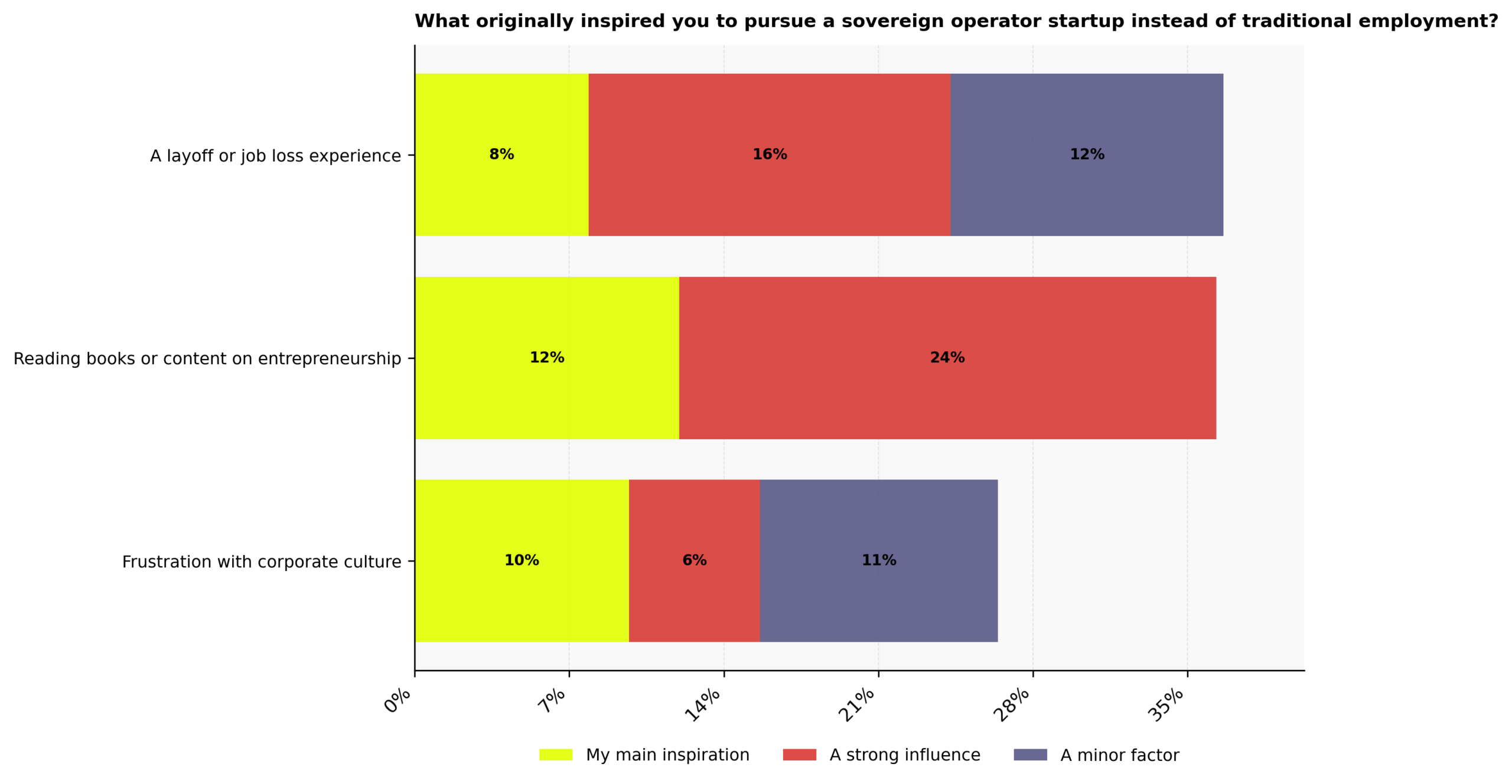
- 12% of entrepreneurs were mainly inspired to pursue a sovereign operator startup instead of traditional employment by reading books or content on entrepreneurship, and this was a strong influence for another 24%, while a layoff or job loss was the main inspiration for 8%, a strong influence for 16%, but only a minor factor for 12%; 10% were mainly inspired to pursue a sovereign operator startup due to their frustration with corporate culture; this was a strong influence for 6%, but only a minor factor for 11%
- 34% of entrepreneurs’ current sovereign operator startups are in the ideas stage currently and not yet launched, and for 32%, this is close to their current stage, while 34% are not quite at the point of having an established revenue of between $50 and $200k monthly
- 51% of entrepreneurs agree that their sovereign operator startups best fit in with the software and technology industry, and 49% best fit in with professional services
- Content creation and media is the perfect fit for 15% of entrepreneurs’ sovereign operator startup business models, and a good option for 22%; however, it’s not ideal for 6% and doesn’t fit for 7%; solo consulting or coaching is the perfect business model fit for 8% and a good option for 11%, but not for 7%, while software or SaaS suits 14%; a service-based agency of one is the right fit for 6%, and for 4% of entrepreneurs, the perfect business model fit is digital products and courses
- 16% of entrepreneurs’ sovereign operator startups are S-corporations; 20% are leaning towards this legal structure, but it’s not the top pick for 14%, and 6% would not choose it; 10% are structured as single-member LLCs and 9% are learning this way, but 3% would not rate this as their top pick and 2% wouldn’t choose it; sole proprietorship is preferred by 5% and a good option for 6%, but not for 4%, while 3% are not yet formally structured, and no one voices a preference for C-corporation
- 78% of entrepreneurs primarily bootstrap their sovereign operator startup and use small loans, 12% fund their startups by selling digital products or courses, and 5% use their personal savings
- 50% of entrepreneurs price offers in their sovereign operator startups using value-based pricing, and the other 50% use flat-fee pricing
- 43% of entrepreneurs dedicate between 10 and 25 hours a week to their sovereign operator startup, 31% dedicate between 26 and 40 hours weekly, 24% 41 to 60 hours, and 1% over 60 hours every week, while another 1% dedicates fewer than 10 hours every week to their startup
- 99% of entrepreneurs handle operations without employees in their sovereign operator startups by using AI and automation tools, 1% outsource to freelancers, and no one mentions handling everything personally
- For 20% of entrepreneurs, project management scheduling apps are absolutely essential for running their sovereign operator startup; for 6%, AI writing and content tools are absolutely essential; 35% agree these tools are very helpful; 5% rely on customer relationship management software, and 22% find these tools very helpful, but 6% don’t need them, and just 5% find payment and invoicing platforms a great help
- Marketing and sales are an absolutely essential skill for 32% of entrepreneurs running a sovereign operator startup, 22% agree these skills are very important, and 3% find them somewhat important, but for 4%, they are not important; negotiation skills top the list for 14% of entrepreneurs, and 14% find them very important, but 2% don’t find them important at all, followed by 3% who agree time management skills are absolutely essential, 4% who find them very important, and 2% who agree that this is a somewhat important skill
- Mastermind groups or peer circles are absolutely essential support networks for 59% of entrepreneurs’ sovereign operator startups and are very helpful for 13%; 18% find paid coaches or mentors to be very helpful too, while 10% agree that family and personal relationships are a somewhat useful support network
- Marketplace platforms are the top revenue driver for 7% of entrepreneurs’ sovereign operator startups, a strong contributor for 28%, and make a minor impact for 15%, but are not a factor for 11%, compared to referral networks, which are the top revenue driver for 11% of entrepreneurs, a strong contributor for 21%, and have a minor impact for 6%, with just 1% pointing to these networks as not being a factor
- 97% of entrepreneurs measure success in their sovereign operator startups by profit margins and efficiency, and 3% measure it by the number of clients or customers served
- For 91% of entrepreneurs, AI has changed the way they operate their sovereign operator startup by replacing the tasks they used to outsource, and for 2%, AI has increased their overall output capacity, but 7% have seen minimal impact on their operations so far
- ChatGPT or a similar chatbot is an absolutely essential AI tool for 16% of entrepreneurs in their sovereign operator startups; it’s useful for 39%’s work, but not the main tool used by 22%, and 9% don’t use it at all, while 4% find AI image generators useful in their work, they are not a main tool for 5%, and 1% don’t use them, and 2% don’t yet use any AI tools
- 14% of entrepreneurs view AI’s impact on their sovereign operator startup as a real concern, 54% don’t think it’s a big worry, and 17% have no fear of AI at all; while losing their unique voice is a real concern for 8%, it’s not a big worry for 5%, and it’s not a fear at all for 2%
- Avoiding burnout from solo operations is the main challenge for 9% of entrepreneurs running a sovereign operator startup; this is a significant challenge for 68% and a minor challenge for 8%, while managing cash flow unpredictability poses a significant challenge for 14% of entrepreneurs
- For 9% of entrepreneurs, not needing additional help at their current scale is the main reason they avoid hiring; 31% see this as a significant factor, 39% consider it minor, and it’s not a reason for 16%, while legal and compliance burden is a significant factor in avoiding hiring for 2% and a minor factor for 3%
- Diluted brand identity is a top concern for 13% of entrepreneurs when scaling a sovereign operator startup, and it’s a real worry for 46%; 3% are most concerned about losing personal control, and this is a real worry for 20%, but not a big worry for 6%; while 8% are most concerned about burnout from added workload, and this is a real worry for 4%
- 97% of entrepreneurs are somewhat concerned about sustaining their sovereign operator startup long-term; in contrast, 3% are somewhat confident in sustaining their startup, and no one voiced being very concerned about sustainability
- Having no exit planned ever is not the first choice of exit plan for 48% of entrepreneurs with sovereign operator startups, and it’s not the plan at all for 48%, while 1% absolutely plan to wind down their startup eventually
- Key trends in sovereign operator startups
Methodology and data
Sourced using Artios from an independent sample of 1,362,894 opinions of entrepreneurs in the USA across X, Quora, Reddit, Bluesky, TikTok, and Threads. Responses are collected within a 95% confidence interval and a 5% margin of error. Results are derived from what people describe online, from opinions expressed, and not actual questions answered by people in the sample.
What inspired entrepreneurs to pursue a sovereign operator startup instead of traditional employment?
12% of entrepreneurs were mainly inspired to pursue a sovereign operator startup instead of traditional employment by reading books or content on entrepreneurship, and this was a strong influence for another 24%, while a layoff or job loss was the main inspiration for 8%, a strong influence for 16%, but only a minor factor for 12%; 10% were mainly inspired to pursue a sovereign operator startup due to their frustration with corporate culture, this was a strong influence for 6%, but only a minor factor for 11%
Three main areas of inspiration opened the door to entrepreneurship:
Which stage best describes entrepreneurs’ current sovereign operator startups?
34% of entrepreneurs’ current sovereign operator startups are in the ideas stage currently and not yet launched, and for 32%, this is close to their current stage, while 34% are not quite at the point of having an established revenue of between $50 and $200k monthly
Stages are split between ideas and established:

Entrepreneurs pursuing sovereign operator startups are at different points in their journey, with many still in the early phases of building their ventures. 34% are exactly at the idea stage, not yet launched, while another 32% feel they are close to this stage. This means two-thirds of entrepreneurs are either actively developing their concepts or preparing to take the leap, showing strong momentum and intent to move from planning to action.
The remaining 34% are not yet at the stage of generating established monthly revenue of $50-$200k, although they have moved beyond the idea stage. This reinforces the longer path many startups face before reaching profitability. Research indicates that startups take an average of 3–4 years to become profitable, while only 40% actually achieve profitability, showing that a substantial proportion of businesses remain in the earlier stages of development for several years.
What industry best fits entrepreneurs’ sovereign operator startups?
51% of entrepreneurs agree that their sovereign operator startups best fit in with the software and technology industry, and 49% best fit in with professional services
Industry focus is almost evenly divided:

Entrepreneurs building sovereign operator startups focus on two dominant industries with strong growth potential and flexibility. Software and technology lead the pack at 51%, proving that more than half of people are drawn to digital products, platforms, and tech-enabled solutions.
The strong position of software and technology fits the size of the wider US market. The country has an estimated 585,000 software and IT services companies, providing a large base of businesses and opportunities within the sector. Broader databases also track more than 1.9 million registered startups across digital and emerging technology fields. This established business environment provides plenty of room for entrepreneurs to develop independent technology ventures.
Professional services follow closely at 49%, indicating that nearly half of entrepreneurs are drawing on their expertise in consulting, coaching, creative work, or specialized advisory roles. This sector thrives on personal branding, direct client relationships, and delivering high-value outcomes without heavy infrastructure.
These two industries make up the full picture, illustrating how our audience splits almost evenly between product-driven tech businesses and service-based models. Both paths support the sovereign operator mindset by enabling independence, income control, and the freedom to design work around personal goals rather than corporate structures.
Which business model best fits entrepreneurs’ sovereign operator startups?
Content creation and media is the perfect fit for 15% of entrepreneurs’ sovereign operator startup business models, and a good option for 22%; however, it’s not ideal for 6% and doesn’t fit for 7%; solo consulting or coaching is the perfect business model fit for 8% and a good option for 11%, but not for 7%, while software or SaaS suits 14%; a service-based agency of one is the right fit for 6%, and for 4% of entrepreneurs, the perfect business model fit is digital products and courses
Ideal business models are split into five categories:

Entrepreneurs are gravitating toward business models that match their skills, goals, and preferred way of working. While business models associated with sovereign operator startups vary, content creation and media receive the strongest overall fit. For 15%, it is a perfect fit, while 22% see it as a good option. Smaller shares rate it as not ideal at 6% or say it does not fit at 7%.
Solo consulting or coaching also has broad appeal, with 8% of entrepreneurs calling it a perfect fit and 11% considering it a good option. Another 4% view it as not ideal, while 3% say it does not fit.
Software or SaaS that is built and operated by one person is a perfect fit for 5% and a good option for 9%. Less than 1% consider it not ideal, indicating limited negative views of this model.
A service-based agency of one has a smaller but positive presence, with 2% of entrepreneurs describing it as a perfect fit and 4% calling it a good option. Digital products and courses receive 4% for perfect fit, while less than 1% say this model does not fit.
Which legal structure do entrepreneurs’ sovereign operator startups operate under?
16% of entrepreneurs’ sovereign operator startups are S-corporations; 20% are leaning towards this legal structure, but it’s not the top pick for 14%, and 6% would not choose it; 10% are structured as single-member LLCs and 9% are learning this way, but 3% would not rate this as their top pick and 2% wouldn’t choose it; sole proprietorship is preferred by 5% and a good option for 6%, but not for 4%, while 3% are not yet formally structured, and no one voices a preference for C-corporation
Some legal structures are a better choice than others:
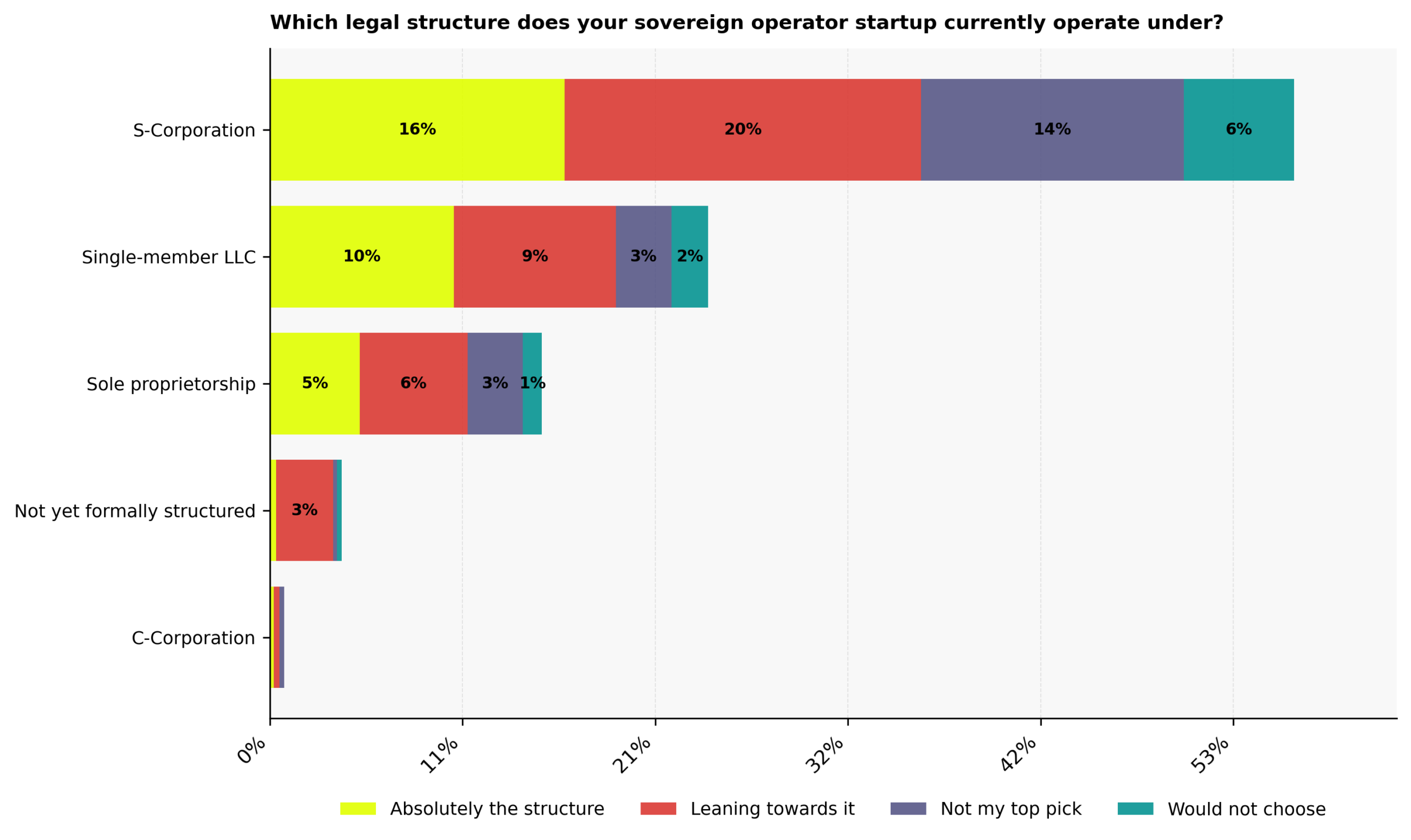
Entrepreneurs in the US choose legal structures that balance protection, tax efficiency, and simplicity as they build their sovereign operator startups. The S-Corporation stands out as the most popular option. For 16%, it is absolutely the structure; 20% lean toward it; 14% say it is not their top pick, and 6% would not choose it. Entrepreneurs who favor S-Corp structures likely see strong value in the model for its potential tax advantages and formal business standing.
Single-member LLCs also attract a fair share of attention from US-based entrepreneurs, with 10% calling it absolutely the structure and 9% leaning towards it, compared to 3% who say it is not their top pick and 2% who would not choose it.
Sole proprietorship appeals to 5% of our audience as the structure they absolutely prefer and 6% as leaning toward it, with only 3% viewing it as not their top pick and 1% saying they would not choose it.
Very few startups are not yet formally structured, with less than 1% of entrepreneurs describing this as their current structure, 3% leaning toward it, less than 1% calling it not their top pick, and less than 1% saying they would not choose it.
C-Corporations have the least presence, with less than 1% calling them the definite structure, less than 1% leaning toward them, and less than 1% saying they are not their top pick.
How do entrepreneurs primarily fund their sovereign operator startups?
78% of entrepreneurs primarily bootstrap their sovereign operator startup and use small loans, 12% fund their startups by selling digital products or courses, and 5% use their personal savings
Self-funding for startups leads the way:
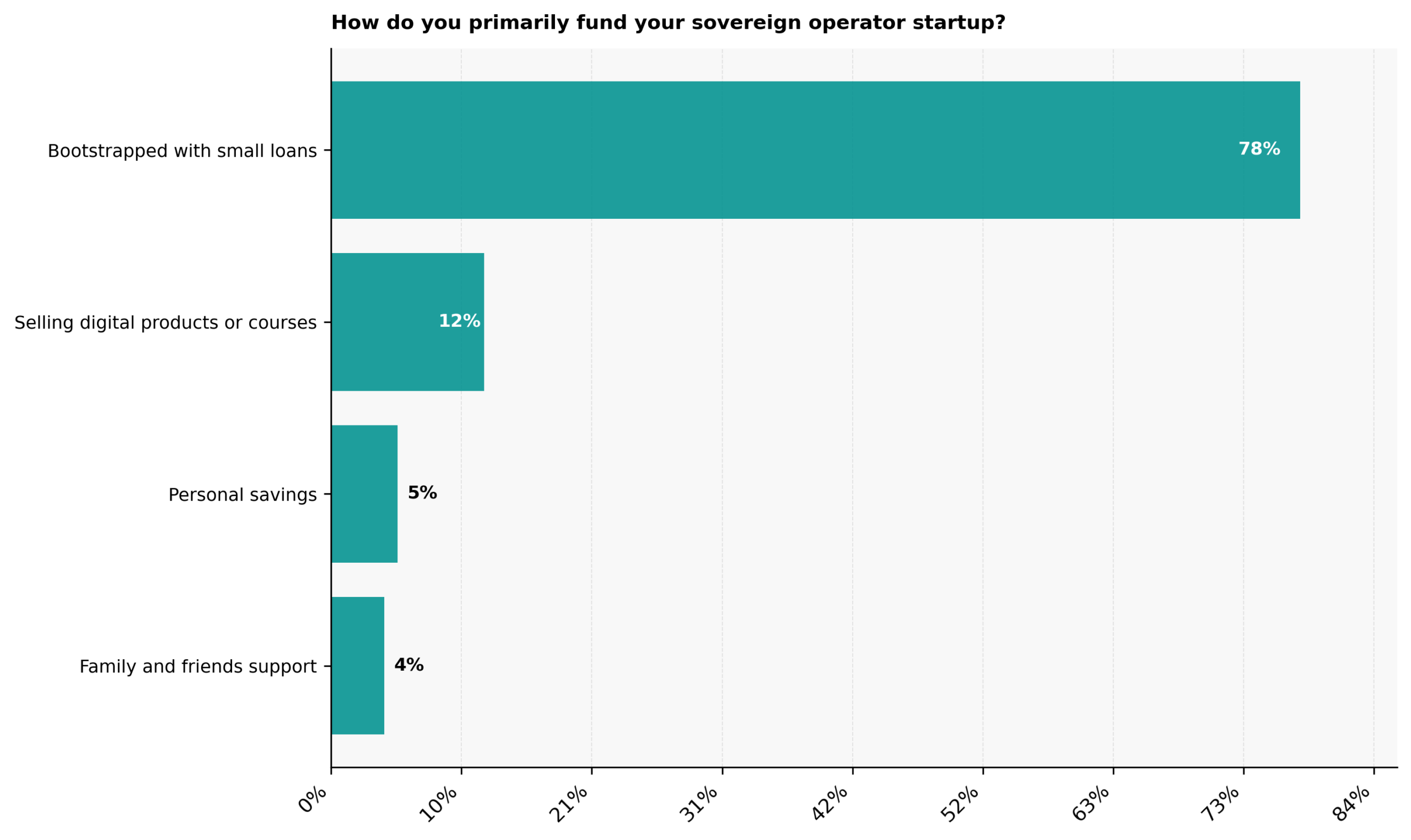
Approximately 75% to 80% of startups are bootstrapped without external funding. 78% of entrepreneurs primarily use this method to find their sovereign operator startup, combined with small loans. This makes it the leading funding route and indicates that most entrepreneurs build their businesses without relying heavily on outside capital.
Other funding approaches play smaller but distinct roles. Selling digital products or courses is the main funding method for 12%, giving entrepreneurs a way to generate income while building their broader operation.
Personal savings account for 5% of our audience’s views, telling us that a smaller share relies primarily on money they have already set aside. Family and friends provide the main source of funding for 4% of entrepreneurs, making personal networks another option, though less common.
These funding paths signal a clear preference for maintaining ownership and avoiding traditional investors, with people choosing methods that match their values, risk tolerance, and long-term vision for building sustainable, self-directed businesses.
How do entrepreneurs price offers in their sovereign operator startups?
50% of entrepreneurs price offers in their sovereign operator startups using value-based pricing, and the other 50% use flat-fee pricing
Entrepreneurs running sovereign operator startups are split evenly between two clear pricing strategies, each offering distinct advantages.
Value-based pricing accounts for 50%, meaning half the entrepreneurs set their rates based on the outcomes and transformation they deliver to clients rather than the hours they work.
Flat-fee pricing makes up the other 50% of our audience, indicating that the remaining half prefers straightforward, fixed-rate structures that provide clarity and predictability for both themselves and their customers.
The findings show our audience is divided between maximizing perceived value and offering simple, transparent pricing. Both strategies support the sovereign operator mindset by giving people control over how they position their offers, ensuring they can choose the method that best fits their business model, client expectations, and personal comfort with pricing conversations.
How many hours per week do entrepreneurs dedicate to their sovereign operator startups?
43% of entrepreneurs dedicate between 10 and 25 hours a week to their sovereign operator startup, 31% dedicate between 26 and 40 hours weekly, 24% 41 to 60 hours, and 1% over 60 hours every week, while another 1% dedicates fewer than 10 hours every week to their startup
Time isn’t always in great supply:

Sovereign operator startups typically require a meaningful weekly time commitment, though most entrepreneurs don’t work extremely long hours. The largest group, 43%, dedicates 10 to 25 hours each week. Another 31% spend 26 to 40 hours on their startup, showing that nearly one-third put in a substantial part of a standard working week. Another 24% work 41 to 60 hours, putting almost one-quarter in a full-time or extended schedule.
Only 1% of our audience works more than 60 hours per week, while another 1% spends under 10 hours on their startup. This small share at both extremes confirms that most entrepreneurs work a moderate to high number of hours each week rather than spending very little time or working exceptionally long hours.
The group of entrepreneurs working 41 to 60 hours emulates patterns among small business owners, with 33% reporting more than 50 hours each week and 39% exceeding 60 hours. Weekend work is also common, with 70% working on weekends and many checking in while on vacation.
How do entrepreneurs handle operations without employees in their sovereign operator startups?
99% of entrepreneurs handle operations without employees in their sovereign operator startups by using AI and automation tools, 1% outsource to freelancers, and no one mentions handling everything personally
AI and automation stand in for employees:
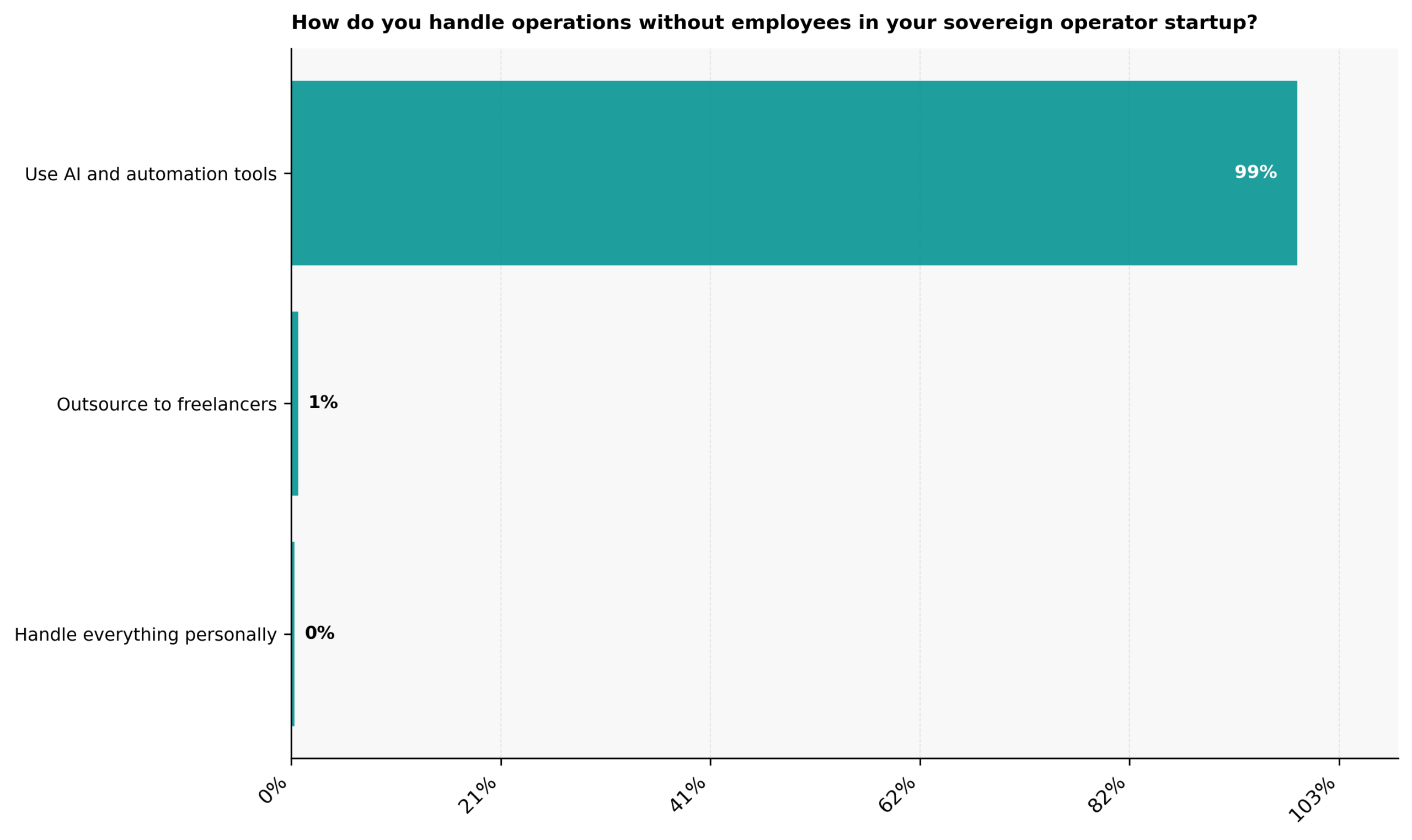
Entrepreneurs running sovereign operator startups are embracing technology to operate efficiently without hiring employees, with nearly all relying on modern tools to streamline workflows. 99% use AI and automation tools. This approach lets them keep operations lean while still delivering professional results, proving that independence doesn’t mean doing everything manually.
Outsourcing to freelancers accounts for 1%, indicating that a very small segment prefers delegating specific tasks to independent contractors when needed. Meanwhile, 0% handle everything personally, meaning no one in our audience tries to manage every aspect of their business alone, without tools or external help.
Which tools are most critical to entrepreneurs running sovereign operator startups?
For 20% of entrepreneurs, project management scheduling apps are absolutely essential for running their sovereign operator startup; for 6%, AI writing and content tools are absolutely essential; 35% agree these tools are very helpful; 5% rely on customer relationship management software, and 22% find these tools very helpful, but 6% don’t need them, and just 5% find payment and invoicing platforms a great help
Tools offer various degrees of help:
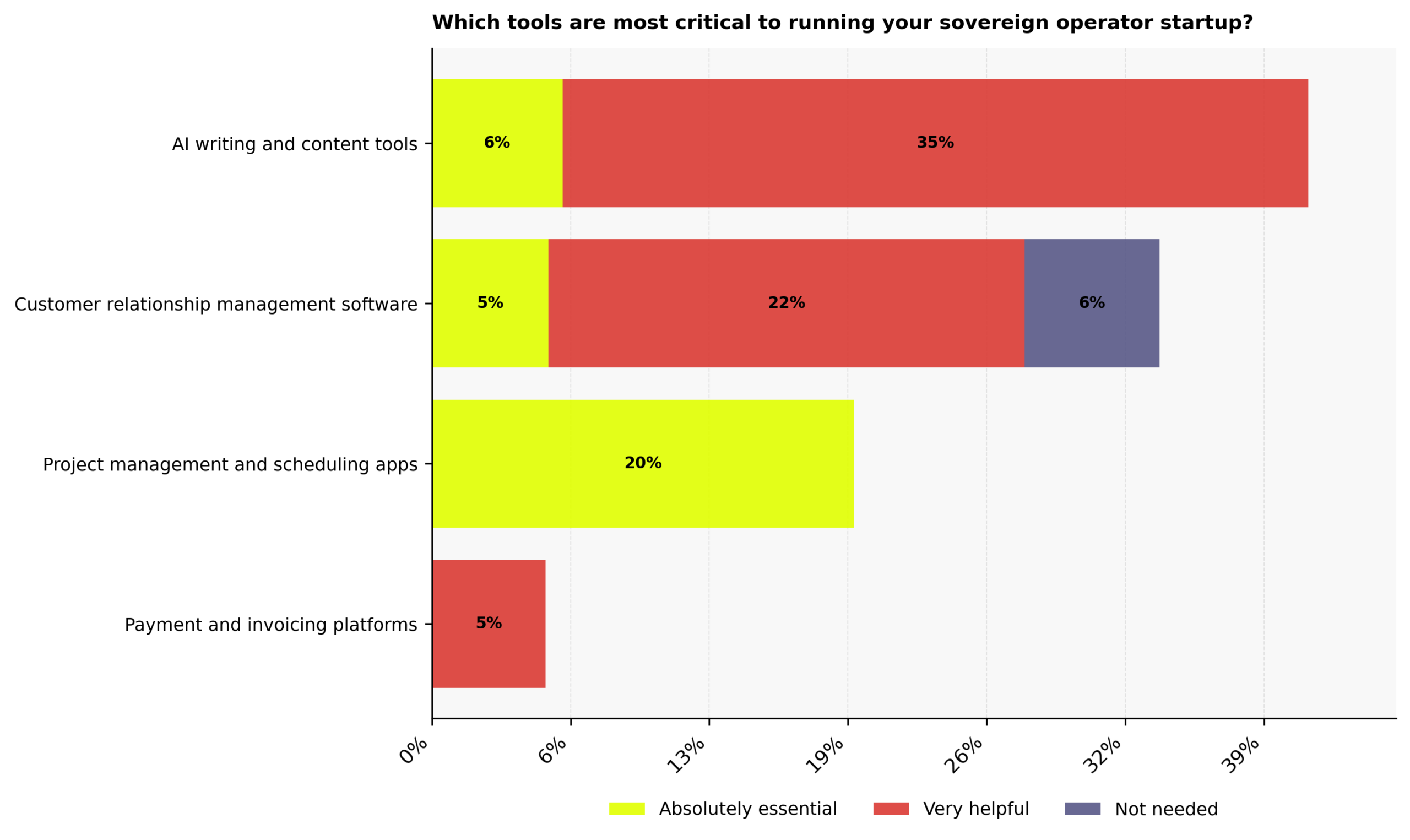
The U.S. The Chamber of Commerce reports that 58% of small businesses now use generative AI, up from 40% in 2024 and more than twice the level recorded in 2023. Amongst our audience, AI writing and content tools are absolutely essential for 6% and very helpful for another 35%, making them useful for creating content and managing communication.
Customer relationship management software (CRM) is absolutely essential for 5% of entrepreneurs and very helpful for 22%, while 6% don’t need it. From this, we can see that customer management needs vary by business model and workload.
Project management and scheduling apps have the strongest essential rating, with 20% describing them as absolutely essential. These tools can help solo entrepreneurs organize tasks, deadlines, appointments, and ongoing projects without relying on employees to coordinate daily work.
Payment and invoicing platforms are very helpful for 5%, providing a smaller but clear group with support for collecting payments and managing billing.
Which skill matters most for entrepreneurs running a sovereign operator startup?
Marketing and sales are an absolutely essential skill for 32% of entrepreneurs running a sovereign operator startup, 22% agree these skills are very important, and 3% find them somewhat important, but for 4%, they are not important; negotiation skills top the list for 14% of entrepreneurs, and 14% find them very important, but 2% don’t find them important at all, followed by 3% who agree time management skills are absolutely essential, 4% who find them very important, and 2% who agree that this is a somewhat important skill
Essential skills hold different weights:
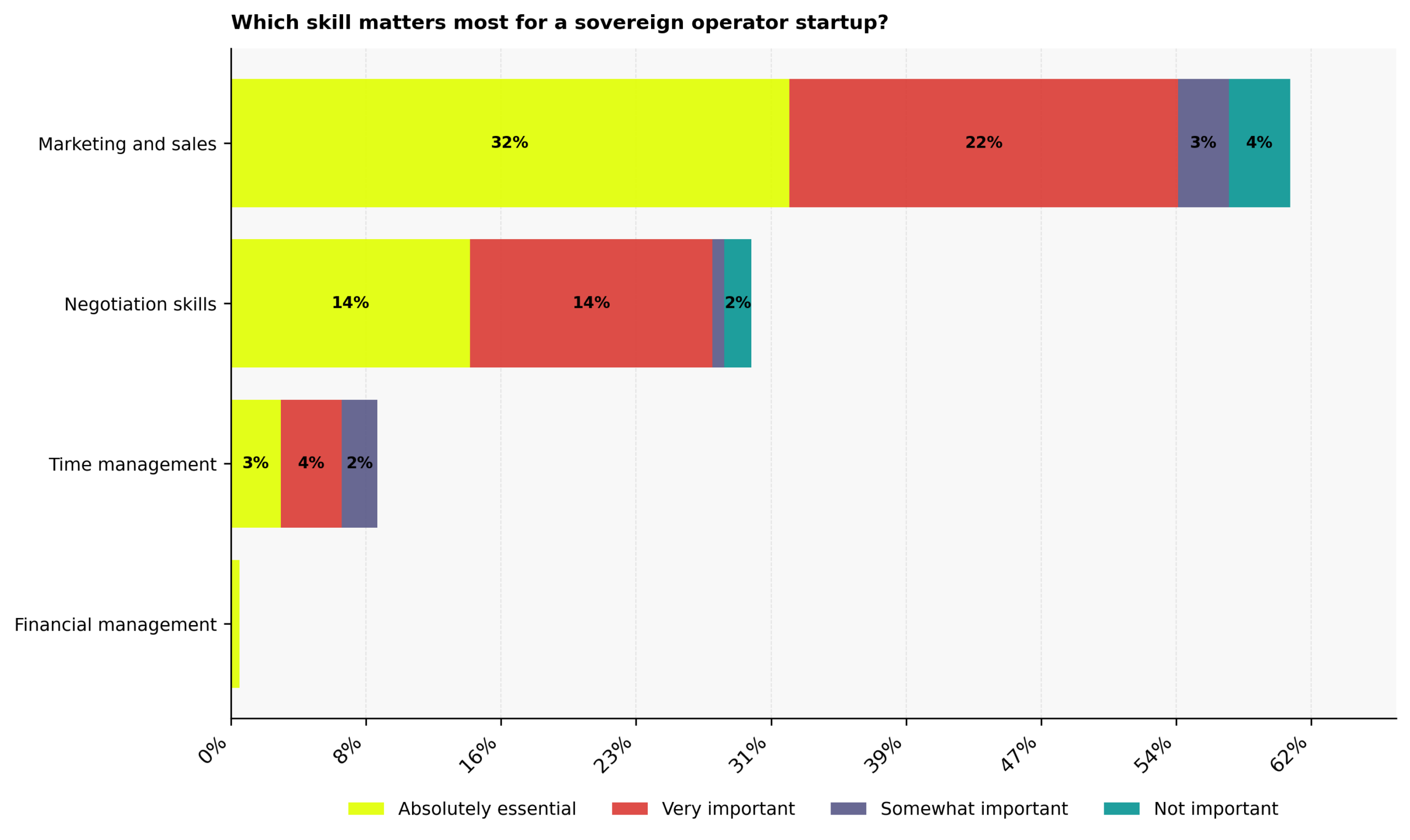
The strongest skill priority for entrepreneurs running sovereign operator startups is marketing and sales. These skills are absolutely essential for 32% and very important for another 22%. A further 3% consider them somewhat important, while they are not important for 4%. This indicates that marketing and sales remain central across importance levels, supporting activities such as attracting customers, building awareness, and generating revenue.
Negotiation skills also have a defined role, with 14% of entrepreneurs describing them as absolutely essential and another 14% calling them very important. Less than 1% consider negotiation somewhat important, while 2% say it is not important.
Time management has a smaller essential rating amongst entrepreneurs, at 3%, with 4% viewing it as very important and 2% considering it somewhat important. This points to a greater need to manage schedules and priorities when running a business independently.
Financial management has the lowest essential rating, at less than 1%. For sovereign operators, this indicates that practical business skills, like winning customers and negotiating opportunities, take priority, while financial management remains a more specialized, behind-the-scenes responsibility.
What type of support network helps entrepreneurs’ sovereign operator startups most?
Mastermind groups or peer circles are absolutely essential support networks for 59% of entrepreneurs’ sovereign operator startups and are very helpful for 13%; 18% find paid coaches or mentors to be very helpful too, while 10% agree that family and personal relationships are a somewhat useful support network
Support networks are split into three categories:

Entrepreneurs are turning to structured, like-minded communities to accelerate their sovereign operator startup journeys, with peer-based support emerging as the definite favorite. Mastermind groups or peer circles are absolutely essential for 59%, and very helpful for 13%, meaning almost three out of four find tremendous value in regular connection with other founders who understand the unique challenges of building alone.
Peer-to-peer relationships are key to helping startups break through growth barriers, confirming that our audience recognizes the power of shared experience and accountability when breaking through the $1m ceiling.
Paid coaches or mentors help 18% of entrepreneurs, indicating that nearly one in five invest in expert guidance to sharpen their strategy and execution. Family and personal relationships are somewhat useful for 10% of entrepreneurs, reflecting that while loved ones offer emotional support, they may not always provide the business-specific advice entrepreneurs need.
Which platform drives the most revenue for entrepreneurs’ sovereign operator startups?
Marketplace platforms are the top revenue driver for 7% of entrepreneurs’ sovereign operator startups, a strong contributor for 28%, and make a minor impact for 15%, but are not a factor for 11%, compared to referral networks, which are the top revenue driver for 11% of entrepreneurs, a strong contributor for 21%, and have a minor impact for 6%, with just 1% pointing to these networks as not being a factor
Two platforms drive the most revenue:
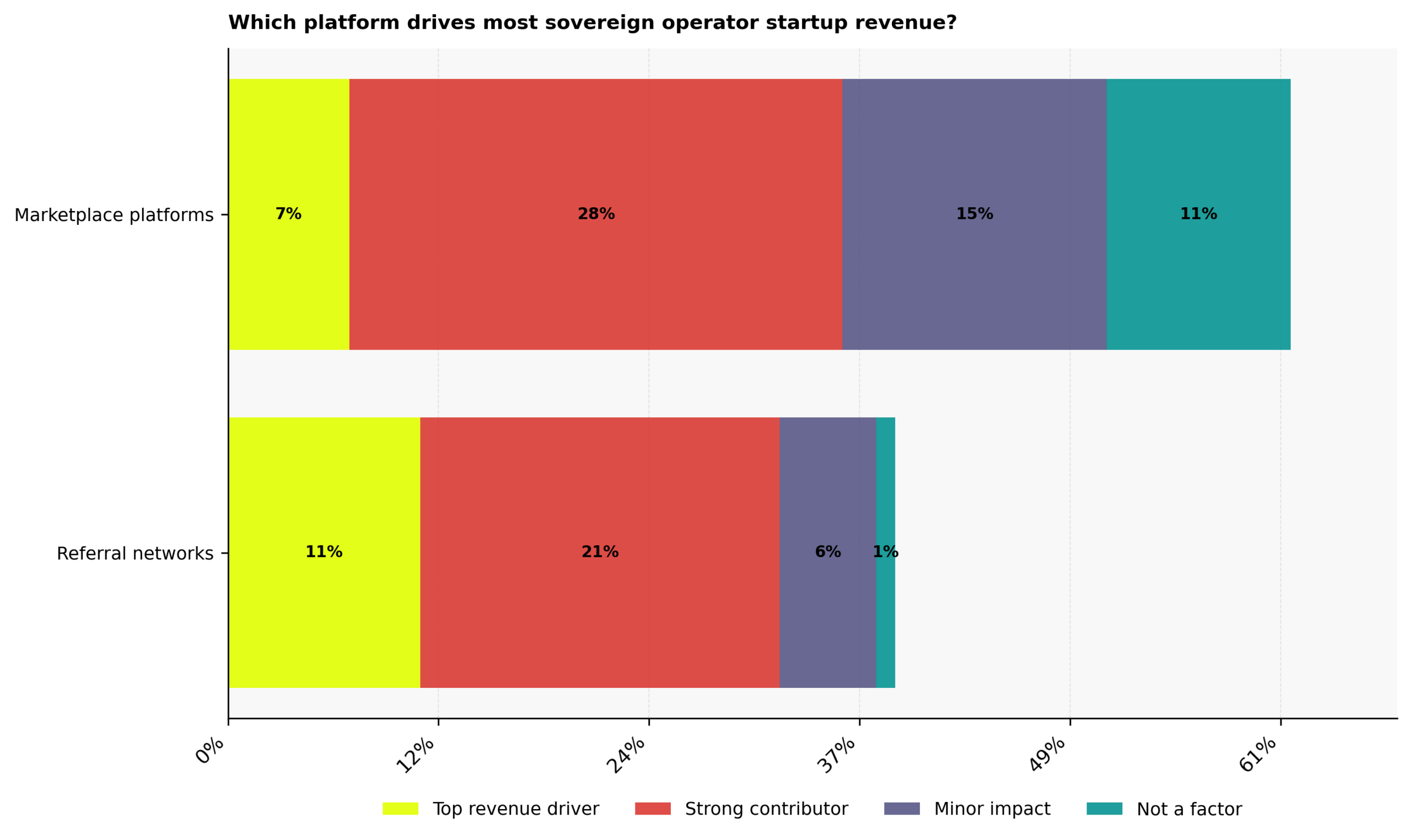
Entrepreneurs are generating revenue through a mix of established marketplaces and relationship-driven channels, with each platform playing a distinct role in their growth strategies.
Marketplace platforms serve as the top revenue driver for 7% of entrepreneurs, a strong contributor for 28%, a minor impact for 15%, and not a factor for 11%. Between those who rely heavily on these platforms to reach customers and those who see some benefit, nearly half of people are leveraging existing ecosystems to scale their offers without building traffic from scratch.
Referral networks are the top revenue driver for 11%, a strong contributor for 21%, a minor impact for 6%, and not a factor for just 1%. This means about one-third of entrepreneurs in the US rely on referrals as a primary or powerful income source, emphasizing that trust-based recommendations and word-of-mouth remain highly effective for sovereign operators. Only a small number see minimal or no impact from referrals, indicating that almost everyone in our audience recognizes the value of cultivating relationships.
Marketplaces provide access to established platforms and potential customers, while referral networks can bring opportunities through existing connections. For sovereign operators, using either channel strategically can extend reach without requiring a large sales team or traditional workforce.
How do entrepreneurs measure success in their sovereign operator startups?
97% of entrepreneurs measure success in their sovereign operator startups by profit margins and efficiency, and 3% measure it by the number of clients or customers served
One main metric measures success:
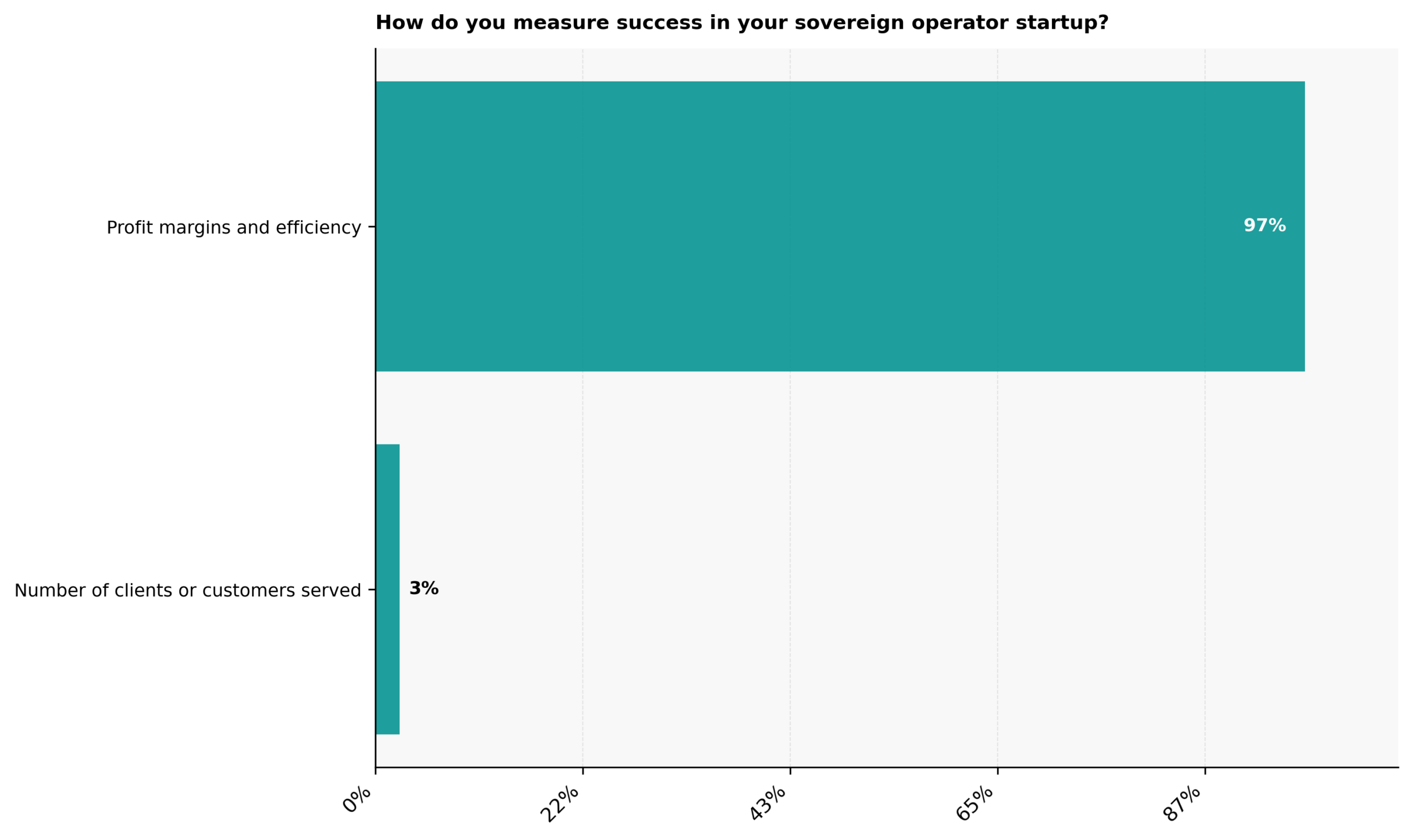
While research shows that businesses may take several years to reach formal profitability, profitability is still the clear measure of success for entrepreneurs running sovereign operator startups. 97% measure success through profit margins and efficiency. This focus fits a business model where entrepreneurs often manage resources closely and need each part of the operation to produce value. Strong margins show the business can generate income efficiently, while efficiency indicates it uses time, money, and tools well.
Only 3% of entrepreneurs measure success primarily by the number of clients or customers served. Customer volume still offers a useful view of reach and demand, but the much smaller figure points to most sovereign operators not making customer growth their main goal. Serving more people does not necessarily strengthen a business if the added work increases costs without improving profitability.
How has AI changed the way entrepreneurs operate their sovereign operator startups?
For 91% of entrepreneurs, AI has changed the way they operate their sovereign operator startup by replacing the tasks they used to outsource, and for 2%, AI has increased their overall output capacity, but 7% have seen minimal impact on their operations so far
AI’s biggest impact is on outsourcing:
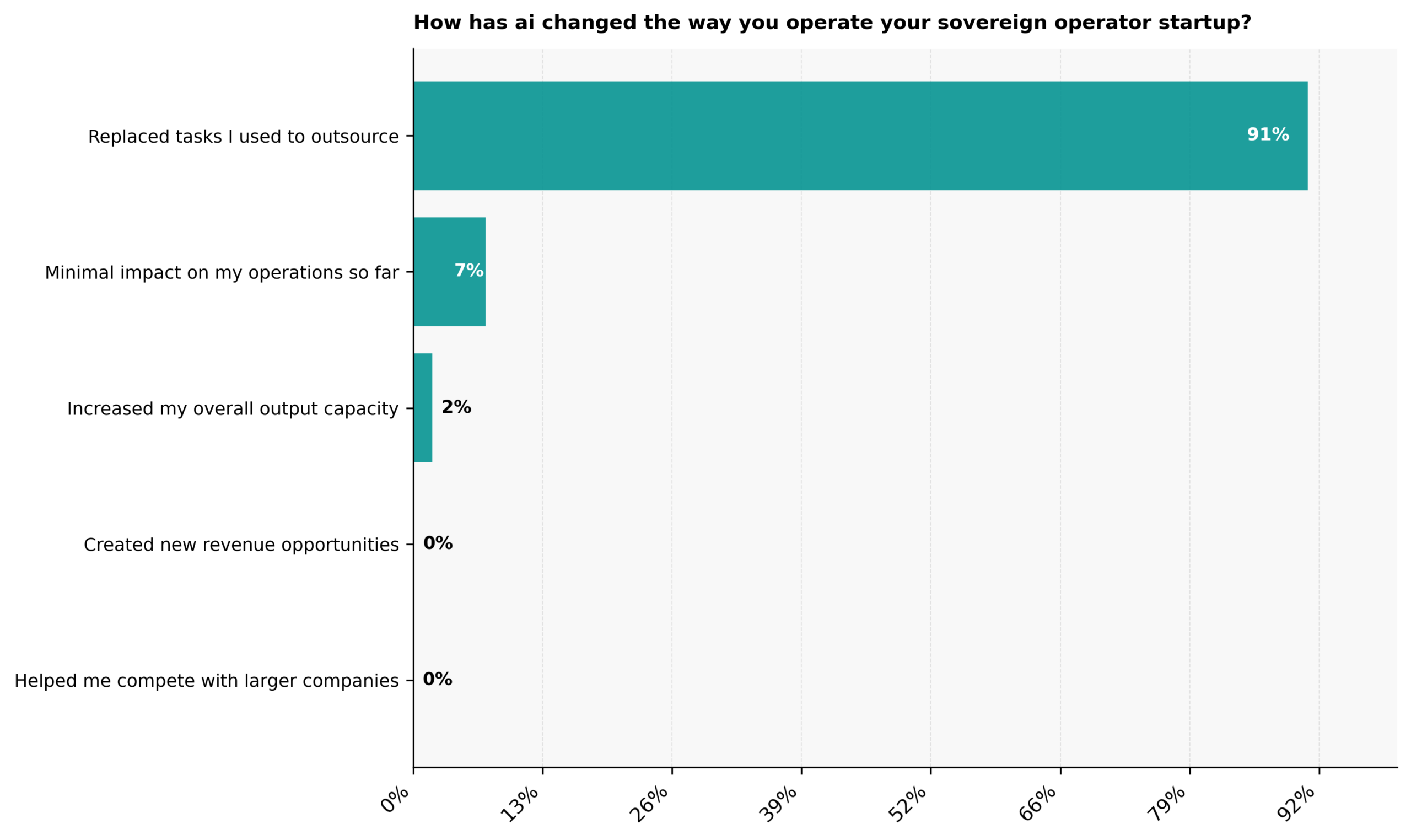
AI is already changing how most entrepreneurs run sovereign operator startups, with 91% agreeing that it has replaced tasks they previously outsourced. This emphasizes that AI is being used primarily to bring work back in-house, allowing entrepreneurs to handle activities that once required outside specialists. It also matches the broader movement described in Harvard Business Review’s analysis of AI and outsourcing, which explains how AI is changing the cost and structure of outsourced work.
For 7% of our audience, AI has had minimal impact on operations so far, illustrating that adoption and practical use still vary between businesses. Another 2% say AI has increased their overall output capacity, indicating that a smaller group is already using it to produce more within their existing resources.
No entrepreneurs report that AI has created new revenue opportunities, with 0% choosing this option. Likewise, 0% say AI has helped them compete with larger companies.
The data points to a clear current role for AI in sovereign operator businesses. Rather than mainly expanding revenue or competing directly with larger firms, it primarily helps entrepreneurs reduce reliance on outsourced support. Bringing more tasks in-house can give solo operators greater control over daily operations while keeping their business model lean.
Which AI tool do entrepreneurs use most in their sovereign operator startups?
ChatGPT or a similar chatbot is an absolutely essential AI tool for 16% of entrepreneurs in their sovereign operator startups; it’s useful for 39%’s work, but not the main tool used by 22%, and 9% don’t use it at all, 4% find AI image generators useful in their work, but they are not a main tool for 5%, and 1% don’t use them, and 2% don’t yet use any AI tools
ChatGPT remains at the top:

By 2025, 34% of Americans had used ChatGPT, rising to 58% among people under 30. Understandably, then, ChatGPT or similar chatbots are the top tool for entrepreneurs running sovereign operator startups. They are essential for 16% of our audience and useful in the work of another 39%. A further 22% use them but do not consider them their main tool, while 9% do not use them at all. From this, we can see that chatbot technology supports different levels of involvement, from a core business resource to an occasional tool.
AI image generators have a much smaller role. Less than 1% consider them essential, 4% find them useful in their work, 5% use them without making them their main tool, and 1% do not use them. 1% say AI is not their main tool, and another 1% do not use AI. AI automation platforms are useful for less than 1%, while no responses were recorded about AI writing assistants.
What is entrepreneurs’ biggest fear about AI’s impact on their sovereign operator startups?
14% of entrepreneurs view AI’s impact on their sovereign operator startup as a real concern, 54% don’t think it’s a big worry, and 17% have no fear of AI at all; while losing their unique voice is a real concern for 8%, it’s not a big worry for 5%, and it’s not a fear at all for 2%
The fear of AI is not strong:

Entrepreneurs are largely confident about AI’s role in their sovereign operator startups, with most expressing little to no anxiety about its impact. For those with no real concerns yet, 14% of our audience view it as a real concern, 54% say it is not a big worry, and 17% feel no fear at all. This means most entrepreneurs are comfortable with how AI fits into their operations, seeing it as a tool rather than a threat.
Losing a unique voice is a more specific concern, but it affects far fewer entrepreneurs. It is a real concern for 8%, while it is not a big worry for 5%, and 2% have no fear about losing their individual voice. For sovereign operators, protecting a distinct style can be important because their personal expertise and identity often form part of the business itself.
What is the biggest challenge entrepreneurs face in running a sovereign operator startup?
Avoiding burnout from solo operations is the main challenge for 9% of entrepreneurs running a sovereign operator startup; this is a significant challenge for 68% and a minor challenge for 8%, while managing cash flow unpredictability poses a significant challenge for 14% of entrepreneurs
Burnout is the biggest hurdle:
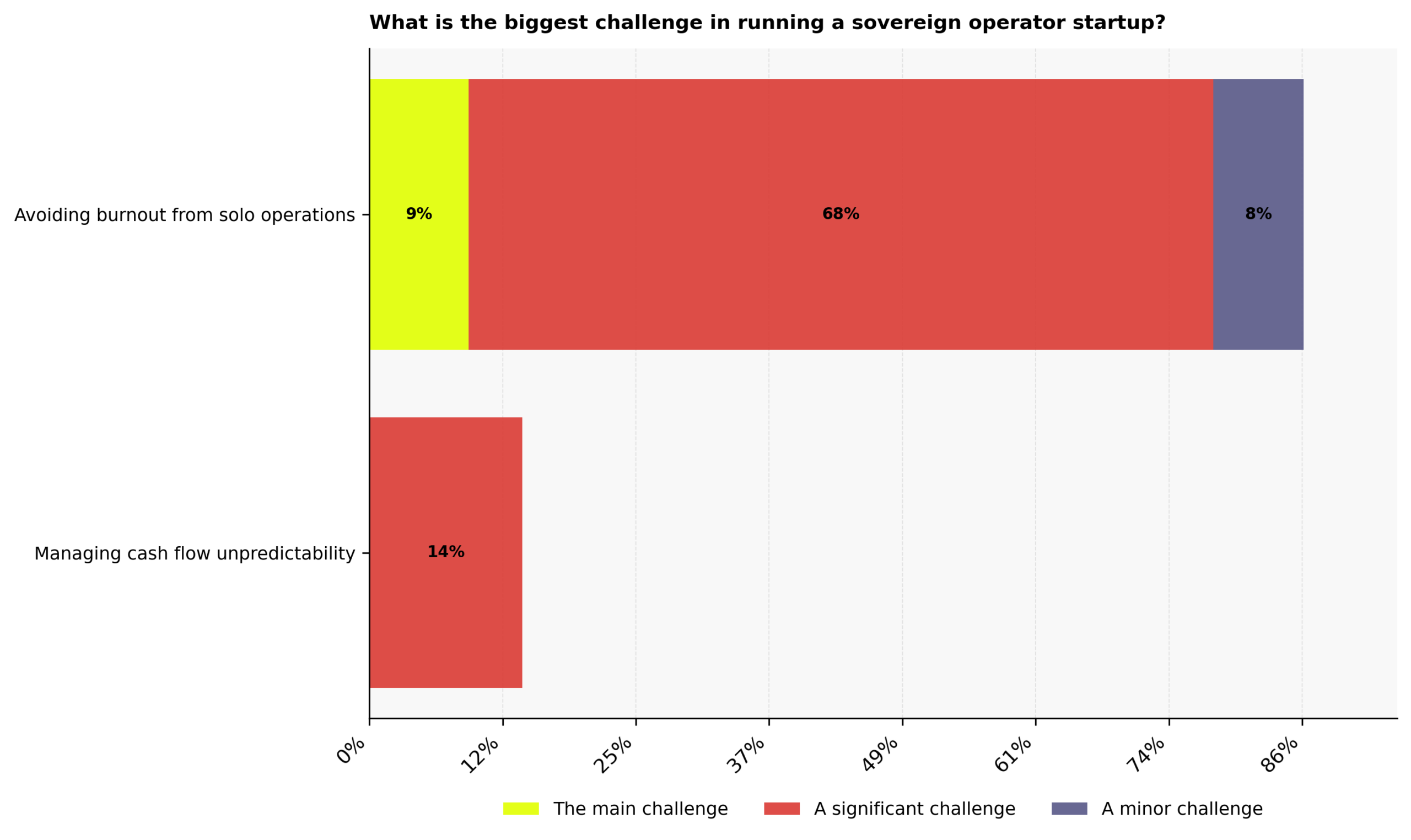
Running a sovereign operator startup gives entrepreneurs control over their work, but managing the business alone can create pressure. Avoiding burnout from solo operations is the main challenge for 9%, while 68% describe it as a significant challenge. Another 8% consider burnout a minor challenge. The large share viewing it as significant reiterates how maintaining energy and managing a demanding workload are central parts of sustaining a solo business.
Cash flow unpredictability is also a concern, with 14% describing it as a significant challenge. Unlike burnout, which is closely tied to workload and personal capacity, uneven cash flow can affect planning, spending, and confidence in future business decisions. Keeping a close view of income and expenses can help entrepreneurs manage quieter periods and make better use of stronger months.
Fortune reports that 87% of founders experience depression, anxiety, or burnout, showing that the pressure of running a business can extend beyond day-to-day operations.
This broader context reinforces why workload management deserves attention in a sovereign operator model. Building realistic schedules, protecting recovery time, and keeping operations manageable can help entrepreneurs maintain the model’s independence without letting business demands become overwhelming.
What is the top reason entrepreneurs avoid hiring in their sovereign operator startups?
For 9% of entrepreneurs, not needing additional help at their current scale is the main reason they avoid hiring, 31% see this as a significant factor, 39% consider it minor, and it;s not a reason for 16%, while legal and compliance burden is a significant factor in avoiding hiring for 2%, and a minor factor for 3%
Hiring is not a major concern at present:

The decision not to hire in sovereign operator startups mainly depends on business scale rather than a strong objection to employees. For 9% of entrepreneurs, not needing additional help at their current scale is the main reason they avoid hiring. Another 31% see it as a significant factor, while 39% consider it minor. At the other end, 16% say business scale is not a reason for avoiding hiring, illustrating that some entrepreneurs weigh different factors when deciding whether to add employees.
Legal and compliance demands have a much smaller influence. They are a significant factor for 2% of our audience and a minor factor for another 3%. Evidently, while regulatory responsibilities can affect hiring decisions, they are not a leading barrier for most sovereign operators.
Our audience is clearly making deliberate choices to stay solo or near-solo as they scale. Entrepreneurs understand that hiring adds new layers of management and cost, so they focus on building systems that maximize output without traditional staffing. This approach supports the sovereign operator philosophy of maintaining full control while growing sustainably on their own terms.
What worries entrepreneurs most about scaling a sovereign operator startup?
Diluted brand identity is a top concern for 13% of entrepreneurs when scaling a sovereign operator startup, and it’s a real worry for 46%; 3% are most concerned about losing personal control, and this is a real worry for 20% but not a big worry for 6%; while 8% are most concerned about burnout from added workload, and this is a real worry for 4%
Brand identity is the biggest concern:
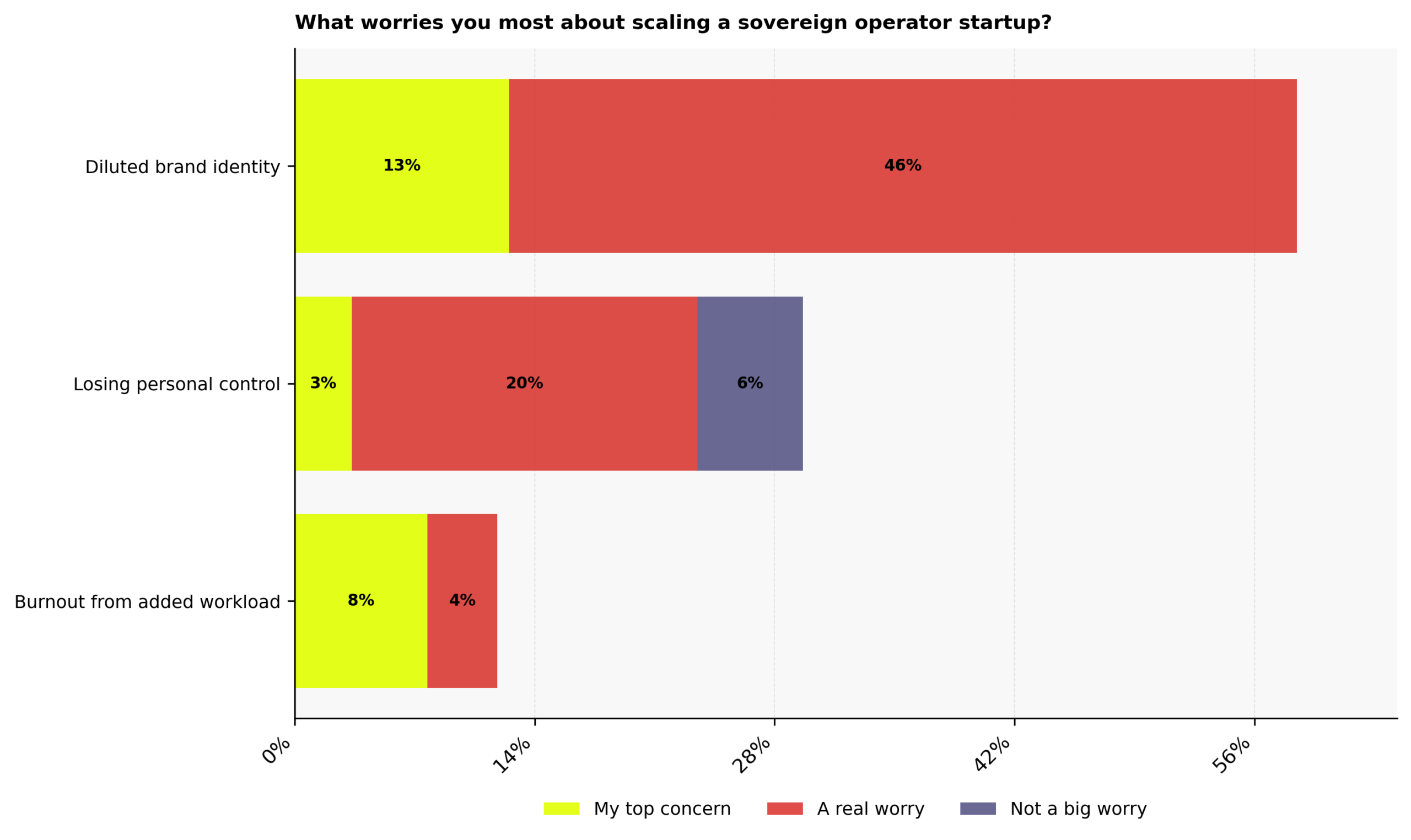
Scaling a sovereign operator startup can introduce concerns about maintaining the qualities that made the business distinctive in the first place. Diluted brand identity is the strongest concern, with 13% of entrepreneurs naming it their top concern and 46% calling it a real worry.
The results reiterate that keeping a clear and recognizable identity becomes a major consideration as a business grows. Brand dilution can weaken how a business is perceived and reduce the value associated with its identity, making a strong and consistent brand identity important during expansion.
Losing personal control is a smaller concern overall. It is the top concern for 3% of our audience and a real worry for 20%, while 6% do not see it as a big worry. Some entrepreneurs are therefore comfortable with growth but still want to remain closely involved in important decisions and the direction of the business.
Burnout from an increased workload also features, although at lower levels. It is the top concern for 8% and a real worry for 4%. As responsibilities increase, entrepreneurs need to manage growth without letting additional demands overwhelm how they operate.
How confident are entrepreneurs in sustaining their sovereign operator startups long-term?
97% of entrepreneurs are somewhat concerned about sustaining their sovereign operator startup long-term; in contrast, 3% are somewhat confident in sustaining their startup, and no one voiced being very concerned about sustainability
Confidence is somewhat shaky:
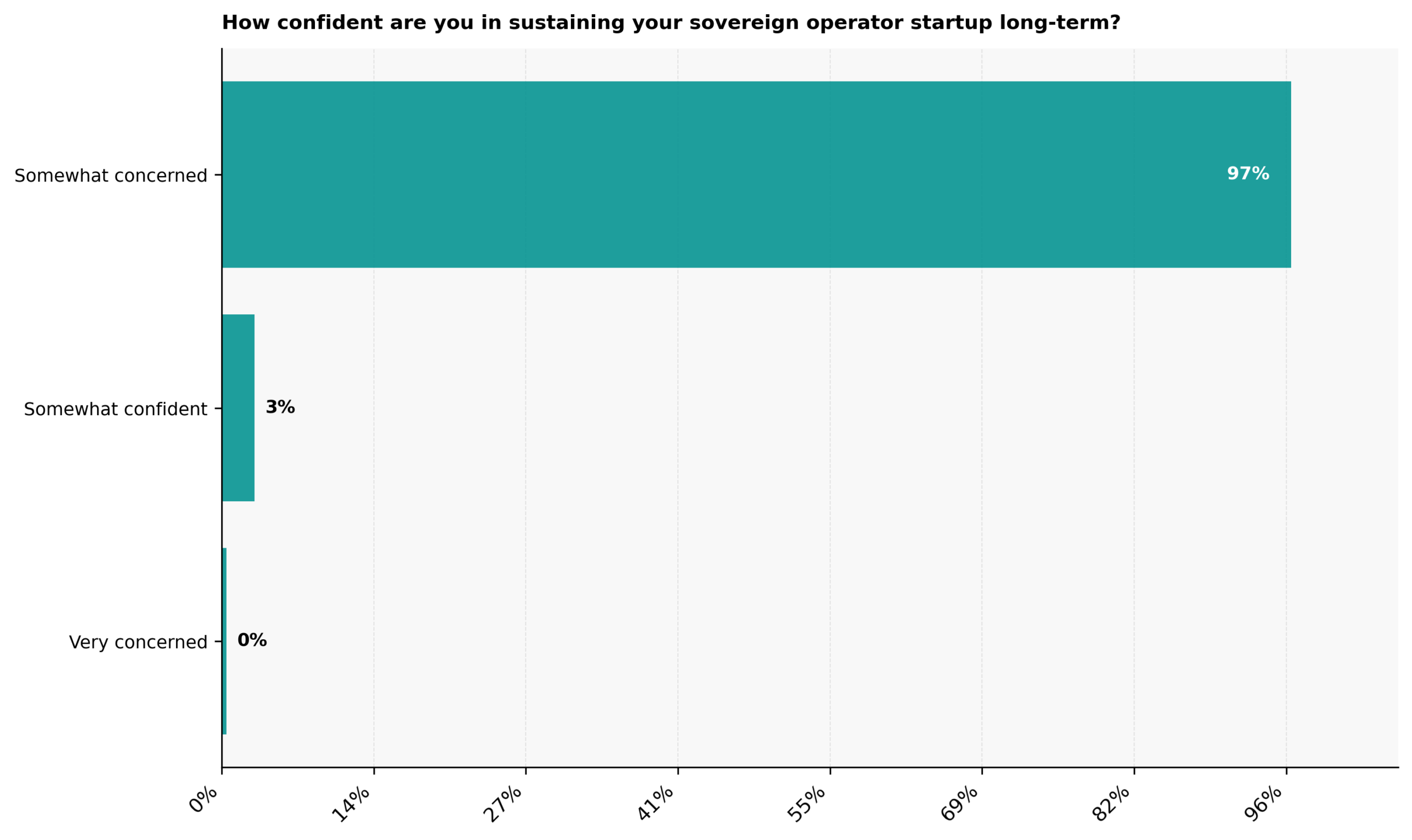
Long-term sustainability remains a concern for almost all entrepreneurs running sovereign operator startups. 97% are somewhat concerned about sustaining their businesses over time, showing that maintaining stability becomes a clear priority as the business develops.
Only 3% are somewhat confident, indicating that a small share of our audience already feels more secure about their startup’s long-term viability. No entrepreneurs are very concerned, with 0% choosing this level, so concern is present but not at its most severe.
The overall cautious outlook is understandable given the challenges new businesses face countrywide. U.S. Bureau of Labor Statistics data shows that nearly half of startups do not survive their first five years.
What best describes entrepreneurs’ sovereign operator startup exit plans?
Having no exit planned ever is not the first choice of exit plan for 48% of entrepreneurs with sovereign operator startups, and it’s not the plan at all for 48%, while 1% absolutely plan to wind down their startup eventually
Not having an exit is not preferred:
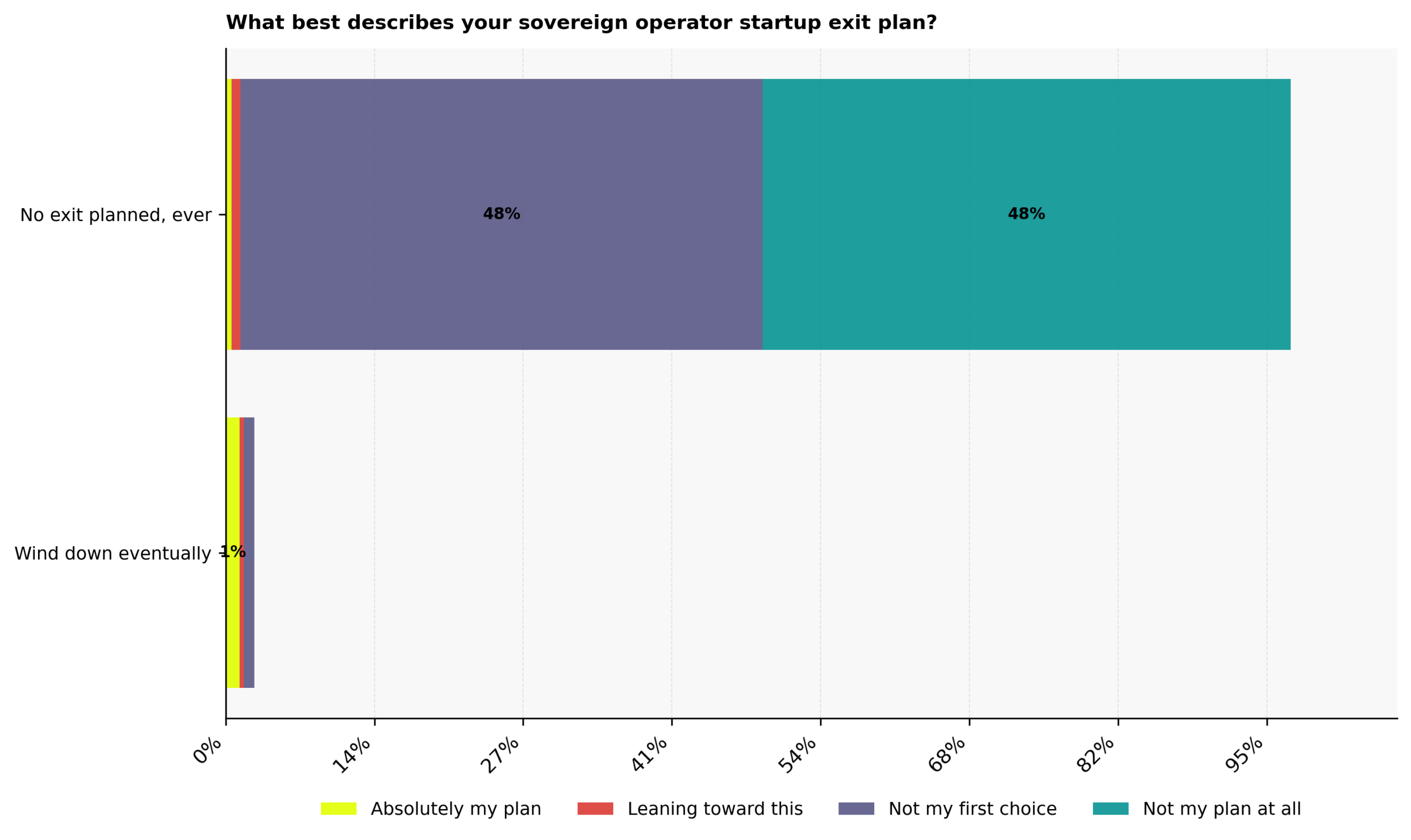
Entrepreneurs running sovereign operator startups strongly prefer keeping the business going rather than planning a permanent exit. For the no exit planned, ever option, less than 1% of our audience state this is absolutely their plan, while fewer than 1% are leaning toward it.
At the same time, 48% say it is not their first choice, and another 48% indicate it is not their plan at all. This tells us that most entrepreneurs don’t plan to sell, merge, or cash out; instead, they want to maintain ownership and operate on their own terms indefinitely.
The alternative of winding down eventually has limited support. Just 1% say this is absolutely their plan, while less than 1% are leaning toward it. Fewer than 1% also say winding down is not their first choice, suggesting this outcome is not a major part of most entrepreneurs’ current plans.
Key trends in sovereign operator startups
These findings show that sovereign operator startups are built around independence, control and keeping operations lean. Entrepreneurs are drawn to business models that allow them to work on their own terms, while technology and AI play an increasingly important role in handling day-to-day operations without traditional teams. At the same time, running solo brings challenges around workload, sustainability and scaling without losing the identity that makes the business distinctive.
Overall, the results conclusively point to a model that prioritizes autonomy and efficiency, while requiring entrepreneurs to balance independence with the practical demands of building a business for the long term.